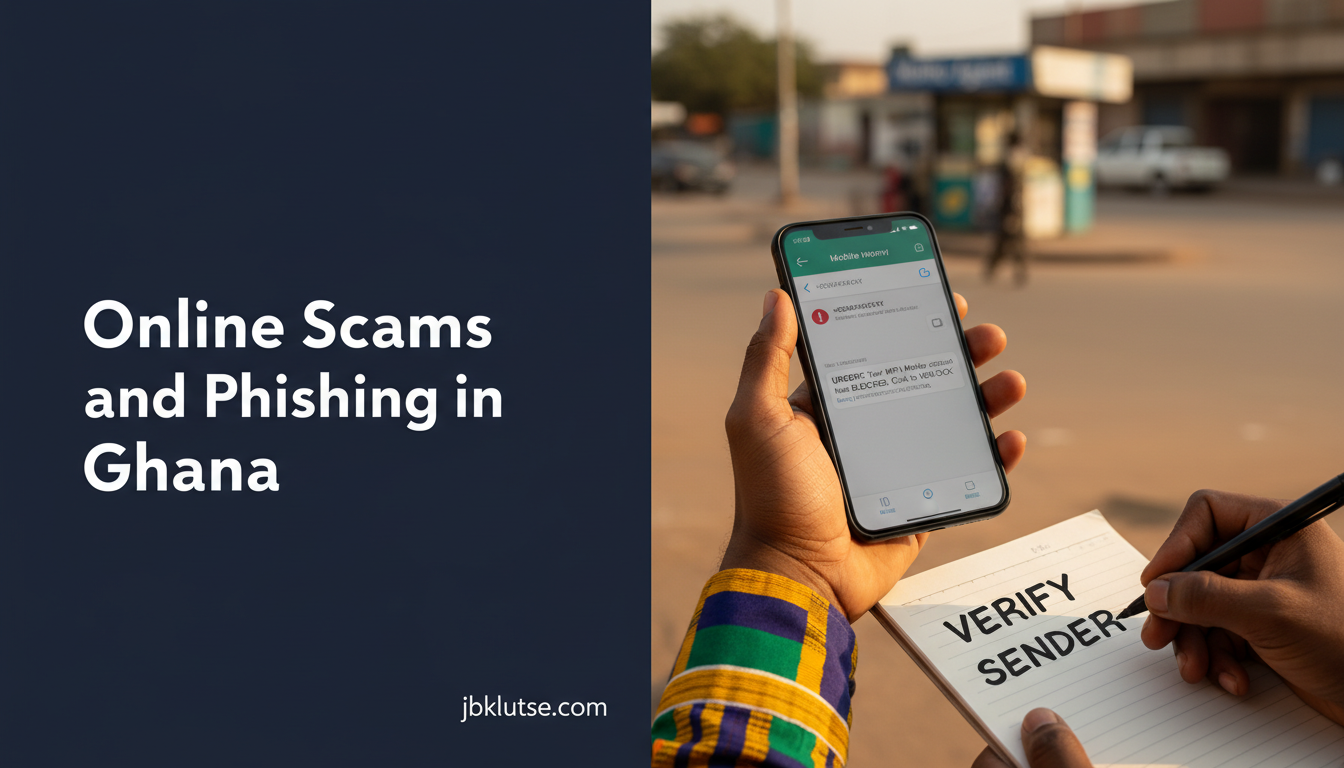
Online scams ghana cost Ghanaians millions of cedis every year through phishing emails that clone banks, fake WhatsApp codes that hijack accounts, and crypto schemes promising returns that never arrive. This hub maps every major scam category targeting Ghanaians in 2026, shows you the warning signs fraudsters use to hook victims, and links to detailed cluster guides that explain how each scam works, what to watch for, and where to report when you or someone you know gets targeted.
Table of Contents
- TL;DR
- What Are Online Scams and Phishing?
- Why Online Scams and Phishing Matter in Ghana
- The Online Scams Ecosystem in Ghana
- Email Phishing
- Crypto Investment Scams
- Fake Bank Alert SMS
- WhatsApp Verification Code Scams
- E-Commerce Delivery Scams
- Fake Bank Websites
- Job Offer Phishing
- Reporting and Recovery
- Scam Delivery Channels: How Fraudsters Reach You
- How to Verify a Suspicious Message
- Common Mistakes and Fixes
- FAQs
- Related Reads
- Closing
- Sources
TL;DR
- Phishing emails, fake bank SMS, and WhatsApp verification scams are the top three attack vectors in Ghana
- Crypto investment fraud jumped 67% in 2025 according to Ghana Police Cyber Crime Unit data
- Job offer phishing targets university graduates and young professionals in Accra, Kumasi, and Takoradi
- Most scams succeed because they create urgency or impersonate trusted brands (banks, telcos, e-commerce sites)
- Reporting channels exist but victim recovery rates remain below 12%
What Are Online Scams and Phishing?
Online scams are fraudulent schemes delivered via email, SMS, WhatsApp, social media, or fake websites that trick victims into sharing passwords, PINs, or bank details, or into sending money directly to criminals. Phishing is the subset of scams that use fake messages or sites to impersonate legitimate institutions (banks, telcos, government agencies, employers) to harvest login credentials or payment information.
In Ghana, the Ghana Police Service Cyber Crime Unit recorded 4,872 online fraud reports in 2025, a 38% increase over 2024. The Bank of Ghana and National Communications Authority have both issued public advisories warning Ghanaians about the surge in SMS phishing (smishing) and voice call scams (vishing).
The average loss per victim in mobile money scams sits at GHS 1,200 (April 2026) according to a 2025 Bank of Ghana study, while crypto investment scams see losses between GHS 5,000 and GHS 50,000 (April 2026) per victim. University students, young professionals aged 22 to 35, and traders using mobile banking are the most targeted groups.
Why Online Scams and Phishing Matter in Ghana
Ghana’s rapid mobile money adoption, the explosion of e-commerce, and the growth of remote work have created a huge attack surface for scammers. MTN MoMo alone processes 2.1 billion transactions yearly, Telecel Cash and AirtelTigo Money add millions more, and every transaction is a potential phishing opportunity if the user doesn’t know how to verify sender identity.
The National Insurance Commission reported in early 2026 that insurance fraud linked to fake policy sales via WhatsApp cost the sector GHS 14 million (April 2026) in 2025. The Ghana Revenue Authority and Driver and Vehicle Licensing Authority have both flagged spikes in fake payment portals that clone their official sites to steal credit card details during tax or license renewals.
The regulatory response is still catching up. The Electronic Transactions Act (2008) and Cybersecurity Act (2020) give law enforcement the legal framework to prosecute cybercrime, but conviction rates remain low because most scammers operate from outside Ghana using VPNs and disposable SIM cards. The Economic and Organised Crime Office (EOCO) launched a dedicated cyber fraud unit in 2024, but public awareness campaigns remain underfunded.
Consumer education is the strongest defence. Banks, telcos, and payment platforms have improved their in-app warnings, but phishing success rates still hover around 7% in Ghana compared to 3% in South Africa, according to a 2025 Kaspersky report covering West Africa.
The Online Scams Ecosystem in Ghana
Below is the taxonomy of the most common scam types targeting Ghanaians, with links to the cluster articles that break each one down in detail.
Email Phishing
Fake emails that impersonate banks, telcos, or government agencies to steal login credentials or trick you into clicking malicious links. Common phishing emails in Ghana covers the top templates scammers reuse (account suspension, prize winnings, loan approval, tax refund) and shows you how to verify sender authenticity before you click anything.
Crypto Investment Scams
Promises of guaranteed returns through Bitcoin, Ethereum, or fake local tokens that collapse after recruiting enough victims. Crypto investment Online Scams Ghana explains Ponzi mechanics, profiles recent collapsed schemes (GhanaCoin, Afro Future Currency), and shows you red flags like referral bonuses, celebrity endorsements with no disclaimers, and platforms with no regulatory approval from the Securities and Exchange Commission.
Fake Bank Alert SMS
Text messages that spoof bank shortcodes (e.g. “GCB” or “CalBank”) to notify you of fake debits or credits, then redirect you to phishing sites to “reverse” the transaction. Fake bank alert SMS scams shows you how to distinguish real bank shortcodes from fake ones, and why you should never click links inside unsolicited SMS messages claiming to be from your bank.
WhatsApp Verification Code Scams
Scammers request your 6-digit WhatsApp verification code by pretending to be a friend or business contact who “accidentally sent it to your number.” Once they have the code, they hijack your WhatsApp account and use it to scam your contacts. WhatsApp verification code scams explains the social engineering tactics, how account takeover works, and the steps to reclaim your account if you fall victim.
E-Commerce Delivery Scams
Fake delivery notifications from Jumia, Konga, or Glovo that ask you to pay a customs fee or confirm your address by entering your debit card details on a fake checkout page. Fake Jumia delivery scams shows you the exact SMS and email templates scammers use, how to verify tracking numbers directly with the retailer, and what to do if you entered payment details on a phishing site.
Fake Bank Websites
Clone sites that mirror GCB Bank, Ecobank, Absa, or Fidelity’s login portals to harvest your internet banking username and password. How to spot a fake bank website teaches you to check the URL padlock icon, verify SSL certificates, bookmark your bank’s real login page, and never follow links from emails or SMS to access online banking.
Job Offer Phishing
Fake job ads on LinkedIn, JobWeb Ghana, Jobberman, or Facebook that ask you to pay an “application fee,” “interview logistics,” or “security clearance” before you can be hired. Job offer phishing in Ghana profiles the scam templates (UN positions, oil and gas roles, remote tech jobs), lists the red flags (upfront fees, Gmail recruiter addresses, spelling errors in offer letters), and names legitimate employers who never charge application fees.
Reporting and Recovery
Victims often don’t know where to report fraud or assume nothing can be done. Reporting online fraud in Ghana lists the official channels (Ghana Police Cyber Crime Unit hotline, Bank of Ghana consumer protection desk, NCA complaint portal), what evidence to collect before you file, and realistic expectations for fund recovery based on 2025 case outcomes.
Scam Delivery Channels: How Fraudsters Reach You
| Channel | Scam Types | Prevalence (2025) | Defence |
|---|---|---|---|
| Phishing, fake invoices, lottery scams | 38% of fraud reports | Verify sender address, never click links | |
| SMS | Fake bank alerts, MoMo PIN requests | 29% of fraud reports | Check sender shortcode, call bank directly |
| Verification code theft, fake giveaways | 21% of fraud reports | Enable 2FA, never share verification codes | |
| Social media (Facebook, Instagram) | Job scams, romance scams, crypto Ponzis | 8% of fraud reports | Verify profiles, research investment platforms |
| Voice calls (vishing) | Impersonation (bank fraud dept, police) | 4% of fraud reports | Hang up, call official number back |
Source: Ghana Police Service Cyber Crime Unit 2025 Annual Report
How to Verify a Suspicious Message
Step 1: Pause before you act. Scammers create urgency (“your account will be locked in 24 hours”). Legitimate institutions give you days or weeks to respond, and they don’t threaten account closure via SMS.
Step 2: Check the sender identity.
– Email: Hover over the sender name to see the actual email address. noreply@gcbbank-gh.com is fake. noreply@gcbbank.com.gh is real.
– SMS: Banks use shortcodes (e.g. GCB or CalBank), not 10-digit mobile numbers. If it’s a regular phone number, it’s not your bank.
– WhatsApp: Scammers clone display names. Check the profile photo and last-seen status. Call the contact via phone to confirm they sent the message.
Step 3: Verify via official channels. Call your bank’s customer service number (printed on the back of your debit card), not the number in the suspicious SMS. Check your bank’s official website by typing the URL manually into your browser, not by clicking a link.
Step 4: Never share PINs, passwords, or verification codes. No bank, telco, or payment platform will ever ask you for these via SMS, email, or phone call. If someone asks, it’s a scam.
Step 5: Report immediately. Forward phishing emails to your bank’s fraud desk. Report SMS scams to the NCA via their shortcode 0555. File a complaint with the Ghana Police Cyber Crime Unit if money was lost.
Common Mistakes and Fixes
Mistake 1: Clicking links in unsolicited SMS or emails.
Banks and telcos send alerts, but they never include clickable links that take you to login pages. Scammers embed phishing URLs that look real at first glance.
Fix: Bookmark your bank’s official login page and always navigate there manually. Never click links in SMS or email.
Mistake 2: Sharing WhatsApp verification codes with “friends” who request them.
Scammers impersonate contacts in your phonebook. Once they have the 6-digit code, they hijack your WhatsApp and lock you out.
Fix: WhatsApp codes are only for you. If someone asks for yours, call them on their phone number to verify. Enable two-step verification in WhatsApp settings.
Mistake 3: Paying upfront fees for job offers or loans.
Legitimate employers in Ghana don’t charge application fees. Legitimate lenders process loan applications through regulated channels (banks, microfinance institutions registered with the Bank of Ghana).
Fix: Research the employer on LinkedIn or their official website. Check loan offers against the Bank of Ghana’s register of licensed lenders.
Mistake 4: Trusting “too good to be true” investment returns.
Crypto platforms promising 20% monthly returns, forex trading bots with “zero risk,” or gold trading schemes with guaranteed payouts are Ponzi schemes that collapse after recruiting enough victims.
Fix: Check if the investment platform is registered with the Securities and Exchange Commission. If it’s not listed, it’s unregulated and probably a scam.
Mistake 5: Entering payment details on unfamiliar checkout pages.
Clone sites that mimic Jumia, ECG prepaid top-up, or Ghana Water prepaid meters harvest your card number and CVV.
Fix: Check the URL before you pay. https://www.jumia.com.gh is real. https://jumia-gh.online is fake. Look for the padlock icon in your browser’s address bar.
FAQs
What should I do if I already sent my PIN to a scammer?
Call your mobile money provider’s customer service line immediately (MTN: 100, Telecel: 500, AirtelTigo: 181) and request a PIN change or account freeze. File a police report with the Cyber Crime Unit at +233 30 277 1771. Change your PIN on all linked accounts (bank, utility prepaid meters).
Can I recover money sent to a scammer’s mobile money account?
Recovery rates sit below 12% because scammers cash out within minutes and use unregistered SIM cards. File a report anyway. The telco can trace the IMEI number of the phone used to cash out, which sometimes leads to arrests if the scammer reuses the phone.
How do I check if a website is fake?
Look at the URL. Real bank sites end in .com.gh (e.g. gcbbank.com.gh). Scam sites use .online, .co, or misspellings (gcbbank-gh.com). Check for the SSL padlock icon. Click it to view the certificate details and confirm the site owner matches the institution name.
Are crypto investments illegal in Ghana?
Crypto trading isn’t illegal, but most platforms operating in Ghana aren’t licensed by the Securities and Exchange Commission. The Bank of Ghana has warned that crypto transactions fall outside deposit insurance protections. If a platform collapses, you have no legal recourse to recover funds.
What is smishing?
Smishing is SMS phishing. Scammers send text messages that impersonate banks, telcos, or government agencies to steal your login credentials or trick you into authorising fraudulent transactions. The term blends “SMS” and “phishing.”
How do I report a fake job ad on LinkedIn?
Click the three dots next to the job post and select “Report.” Choose “Scam or fraud” as the reason. Forward the recruiter’s messages to LinkedIn’s safety team via their help centre. Also report it to the Ghana Police Cyber Crime Unit if the scammer asked for money.
Related Reads
- Zoom out: Start with the full Cybersecurity Super Pillar for the big-picture view of consumer security, data privacy, and fraud protection across Ghana’s digital economy.
- Deep-dives within this hub:
- Common phishing emails in Ghana
- Crypto investment Online Scams Ghana
- Fake bank alert SMS scams
- WhatsApp verification code scams
- Fake Jumia delivery scams
- How to spot a fake bank website
- Job offer phishing in Ghana
- Reporting online fraud in Ghana
- Related hubs:
- MoMo fraud protection breaks down mobile money scams, unauthorised transaction reversals, and how telcos handle fraud complaints.
- SIM security and phone protection covers SIM swap fraud, IMEI blocking, and how to lock down your device if it’s stolen.
For ongoing consumer protection updates and scam alerts as they break, follow our cybersecurity coverage on the main Cybersecurity pillar and subscribe to our weekly newsletter.
Closing
Online scams evolve as fast as Ghana’s digital infrastructure grows. New phishing templates appear every month, scammers clone new platforms (delivery apps, utility portals, loan services), and social engineering tactics get more sophisticated. Your best defence is staying informed, verifying before you click, and never sharing credentials under pressure.
Follow our updates on X at @jbklutsemedia for real-time scam alerts and cybersecurity news as it happens.
Sources
- Ghana Police Service Cyber Crime Unit 2025 Annual Report (February 2026)
- Bank of Ghana Consumer Protection Directorate Fraud Statistics Q4 2025
- National Communications Authority Public Advisory on SMS Phishing (January 2026)
- Kaspersky West Africa Cybersecurity Report 2025
- Securities and Exchange Commission Ghana Register of Licensed Investment Platforms (April 2026)
- Economic and Organised Crime Office Cyber Fraud Unit Press Briefing (March 2026)