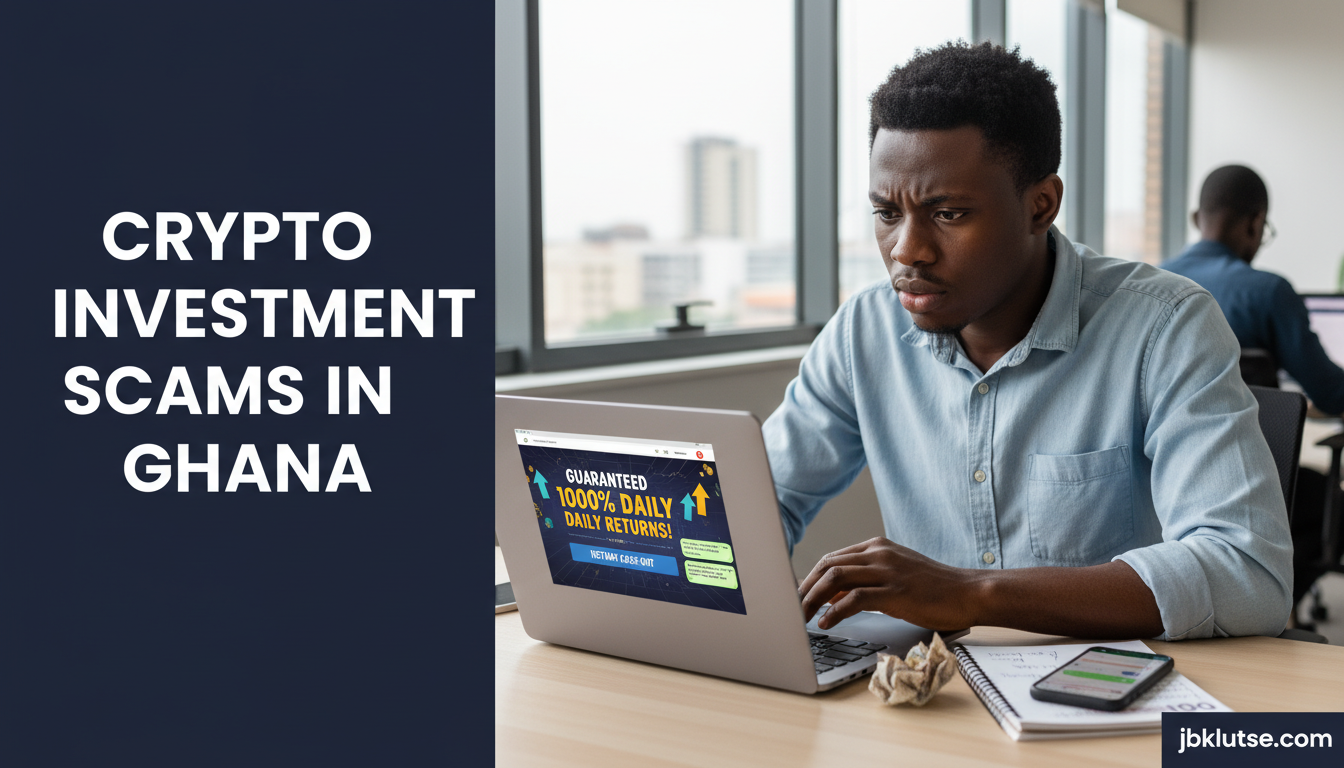
A crypto scam Ghana operation can drain your mobile money wallet, bank account, or crypto holdings in minutes, and the Bank of Ghana has warned repeatedly about unregulated platforms promising 50% monthly returns that collapse overnight. This guide exposes the five most common crypto scams targeting Ghanaians in 2026, shows you the red flags fraudsters always miss, and maps the legal channels where you can report losses and potentially recover funds.
Table of Contents
- TL;DR
- How Crypto Scams Target Ghanaians
- The Fake Investment Platform
- The Ponzi Referral Scheme
- The Fake Exchange Clone
- The WhatsApp Investment Coach Scam
- The Romance-to-Investment Scam
- How to Spot a Crypto Scam
- Unrealistic Return Promises
- Unregistered with Ghanaian Regulators
- Pressure Tactics
- Poor Website Quality
- Payment Methods Limited to Mobile Money or Crypto
- Ghana-Specific Considerations
- Regulatory Warnings
- Common Telco Scam Channels
- Legal Recourse
- Pricing Reality Check
- Protecting Yourself
- Verify Before You Invest
- Secure Your Accounts
- Cross-Check Offers with Trusted Sources
- Report Suspicious Activity
- FAQs
- Related Reads
- Closing
- Sources
Crypto scams in Ghana have grown alongside legitimate crypto adoption. As more Ghanaians buy Bitcoin, USDT, or other tokens through local exchanges or peer-to-peer platforms, scammers have built fake platforms, impersonated trusted brands, and weaponized social media to steal hundreds of thousands of cedis from individuals, students, and small business owners.
TL;DR
- Fake crypto investment platforms in Ghana promise 30% to 100% monthly returns, then vanish with deposits
- Ponzi schemes recruit victims via WhatsApp groups, churches, and campus networks
- Phishing sites clone legitimate Ghanaian exchanges like Bitmama, Yellowcard, and Binance P2P
- The SEC Ghana warns that most crypto platforms operating in Ghana are unregistered and unregulated
- Report suspected scams to the Economic and Organised Crime Office (EOCO) and the Cyber Security Authority
How Crypto Scams Target Ghanaians
The Fake Investment Platform
The most widespread crypto scam Ghana model is the fake high-yield investment platform. Scammers launch a website, Telegram group, or WhatsApp community advertising returns of 30%, 50%, or 100% per month from “automated crypto trading bots” or “Bitcoin mining pools.”
The platform accepts deposits in mobile money (MTN, Telecel, AirtelTigo), bank transfers, or direct crypto transfers to a wallet address. Early investors receive payouts on time to build trust and encourage referrals. Once the platform accumulates enough deposits (often GHS 500,000 to GHS 2 million (April 2026)), it disappears. The website goes offline, Telegram admins delete the group, and victims lose everything.
Real case (2025): A platform called “BitGold Ghana” recruited over 1,200 victims via campus networks at the University of Ghana, KNUST, and UCC, promising 40% monthly returns. It collapsed in November 2025 with an estimated GHS 1.8 million (April 2026) in deposits. The promoters were students themselves, paid in recruitment commissions, and had no idea they were fronting a scam until the site vanished.
The Ponzi Referral Scheme
Ponzi crypto scams reward you for recruiting others. You deposit GHS 500, GHS 1,000, or GHS 5,000 (April 2026), then earn a commission (typically 10% to 20%) for every person you bring in. Your “investment” grows only when new money enters the system.
These schemes spread through churches, workplace groups, alumni networks, and family WhatsApp groups. A trusted friend or relative endorses the platform, making victims lower their guard. The scheme collapses when recruitment slows and payouts exceed new deposits.
Warning signs:
– Focus on recruitment more than the underlying investment
– No clear explanation of how profits are generated
– Payouts depend on new members joining
– Pressure to recruit quickly to “lock in your level”
The Fake Exchange Clone
Scammers clone the login pages of legitimate Ghanaian crypto exchanges like Bitmama, Yellowcard, Quidax, or Binance P2P. The fake site looks identical to the real one, down to the logo, colour scheme, and layout. The URL is slightly misspelled: bitmama-gh.com instead of bitmama.io, or yellowcard-ghana.com instead of yellowcard.io.
Victims land on the fake site via Google Ads, Facebook Ads, or SMS phishing messages. They enter their login credentials, and the scammer harvests them. If the victim also enters a two-factor authentication code, the scammer can drain the account in real time.
Ghana anchor: In March 2026, the Cyber Security Authority flagged 14 fake crypto exchange domains targeting Ghanaians, including clones of Binance, Luno, and Remitano. All 14 sites were registered in the previous 30 days and used .com.gh or .net domains to appear local.
The WhatsApp Investment Coach Scam
A scammer poses as a crypto investment expert offering free advice or signals. They contact you via WhatsApp, often using a profile photo of a young, wealthy-looking person in front of luxury cars or Dubai landmarks. They share screenshots of massive profits from Bitcoin or forex trades and offer to teach you their strategy for a small upfront fee (GHS 200 to GHS 500 (April 2026)) or a deposit into a “shared trading account.”
Once you pay, they either disappear or direct you to a fake trading platform where your deposits are stolen.
Red flags:
– Unsolicited contact via WhatsApp, Telegram, or Instagram DMs
– Claims of 80% to 95% win rates
– Pressure to act fast (“this signal expires in 2 hours”)
– Requests for payment via mobile money or crypto only
The Romance-to-Investment Scam
This is a hybrid scam. The fraudster builds a romantic relationship with the victim on a dating app, Facebook, or Instagram over weeks or months. Once trust is established, they introduce a “crypto investment opportunity” that has made them wealthy. They offer to invest on the victim’s behalf or guide them through setting up an account on a fake platform.
Victims send money thinking they’re investing alongside someone they trust, only to discover the entire relationship was engineered to steal their funds.
Case data: The EOCO reported in January 2026 that romance-to-investment scams accounted for 18% of all reported crypto fraud cases in Ghana in 2025, with individual losses ranging from GHS 3,000 to GHS 85,000 (April 2026).
How to Spot a Crypto Scam
Unrealistic Return Promises
Legitimate crypto investments fluctuate. No platform can guarantee fixed monthly returns of 20%, 30%, or 50%. If the platform promises these returns regardless of market conditions, it is a scam.
Reality check: Bitcoin’s average annual return over the last five years is approximately 60% per year, not per month. A platform promising 50% per month would need to deliver 600% annualised returns, which is mathematically unsustainable.
Unregistered with Ghanaian Regulators
The Securities and Exchange Commission (SEC Ghana) maintains a list of licensed investment firms. As of April 2026, no crypto platform is licensed by the SEC to offer investment services in Ghana. The Bank of Ghana has not approved any crypto investment scheme.
Check the SEC’s official website at sec.gov.gh for the current list of licensed firms. If the platform isn’t on the list, it’s operating outside Ghana’s regulatory framework.
Pressure Tactics
Scammers create urgency. “Limited slots available.” “Register by midnight to lock in your rate.” “The promotion ends tomorrow.” Legitimate platforms don’t pressure you to deposit immediately.
Poor Website Quality
Fake platforms often have:
– Spelling and grammar errors
– No physical address or contact phone number
– No team page or verifiable company registration
– Hosting on cheap shared servers (check the domain age and registrar)
– No HTTPS encryption (look for the padlock icon in the browser address bar)
Payment Methods Limited to Mobile Money or Crypto
If the platform only accepts MTN Mobile Money, Telecel Cash, or direct crypto transfers, and refuses bank transfers or card payments, it’s designed for untraceable theft. Legitimate businesses offer multiple payment options.
Ghana-Specific Considerations
Regulatory Warnings
The Bank of Ghana issued a public notice in February 2024 stating that cryptocurrencies are not legal tender in Ghana and that any investment in crypto assets carries substantial risk. The SEC followed with a warning in March 2024 against unlicensed crypto investment schemes.
The Cyber Security Authority maintains a scam reporting hotline at +233 501 380 382 and an email at cert@csa.gov.gh.
Common Telco Scam Channels
Scammers use MTN, Telecel, and AirtelTigo numbers to send fake investment SMS messages. Example: “Your friend Kwame sent you a GHS 500 (April 2026) crypto bonus. Click here to claim: [link].” The link leads to a phishing site.
To verify, call the sender directly on a known number. Never click links in unsolicited SMS messages.
Legal Recourse
If you’ve lost money to a crypto scam Ghana operation, file a report with:
– EOCO (Economic and Organised Crime Office): +233 302 773 906, Accra office at Osu RE
– Ghana Police Cybercrime Unit: +233 302 773 906, or visit the nearest police station
– Cyber Security Authority CERT: cert@csa.gov.gh
Recovery is difficult because crypto transactions are irreversible, but early reporting increases the chance that EOCO can freeze bank accounts linked to the scammers.
Pricing Reality Check
As of April 2026, 1 Bitcoin (BTC) trades at approximately GHS 630,000 (April 2026). A platform claiming you can buy Bitcoin at GHS 400,000 (April 2026) or “guaranteed triple your money in 30 days” is lying. Cross-check prices on Binance, Coinbase, or local exchanges like Bitmama before depositing.
Protecting Yourself
Verify Before You Invest
- Check the SEC Ghana license list
- Google the platform name plus “scam” or “review”
- Search for the company’s Ghana Card registration or CAC number
- Ask for a physical office address and visit it
Secure Your Accounts
- Enable two-factor authentication on all crypto accounts
- Use a unique password for each platform (consider a password manager)
- Never share your seed phrase, private key, or login credentials
- Bookmark the official URL of exchanges you use and never click links in emails
Cross-Check Offers with Trusted Sources
Before investing in any crypto opportunity, discuss it with someone who understands blockchain technology. Check online forums like Nairaland’s Ghana section, Reddit’s r/CryptoScams, or local tech communities on Facebook.
For step-by-step guidance on identifying fake websites, see our guide on how to spot a fake bank website. The same red flags apply to fake crypto platforms.
Report Suspicious Activity
If someone contacts you via WhatsApp, Telegram, or SMS with an investment pitch, report the number to your telco’s fraud desk:
– MTN: Dial *100# and select “Report Fraud”
– Telecel: Call 100 or email customercare@telecelmobile.com.gh
– AirtelTigo: Call 100 or email customercare@airteltigo.com.gh
FAQs
Are all crypto investments in Ghana scams?
No. Legitimate Ghanaian exchanges like Bitmama, Yellowcard, and Quidax operate transparently and don’t promise fixed returns. Buying and holding Bitcoin or other tokens on these platforms is not a scam, but it carries market risk. The scam is platforms promising guaranteed profits.
Can I recover money lost to a crypto scam?
Recovery is difficult because crypto transactions are irreversible. However, if the scammer used a Ghanaian bank account or mobile money number, EOCO can sometimes freeze the account and recover partial funds. Report immediately.
How do I check if a crypto platform is licensed in Ghana?
Visit the SEC Ghana website at sec.gov.gh and check the “Licensed Entities” section. As of April 2026, no crypto investment platform is licensed in Ghana. Any platform claiming SEC approval is lying.
What’s the difference between a Ponzi scheme and a legitimate referral program?
A legitimate referral program rewards you for introducing new customers to a real product or service (for example, MTN’s “Refer and Earn” pays you when a friend registers and uses data). A Ponzi scheme pays you only with money from new recruits, not from genuine profit. If the platform has no clear revenue source beyond recruitment, it’s a Ponzi.
Are crypto signals or trading groups legitimate?
Some are, most aren’t. Legitimate crypto analysts share market research and technical analysis, but they never guarantee profits or ask for upfront fees to join a WhatsApp group. If someone charges GHS 500 (April 2026) for “VIP signals” and promises 90% accuracy, it’s a scam.
Can the police recover my Bitcoin if I was scammed?
Unlikely. Bitcoin transactions are irreversible and pseudonymous. Police can investigate if the scammer’s identity is known or if they used a traceable bank account, but recovering the Bitcoin itself is nearly impossible. Prevention is your best defence.
How do fake exchange clones steal my login?
The fake site collects your username, password, and two-factor authentication code when you type them in. The scammer then logs into your real account on the legitimate exchange and withdraws your funds. Always check the URL carefully and bookmark the official site.
What should I do if a friend invites me to a crypto investment group?
Ask your friend where they learned about the platform, how long it’s been running, and whether they’ve successfully withdrawn profits. Check the SEC license list. If the platform is unlicensed and promises high fixed returns, warn your friend and decline the invitation.
Related Reads
- Zoom out: Learn the full cybersecurity landscape at Cybersecurity
- Topic hub: Explore other fraud tactics at Online Scams and Phishing in Ghana
- Related deep-dives:
- Common Phishing Emails in Ghana , how scammers impersonate banks and telcos
- WhatsApp Verification Code Scams , the six-digit code trick that hijacks your account
- Job Offer Phishing in Ghana , fake recruiters who steal your Ghana Card details
- Reporting Online Fraud in Ghana , step-by-step guide to filing complaints with EOCO and the Cyber Security Authority
Closing
Crypto investment scams in Ghana will keep evolving as long as scammers can find victims. The next wave may involve deepfake video calls, fake celebrity endorsements, or cloned social media profiles of real crypto founders. Your defence is knowledge, scepticism, and the discipline to verify before you deposit. If an offer sounds impossibly good, it is impossible.
Follow our updates on X at @jbklutsemedia.
Sources
- Securities and Exchange Commission Ghana , Public Notice on Crypto Assets (March 2024): sec.gov.gh
- Bank of Ghana , Advisory on Virtual Currencies (February 2024): bog.gov.gh
- Economic and Organised Crime Office (EOCO) , Annual Report 2025: eoco.gov.gh
- Cyber Security Authority , CERT Ghana Incident Reports (April 2026): csa.gov.gh
- Bitmama Ghana Official Site: bitmama.io
- Yellowcard Ghana Official Site: yellowcard.io