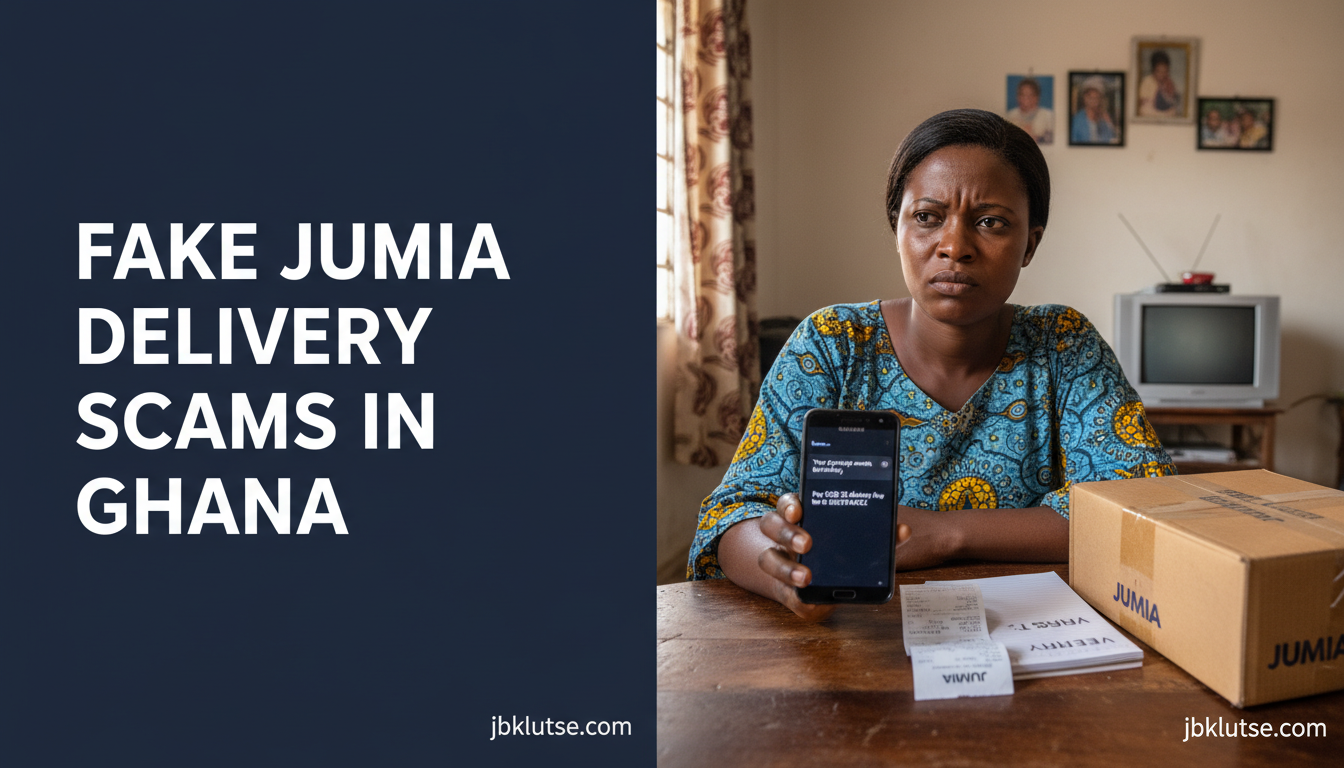
The **jumia delivery scam** has cost Ghanaians hundreds of cedis through fake SMS messages, WhatsApp chats, and phone calls claiming your Jumia order is ready for delivery when you never placed one. Scammers impersonate Jumia’s courier network to steal money via mobile money transfers, card details, or phishing links that harvest your login credentials. This guide breaks down the five most common variants of the scam running in Accra, Kumasi, and other cities as of April 2026, shows you the exact red flags that separate real Jumia communications from fakes, and explains how to verify any suspicious delivery message in under two minutes.
Table of Contents
- TL;DR
- How the Scam Works
- Red Flags That Expose Fake Jumia Messages
- Real Cases from Ghana (2025-2026)
- Case 1: The Takoradi Customs Scam (December 2025)
- Case 2: The Accra OTP Hijack (February 2026)
- Case 3: The Kumasi Fake Photo (March 2026)
- How to Verify a Jumia Delivery Message (2-Minute Check)
- Ghana-Specific Considerations
- Protecting Yourself: Preventive Measures
- Secure Your Jumia Account
- Recognize Legitimate Jumia Contact Channels
- Train Your Household
- Use Jumia's Built-In Fraud Reporting
- What to Do If You Were Scammed
- Immediate Actions (First 2 Hours)
- Official Reporting (First 48 Hours)
- Financial Recovery
- How Jumia Is Fighting Back
- FAQs
- Related Reads
- Closing
- Sources
TL;DR
- Fake Jumia delivery messages arrive via SMS, WhatsApp, or phone call claiming you have a pending order requiring payment or confirmation
- Scammers request mobile money transfers (often GHS 20 to GHS 50 labeled as “delivery fee” or “clearance charge”) or ask for card details and OTP codes
- Real Jumia deliveries are always tied to an actual order in your account dashboard and never demand upfront payment for “customs” or “storage fees”
- Verify any suspicious message by logging into your Jumia account directly (not via any link in the message) or calling Jumia’s official customer line at 0302 74 52 64
- Report scam attempts to Jumia via email (customercare@jumia.com.gh), forward fraudulent SMS to the National Communications Authority (NCA) shortcode 1515, and file a complaint with the Ghana Police Cyber Crime Unit
How the Scam Works
The fake Jumia delivery scam follows a predictable pattern. You receive an unsolicited message (SMS or WhatsApp) claiming to be from “Jumia Express,” “Jumia Courier Service,” or “Jumia Logistics Ghana.” The message states that a package addressed to you is at their warehouse awaiting delivery, and you must confirm receipt or pay a fee to release it.
The scammer’s goal is to extract money or data before you realize you never ordered anything. Common variants include:
Variant 1: The Delivery Fee Scam
You’re told your package is ready but requires a delivery fee (typically GHS 20 to GHS 50) to be paid via mobile money. The message includes a MoMo merchant number or personal wallet number. Once you pay, the scammer blocks you and disappears.
Variant 2: The Customs Clearance Scam
The message claims your international order is held at customs and requires a clearance fee (often GHS 80 to GHS 150) to release it. Scammers leverage the fact that many Ghanaians do order from international sellers on Jumia, making the claim seem plausible.
Variant 3: The Phishing Link Scam
The message includes a link to “confirm your delivery address” or “reschedule delivery.” The link leads to a fake Jumia login page that steals your email, password, and any payment details you enter.
Variant 4: The OTP Harvesting Call
A scammer calls pretending to be a Jumia courier. They claim they’re at your gate but need to verify your identity by reading back a one-time password (OTP) that Jumia “just sent to your phone.” In reality, the scammer triggered a password reset on your Jumia account, and the OTP lets them hijack it.
Variant 5: The Fake Package Photo
WhatsApp messages include a photo of a sealed box with a fake Jumia label and your name. The scammer pressures you to pay a “holding fee” before the package is returned to the sender. The photo is often recycled from legitimate Jumia deliveries posted online.
Red Flags That Expose Fake Jumia Messages
Real Jumia communications have specific characteristics that scammers struggle to replicate. Compare any suspicious message against this checklist:
| Red Flag | Real Jumia Behavior | Scammer Behavior |
|---|---|---|
| Sender identity | SMS from “Jumia” shortcode or email from @jumia.com.gh domain | Random mobile number (e.g. 024, 055, 059 prefix) or Gmail/Yahoo address |
| Order reference | Includes your actual order number (e.g. JM-ORD-123456789) | No order number, or a fake/generic number not in your account |
| Payment request | Never asks for upfront delivery fees (delivery is billed to your Jumia account or paid on delivery) | Demands MoMo transfer, bank deposit, or card details before delivery |
| Link destination | Links go to jumia.com.gh or force.com domains only | Links to suspicious domains (jumia-gh.com, jumiadelivery.org, bit.ly shorteners) |
| Delivery address | Shows the exact address you entered during checkout | Generic “your area” or asks you to “confirm your address” |
| Tracking visibility | Order status and courier contact visible in your Jumia account dashboard | No matching order in your dashboard |
The single most reliable test: Log into your Jumia account at jumia.com.gh (type the URL manually, never click a link in the message). If the message is real, the order and delivery status will appear under “My Orders.” If nothing shows, the message is fake.
Real Cases from Ghana (2025-2026)
Case 1: The Takoradi Customs Scam (December 2025)
A Takoradi-based trader received an SMS claiming her “iPhone 15 Pro Max order” was held at Tema Port requiring a GHS 120 customs clearance fee (April 2026). The message included a MoMo merchant code. She paid, then checked her Jumia account and found no such order. When she called the number in the SMS, it was switched off. She reported the incident to MTN’s fraud desk and the Ghana Police Cyber Crime Unit but never recovered the funds.
Case 2: The Accra OTP Hijack (February 2026)
A student at the University of Ghana, Legon received a call from someone claiming to be a Jumia courier “at the Legon gate” with her package. The caller asked her to read back the OTP code Jumia “just sent” to verify her identity. She complied. Within minutes, the scammer changed her Jumia account password, added their own payment method, and placed orders totaling GHS 890 (April 2026) on her saved card. Jumia reversed the transactions after she filed a complaint, but the attacker had already received and resold the items.
Case 3: The Kumasi Fake Photo (March 2026)
A WhatsApp message showed a photo of a box labeled “Jumia Express – Urgent Delivery” with the recipient’s name. The sender claimed the package contained electronics worth GHS 500 (April 2026) but required a GHS 40 “storage fee” within 24 hours or it would be returned. The recipient reverse-image-searched the photo and found it was stolen from a Facebook post by a Jumia customer in Lagos. She blocked the number and reported it to the NCA.
How to Verify a Jumia Delivery Message (2-Minute Check)
Follow this exact sequence when you receive any Jumia-related message:
Step 1: Do not click any links in the message.
Step 2: Open a new browser tab, type jumia.com.gh manually, and log into your account.
Step 3: Go to “My Orders” and check for any active orders. Real deliveries always appear here with tracking status, courier contact, and estimated arrival time.
Step 4: If you see a matching order, compare the details in the message (order number, delivery address, item description) against your dashboard. Any mismatch means the message is fake.
Step 5: If no order appears in your dashboard, the message is a scam. Delete it and block the sender.
Step 6 (optional): Call Jumia’s official customer care line at 0302 74 52 64 to report the scam attempt. Jumia logs these reports and works with telcos to block fraudulent numbers.
Never trust caller ID alone. Scammers use apps that spoof legitimate business names on your phone’s screen.
Ghana-Specific Considerations
Jumia Ghana operates a “Pay on Delivery” (POD) option for most items, meaning you never need to send mobile money upfront for a delivery fee. If a message demands MoMo payment before the courier arrives, it’s fake.
Jumia’s official courier partners in Ghana include DHL, Pickups, and Jumia’s own in-house logistics team. Real couriers carry Jumia-branded uniforms, handheld scanners, and paper receipts. If someone claims to be a Jumia courier but arrives in plain clothes with no branded materials, refuse to hand over payment or personal details.
The NCA launched a shortcode (1515) in January 2026 for reporting spam and scam SMS. Forward any fake Jumia delivery message to 1515 as a text. The NCA tracks recurring scammer numbers and works with MTN, Telecel, and AirtelTigo to suspend them.
Jumia Ghana does not send delivery notifications via personal WhatsApp numbers. Official WhatsApp messages (rare) come from a verified business account with a green checkmark and the name “Jumia Ghana.” Any message from a standard WhatsApp account with a profile photo of the Jumia logo is fake.
If you paid a scammer via mobile money, contact your telco’s fraud desk immediately (MTN: 100, Telecel: 505, AirtelTigo: 181). File a complaint with reference to the transaction ID. Reversals are rare after 24 hours, but telcos flag the recipient wallet, which helps law enforcement track the scammer.
Protecting Yourself: Preventive Measures
Secure Your Jumia Account
- Enable two-factor authentication (2FA) in your account settings. Jumia supports SMS-based 2FA as of March 2026.
- Use a unique password for Jumia (never reuse passwords across sites).
- Add a trusted phone number to your account. Jumia sends order confirmations to this number, giving you a reference point to compare against suspicious messages.
Recognize Legitimate Jumia Contact Channels
- Official SMS shortcode: “Jumia” (no number prefix)
- Email: Ends with @jumia.com.gh or @force.com (Jumia’s order management system)
- Customer care phone: 0302 74 52 64 (Accra office)
- Social media: Verified accounts on X (@JumiaGhana), Facebook (Jumia Ghana), Instagram (@jumiaghanadeals)
Train Your Household
If elderly relatives or domestic staff receive packages on your behalf, brief them on the scam. Scammers target people less familiar with online shopping. Print a simple checklist (“Did I order this? Is there a matching order in my account?”) and post it near your door.
Use Jumia’s Built-In Fraud Reporting
Jumia’s mobile app (iOS and Android) has a “Report Suspicious Activity” button under Account Settings. Use it to flag fake messages. Jumia’s fraud team investigates and shares data with the Ghana Police Cyber Crime Unit.
What to Do If You Were Scammed
Immediate Actions (First 2 Hours)
- Contact your mobile money provider: Call the fraud desk and request a transaction reversal. Provide the recipient wallet number, transaction ID, and timestamp.
- Change your Jumia password: If you clicked a phishing link or shared your OTP, assume your account is compromised. Reset your password immediately via the official website.
- Check your Jumia order history: Look for unauthorized orders placed by the scammer. Screenshot them and report to Jumia customer care.
- Block the scammer’s number: On your phone and on WhatsApp.
Official Reporting (First 48 Hours)
- File a police report: Visit the Ghana Police Cyber Crime Unit at their office in Accra (Police Headquarters, Ministries) or email cybercrime@police.gov.gh. Bring copies of the fraudulent messages, transaction receipts, and screenshots.
- Report to the NCA: Forward the scam SMS to 1515 or email complaints@nca.org.gh.
- Notify Jumia: Email customercare@jumia.com.gh with the subject line “Scam Report – [Your Order Number or N/A].” Include screenshots of the fake message, the scammer’s contact details, and your account email.
Financial Recovery
Mobile money reversals succeed in under 10% of scam cases if the scammer withdraws the funds quickly or uses a mule account (a third party’s wallet). Your best chance is acting within the first hour.
If the scammer used your card details to place orders on your Jumia account, Jumia’s fraud team can reverse the charges if you report within 72 hours. After that, you must dispute the charges with your bank (GCB, Ecobank, Fidelity, etc.), which can take 30 to 90 days.
Document everything: screenshots, transaction IDs, police report reference numbers. If you need to escalate to the Bank of Ghana or the Data Protection Commission, this documentation is required.
How Jumia Is Fighting Back
Jumia Ghana launched a fraud awareness campaign in January 2026 across its app, website, and social media. Key initiatives include:
- In-app alerts: Pop-up warnings when you log in, reminding users that Jumia never requests delivery fees via MoMo.
- SMS verification: Real Jumia delivery notifications now include a unique 6-digit verification code visible in your account dashboard. You can cross-check any SMS against this code.
- Courier ID badges: All official couriers now carry photo ID badges with QR codes. Scan the code (using any QR app) to verify the courier’s employment status in real time.
- Partnership with telcos: Jumia shares scammer phone numbers with MTN, Telecel, and AirtelTigo monthly. Over 1,200 fraudulent numbers were suspended in Q1 2026.
Jumia also publishes a monthly fraud report on its blog (blog.jumia.com.gh), listing the latest scam variants and red flags. Bookmark it.
FAQs
Does Jumia ever request delivery fees via mobile money?
No. Jumia Ghana’s “Pay on Delivery” option means you pay the courier in cash or via POS terminal when the item arrives. If an order is prepaid (paid during checkout), no additional delivery fee exists. Any message demanding MoMo payment for “delivery,” “customs,” or “storage” is fake.
Can scammers spoof Jumia’s official SMS shortcode?
Rarely. Ghana’s telcos use shortcode authentication, making spoofing difficult. However, scammers send messages from regular mobile numbers (024, 055, 059 prefixes) and add “Jumia” in the sender name field, which some phones display. Always check the actual number, not just the name.
I clicked a link in a fake Jumia message but didn’t enter any details. Am I safe?
Mostly. Clicking the link exposes your IP address and device type to the scammer, but no credentials are stolen unless you entered them. Run a malware scan (use Avast, Bitdefender, or Malwarebytes on Android) and change your Jumia password as a precaution.
How do I know if a phone call is really from Jumia’s courier?
Real Jumia couriers call from numbers that match the “Courier Contact” field in your order dashboard. Cross-check before answering. If the number differs, hang up and call the number listed in your dashboard to verify. Real couriers never ask for OTP codes.
What happens if I gave a scammer my Jumia account OTP?
The scammer now controls your account. Change your password immediately (use the “Forgot Password” flow from a different device). Check your order history for unauthorized purchases. If any exist, contact Jumia at customercare@jumia.com.gh within 24 hours to freeze your account and reverse fraudulent charges.
Can I get my money back if I paid a scammer?
Reversals depend on how fast you act. Contact your mobile money provider’s fraud desk (MTN 100, Telecel 505, AirtelTigo 181) within the first hour. Provide the transaction ID and recipient wallet number. Success rate is low (under 10%) if the scammer withdraws funds immediately, but reporting still helps telcos flag the wallet and assists police investigations.
Does Jumia deliver items requiring customs clearance fees?
Jumia handles all customs payments for international items before the item reaches you. You never pay customs fees directly. Messages claiming your “international order” is held at Tema Port or Kotoka Airport awaiting customs payment are fake.
How do I report a fake Jumia delivery message?
Forward the SMS to NCA shortcode 1515, email customercare@jumia.com.gh with screenshots, and file a police report at the Ghana Police Cyber Crime Unit (cybercrime@police.gov.gh). Provide the scammer’s phone number, message content, and any transaction details if you paid.
Related Reads
- Zoom out: Learn the full landscape of digital threats at our Cybersecurity Super Pillar.
- Topic hub: See all phishing and scam tactics in Ghana at our Online Scams and Phishing Hub.
- Phishing emails: Recognize fraudulent messages in your inbox with our guide to Common Phishing Emails in Ghana.
- SMS fraud: Understand how scammers fake bank alerts at Fake Bank Alert SMS Scams.
- WhatsApp scams: Protect your account from code-stealing tactics at WhatsApp Verification Code Scams.
- Report fraud: Know your options for reporting online scams at Reporting Online Fraud in Ghana.
Closing
The fake Jumia delivery scam thrives on urgency and trust. Scammers bet you’ll pay first and verify later. Flip that script: verify first, act only if the order exists in your dashboard, and never send money based on an unsolicited message alone. As e-commerce grows in Ghana, scammers will refine their tactics, but the core defense remains simple: authenticate every delivery claim through Jumia’s official channels before responding.
Share this guide with family, colleagues, and anyone who shops online. Scammers rely on information asymmetry. When buyers know the red flags, the scam collapses. Follow our updates on X at @jbklutsemedia.
Sources
- National Communications Authority (NCA) Ghana, SMS Fraud Reporting Guidelines, January 2026: https://nca.org.gh
- Jumia Ghana Customer Care, Official Contact Channels, accessed April 2026: https://www.jumia.com.gh/sp-contact-us/
- Ghana Police Service Cyber Crime Unit, Reporting Procedures: https://police.gov.gh
- MTN Ghana Mobile Money Fraud Desk, accessed April 2026: MTN customer care line 100
- Jumia Ghana Blog, Fraud Awareness Campaign (January 2026): https://blog.jumia.com.gh