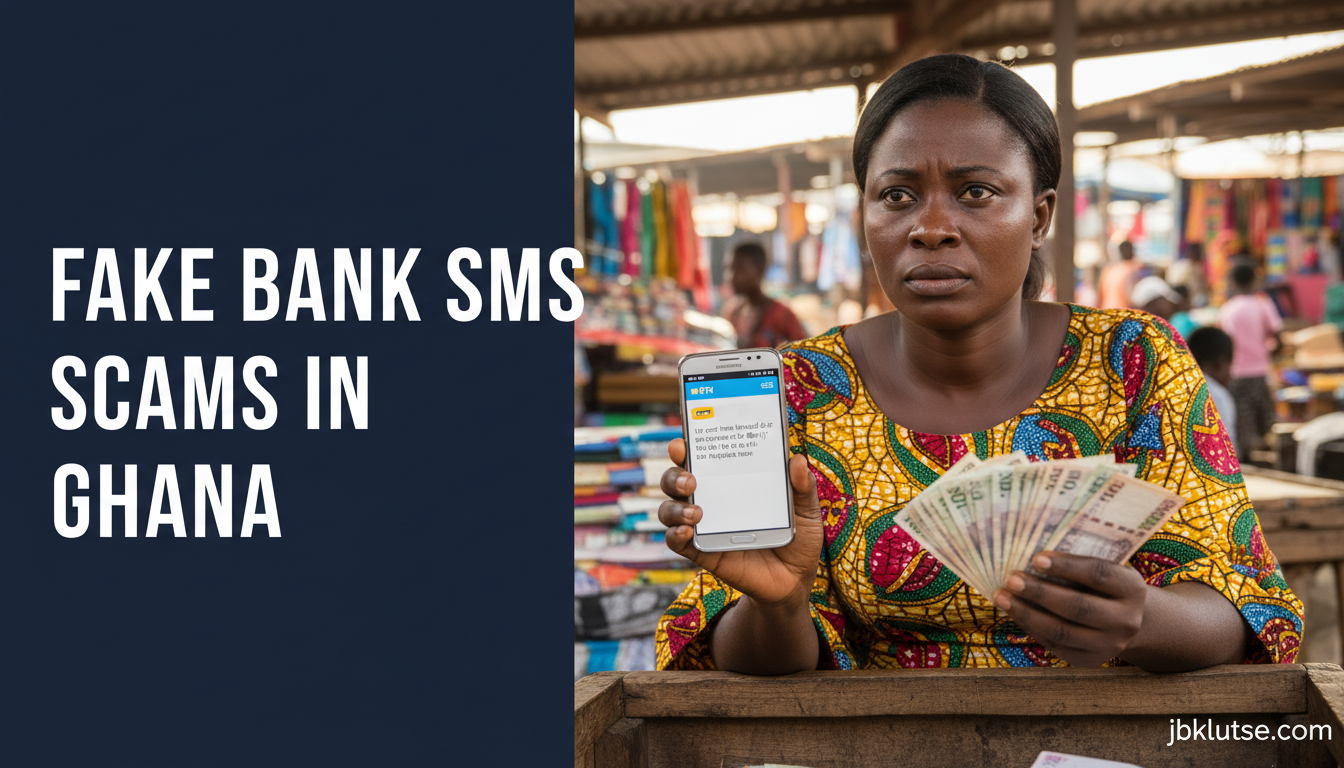
Fake bank SMS Ghana scams have drained thousands of mobile money and bank accounts across Accra, Kumasi, and other cities since 2022, with fraudsters sending fake credit or debit alerts that trick recipients into believing money has moved when it has not. This guide breaks down how these SMS scams work, the specific red flags Ghanaian bank customers should check, which banks and telcos are most frequently impersonated, and the exact verification steps to take before you hand over goods, release funds, or accept a transaction as complete.
Table of Contents
- TL;DR
- How Fake Bank SMS Scams Work in Ghana
- Red Flags That Identify Fake Bank Alerts
- Sender ID Inconsistencies
- Missing or Generic Transaction IDs
- Balance Mismatch
- Grammatical Errors and Odd Phrasing
- Pressure Tactics
- Which Banks and Telcos Are Most Frequently Impersonated
- Step-by-Step Verification Before Releasing Goods
- Step 1: Open Your Bank or MoMo App
- Step 2: Call Your Bank's Official Hotline
- Step 3: Visit an ATM or Bank Branch
- Step 4: Request a Screenshot of the Sender's Transaction Receipt
- Ghana-Specific Considerations
- How to Report Fake Bank SMS in Ghana
- Report to Your Bank or Telco
- File a Report with Ghana Police Cyber Crime Unit
- Report to the National Communications Authority
- What Banks and Telcos Are Doing to Combat Fake SMS
- How to Protect Yourself Going Forward
- FAQs
- Related Reads
- Closing
- Sources
Fake bank alerts typically arrive minutes after a legitimate transaction discussion, using sender IDs that closely mimic MTN MoMo, Vodafone Cash, Fidelity Bank, or Ecobank. The scammer’s goal is simple: you see “GHS 500 received” on your phone, you release the item or service, they walk away, and you discover hours later that no money ever arrived.
TL;DR
- Fake bank SMS scams use spoofed sender IDs to mimic MTN, Vodafone, Fidelity, Ecobank, and other financial institutions
- Red flags include mismatched sender names, missing transaction IDs, incorrect balance updates, and urgent language
- Always verify deposits by checking your bank app balance, calling your bank’s official hotline, or visiting an ATM before releasing goods
- Fraudsters target marketplaces like Makola, Kantamanto, and Facebook Marketplace where cash-on-delivery is common
- Report fake SMS immediately to your bank, your telco, and the Cyber Crime Unit of Ghana Police Service
How Fake Bank SMS Scams Work in Ghana
A fake bank SMS scam follows a predictable sequence. The fraudster identifies a target, usually a small trader, online seller, or service provider who accepts mobile money or bank transfers. The scammer initiates contact to buy goods or pay for services, then claims to have sent payment via MTN MoMo, Vodafone Cash, AirtelTigo Money, or a bank transfer.
Within seconds, the victim receives an SMS that looks identical to a legitimate bank or mobile money alert. The message displays the correct transaction amount, often includes the victim’s name, and uses a sender ID like “MTN” or “Fidelity.” The scammer then pressures the victim to release the goods immediately, claiming they are in a hurry or that the “network is slow today.”
The victim, seeing what appears to be confirmation of payment, hands over the item or completes the service. Hours later, when checking their actual account balance, they discover no deposit was made. The SMS was sent using bulk SMS platforms or SIM box devices that allow custom sender IDs, a loophole that remains open across Ghanaian telecoms as of April 2026.
Red Flags That Identify Fake Bank Alerts
Legitimate bank and mobile money alerts in Ghana follow strict formatting rules. Any deviation is a warning sign.
Sender ID Inconsistencies
MTN MoMo alerts come from “MTN” or “MTN-MOMO.” Vodafone Cash uses “Vodafone.” Fidelity Bank uses “Fidelity.” Ecobank uses “Ecobank.” If you receive an alert from “MTN-GH,” “MobileMoney,” “VodafoneCash,” or any variant, it is fake. Scammers often add a hyphen, extra letter, or space to bypass filters while appearing legitimate at first glance.
Missing or Generic Transaction IDs
Every real mobile money or bank transaction in Ghana includes a unique transaction ID, typically 10 to 16 alphanumeric characters. Fake alerts either omit this field entirely or use a placeholder like “TXN12345” or “REF000000.” Check the format of transaction IDs you have received in the past. If the new alert’s ID looks simpler or shorter, verify before proceeding.
Balance Mismatch
Legitimate alerts include your updated account balance after the transaction. If the SMS says “You have received GHS 500” but does not show your new balance, or if it shows a balance that does not match your last known amount, stop and verify. Scammers rarely have access to your real balance, so they leave this field blank or insert a random number.
Grammatical Errors and Odd Phrasing
Banks and telcos use templates written by professional communications teams. If the SMS contains typos, strange capitalization, or awkward English, treat it as suspicious. Examples of fake phrasing include “You has received GHS 200,” “Confirm to release goods now,” or “Your account have been credited GHS 1000.”
Pressure Tactics
Scammers rely on urgency. They may claim the transaction is “pending confirmation” and you must release goods immediately, or they warn that their “network will reverse the payment” if you delay. Legitimate mobile money alerts do not include calls to action. They state facts: amount, sender, date, time, balance. If the SMS tells you what to do next, it is fake.
Which Banks and Telcos Are Most Frequently Impersonated
Fraudsters target institutions with the largest customer bases and highest transaction volumes in Ghana.
| Institution | Legitimate Sender ID | Common Fake Variants | Customer Base |
|---|---|---|---|
| MTN Mobile Money | MTN, MTN-MOMO | MTN-GH, MoMo, MTN_GHANA | 18+ million active wallets |
| Vodafone Cash | Vodafone | VodafoneCash, VODAFONE-GH, Voda | 6+ million wallets |
| Fidelity Bank | Fidelity | FidelityBank, Fidelity-GH, FidBank | 1.2+ million accounts |
| Ecobank Ghana | Ecobank | EcobankGH, ECO-BANK, Ecobank-Alert | 2+ million accounts |
| AirtelTigo Money | AirtelTigo | Airtel-Tigo, AirtelTigoMoney | 4+ million wallets |
MTN Mobile Money is the most frequently spoofed because of its dominant market share and the high volume of person-to-person transactions. Fidelity Bank ranks second due to its popularity among small businesses and traders who accept bank transfers for inventory purchases.
Step-by-Step Verification Before Releasing Goods
Never rely on an SMS alone to confirm payment. Follow this verification sequence every time.
Step 1: Open Your Bank or MoMo App
The fastest verification method is to log into your mobile banking app or mobile money app and check your transaction history. Look for the exact amount, the sender’s name or number, and the timestamp. If the transaction does not appear within 60 seconds, it did not happen.
MTN MoMo users can dial *170# and select “My Wallet” then “Transaction History.” Vodafone Cash users dial *110# and check recent transactions. AirtelTigo Money users dial *110# and navigate to transaction history. Every mobile money platform in Ghana offers USSD-based transaction logs that update in real time.
Step 2: Call Your Bank’s Official Hotline
If you do not have data or the app is not loading, call your bank’s customer service line from the number printed on your ATM card or listed on their official website. Do not use a phone number provided by the person claiming to have sent money.
Fidelity Bank: 0800 004 000
Ecobank Ghana: 0800 004 325
GCB Bank: 0302 664 910
Stanbic Bank: 0302 742 509
Provide the transaction details from the SMS and ask the agent to confirm whether a deposit was made to your account. Legitimate transactions appear on the bank’s system immediately.
Step 3: Visit an ATM or Bank Branch
If you are near an ATM, insert your card and check your balance. ATMs display the most current balance available on the bank’s core system. If the amount has not been credited, the ATM balance will not reflect it.
Bank branches can verify transactions instantly by looking up your account number. Visit during banking hours, bring a form of ID, and request a mini-statement or balance inquiry.
Step 4: Request a Screenshot of the Sender’s Transaction Receipt
Legitimate senders have a transaction receipt on their phone showing the debit from their account. Ask the person to send a screenshot of their sent transaction, not the SMS they claim to have received. Check for:
- The transaction ID on their receipt matching any alert you received
- Their account balance decreasing by the stated amount
- The timestamp being recent (within the last 5 minutes)
- Your phone number or account number listed as the recipient
If they refuse, claim their phone “is not working,” or send a blurry or edited image, the transaction is fake.
Ghana-Specific Considerations
Fake bank SMS scams peak during high-traffic shopping periods, including December festivities, back-to-school season in September, and major market days in Accra’s Makola and Kumasi’s Central Market. Traders who sell phones, electronics, fabrics, and provisions are most frequently targeted because transaction sizes range from GHS 200 to GHS 5,000 (April 2026), large enough to be worthwhile for scammers but small enough that victims may not immediately verify.
The National Communications Authority has the technical capability to blacklist sender IDs used for fraud, but enforcement is inconsistent as of April 2026. MTN Ghana introduced a verification step in 2025 requiring customers to confirm large MoMo transactions via PIN, but this does not prevent fake SMS delivery since the scammer is not accessing the victim’s wallet. They are simply sending a spoofed message that mimics the format of a legitimate alert.
The Bank of Ghana issued a consumer alert in March 2026 reminding customers to verify all transactions through official bank channels before releasing goods or services. However, the alert was circulated primarily through bank websites and social media, missing the large segment of Ghanaian traders who do not follow financial institutions online.
Mobile money agents, particularly those operating in lorry stations and market stalls, remain vulnerable because they process high volumes of cash-in and cash-out transactions daily and may not verify each SMS in real time. Scammers specifically target agents during peak hours when transaction speed is prioritized over verification.
How to Report Fake Bank SMS in Ghana
If you receive a fake bank alert or fall victim to an SMS scam, report it immediately through multiple channels.
Report to Your Bank or Telco
Call your bank’s fraud hotline or your mobile money provider’s customer service line within 24 hours. Provide the SMS text, the sender ID, the timestamp, and the phone number or account details of the person who claimed to send money. Banks can flag the account and initiate internal investigations.
MTN Ghana fraud hotline: 100 (toll-free from MTN lines)
Vodafone Ghana fraud line: 200 (toll-free from Vodafone lines)
Fidelity Bank fraud hotline: 0800 004 000
File a Report with Ghana Police Cyber Crime Unit
The Cyber Crime Unit of the Ghana Police Service investigates digital fraud, including fake SMS scams. Visit the nearest police station with jurisdiction over cybercrime (major stations in Accra, Kumasi, Takoradi have dedicated cyber units) or call the CID headquarters in Accra at 0302 773 906.
Bring printed copies of the SMS, screenshots of your transaction history showing no deposit, and any communication records with the scammer (calls, WhatsApp messages, SMS threads). The police can work with telecoms to trace the origin of spoofed messages if reported within 72 hours.
Report to the National Communications Authority
The NCA regulates telecoms and can investigate sender ID spoofing. File a complaint through their online portal at nca.org.gh or call 0302 771 701. Include the fraudulent sender ID, the content of the SMS, your phone number, and the date and time you received the message.
The NCA has the authority to fine telcos that fail to prevent sender ID spoofing and can issue directives to block specific sender IDs from being used on Ghanaian networks.
What Banks and Telcos Are Doing to Combat Fake SMS
MTN Ghana introduced SMS alerts with embedded transaction verification links in 2025, allowing recipients to click a URL that opens a secure page showing the transaction status on MTN’s servers. However, scammers adapted by sending fake alerts that include fake URLs leading to phishing sites designed to steal login credentials.
Fidelity Bank added a QR code to its SMS alerts in early 2026. Customers can scan the QR code using the Fidelity mobile app to instantly verify the transaction’s authenticity. This feature has reduced fake alert scams among Fidelity customers by an estimated 40 percent in the first quarter of 2026, according to the bank’s fraud prevention unit.
Vodafone Ghana partnered with Ghana Police Cyber Crime Unit in March 2026 to establish a rapid-response protocol for SMS fraud. Victims can forward suspicious SMS to a dedicated shortcode (1515), which triggers an automated check against Vodafone’s transaction database. If the SMS is fake, Vodafone replies within 60 seconds confirming no transaction occurred.
The Bank of Ghana is piloting a national SMS verification system expected to launch in Q3 2026, which would allow any customer to forward an SMS to a universal shortcode (e.g., 5050) and receive confirmation of authenticity from the relevant bank or mobile money provider. The system will be mandatory for all licensed financial institutions operating in Ghana.
How to Protect Yourself Going Forward
Enable two-factor authentication on all mobile banking apps. MTN MoMo, Vodafone Cash, and most Ghanaian banks now offer biometric login (fingerprint or face recognition) and transaction PINs. Activate these features in your app settings.
Educate employees and family members who handle transactions on your behalf. Many scam victims are shop assistants or junior traders who were not trained to verify SMS alerts before releasing goods. Hold a 15-minute training session showing examples of fake alerts and walking through the verification steps above.
Save your bank’s fraud hotline and customer service numbers in your phone contacts. In the moment of a transaction, you should be able to call your bank without searching for the number online, where scammers may have planted fake contact details.
Use mobile money transaction limits. Set daily transfer limits on your MoMo wallet to GHS 1,000 or GHS 2,000 (April 2026) if you do not regularly send or receive larger amounts. This does not prevent fake SMS, but it reduces the potential loss if you accidentally release goods based on a spoofed alert for a large sum.
Check our guide on how to spot fake bank websites in Ghana for related fraud tactics, and review common phishing emails targeting Ghanaians to understand how scammers build multi-channel attacks.
FAQs
Can scammers send fake SMS that appear in the same thread as my legitimate bank alerts?
No. SMS threading on phones groups messages by sender ID, not by the actual sender. If a scammer spoofs your bank’s sender ID perfectly, their fake message will appear in the same thread as real alerts. This is why you cannot rely on thread placement to verify authenticity. Always check your bank app or call the official hotline.
What should I do if I already released goods before realizing the SMS was fake?
File a police report immediately at the nearest station. Provide all evidence: the fake SMS, the buyer’s phone number, screenshots of your conversation, and any photos or video from your shop’s security camera. Contact your bank or mobile money provider to report fraud and request a trace on the buyer’s account if they provided one. Join the Facebook group “Ghana Scam Alerts” or similar community watchlists where victims share scammer phone numbers and photos.
Are fake bank SMS illegal in Ghana?
Yes. Sending fake bank alerts constitutes fraud under Ghana’s Electronic Transaction Act (Act 1075) and the Criminal Offences Act. Convictions carry penalties of up to five years imprisonment and fines up to GHS 50,000 (April 2026). However, prosecution requires identifying the scammer, which is difficult when they use unregistered SIM cards and VPN-masked bulk SMS platforms.
How can I tell if a transaction ID is real or fake?
Compare the transaction ID in the SMS to transaction IDs from previous legitimate alerts. MTN MoMo transaction IDs are 12 digits starting with “MP” followed by 10 numbers (example: MP2604231548). Vodafone Cash IDs are 14 digits. Fidelity Bank references start with “FID” followed by 10 digits. If the format does not match, or if the ID is too short or generic (like “TXN123” or “REF000”), it is fake.
Do fake SMS scams only target mobile money, or do they affect bank transfers too?
Both. Scammers send fake alerts for MTN MoMo, Vodafone Cash, AirtelTigo Money, and bank transfers from Fidelity, Ecobank, GCB, Stanbic, and other banks. The technique is identical: spoof the sender ID, mimic the alert format, and pressure the victim. Bank transfer scams are slightly less common because bank alerts are harder to replicate perfectly, but they still occur.
Can I block fake SMS from reaching my phone?
Partially. Android users can install SMS filter apps like “SMS Organizer” or “Truecaller” that flag messages from unknown senders or blacklist specific sender IDs. However, these apps cannot detect spoofed sender IDs that perfectly match legitimate bank names. The most reliable defense is verification, not blocking.
What is the most common scenario where Ghanaians fall for fake bank SMS?
Facebook Marketplace transactions. A buyer contacts a seller, agrees on a price, claims to send mobile money, and the seller receives a fake alert within seconds. The buyer insists on collecting the item immediately because they are “traveling” or “the office is closing.” The seller, seeing the SMS and feeling time pressure, hands over the goods without checking their wallet balance.
Will the Bank of Ghana’s planned SMS verification system stop all fake alerts?
No system is 100 percent effective. The national verification shortcode will help by allowing instant checks, but scammers will adapt. They may create fake verification responses or shift to voice call scams where they impersonate bank agents. The system will reduce fake SMS scams significantly, but user education and personal verification habits remain the strongest defense.
Related Reads
- Zoom out: Cybersecurity for Ghanaians
- Topic hub: Online Scams and Phishing in Ghana
- Related deep-dives: Common Phishing Emails in Ghana, How to Spot a Fake Bank Website, WhatsApp Verification Code Scams, Reporting Online Fraud in Ghana
Closing
Fake bank SMS scams are evolving as fast as Ghana’s digital payment infrastructure grows. The introduction of QR code verification by Fidelity Bank and the planned national SMS verification system will close some loopholes, but scammers will find new angles. Your best protection is a simple habit: never release goods, services, or funds based on an SMS alone. Check your app, call your bank, or visit an ATM. The 60 seconds you spend verifying will save you hundreds or thousands of cedis.
Stay ahead of scam tactics and digital security updates. Follow our updates on X at @jbklutsemedia.
Sources
- Bank of Ghana Consumer Alert on SMS Fraud (March 2026): bog.gov.gh
- National Communications Authority Sender ID Guidelines: nca.org.gh
- MTN Ghana MoMo Security Updates (2025): mtn.com.gh
- Fidelity Bank QR Code Alert Launch (January 2026): fidelitybank.com.gh
- Ghana Police Cyber Crime Unit Contact Directory: police.gov.gh
- Vodafone Ghana SMS Verification Shortcode (March 2026): vodafone.com.gh