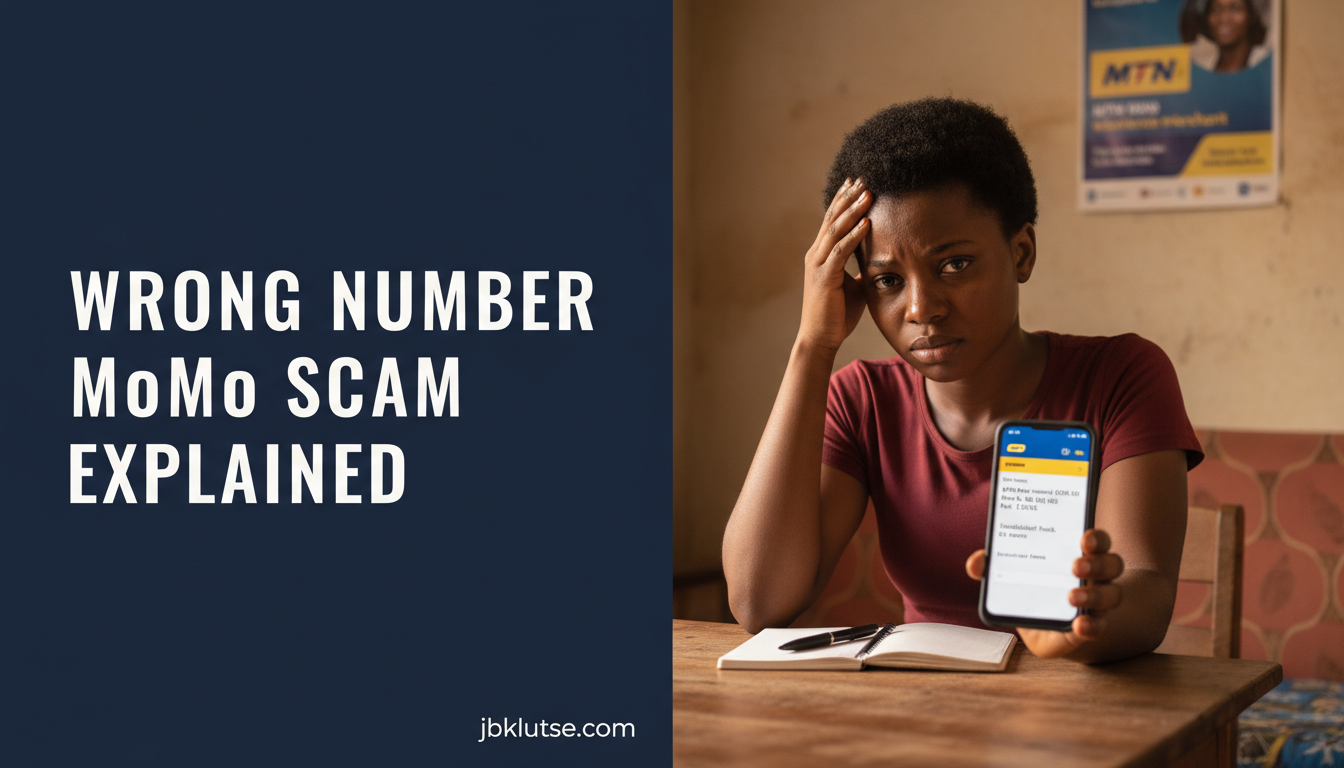
The wrong number momo scam is a social engineering fraud where a stranger claims they accidentally sent you money via MTN MoMo, Telecel Cash, or AirtelTigo Money, then pressures you to send it back to a different number, stealing your actual cedis in the process. Between January and March 2026, the Bank of Ghana flagged 847 reported cases totaling GHS 2.3 million (April 2026) in losses, with the scam spiking during salary week and festive periods when transaction volumes are high across Accra, Kumasi, and Takoradi.
Table of Contents
- TL;DR
- How the Wrong Number MoMo Scam Works
- Step 1: The Fake Alert
- Step 2: The Urgent Call
- Step 3: The Pressure to Send
- Step 4: The Disappearance
- Why the Scam Works
- How to Verify if You Received Money
- Check Your Wallet Balance
- Request Transaction History
- Cross-Reference the Sender Number
- Call Your Telco Fraud Line
- What to Do If You Fall Victim
- Immediate Actions (First 30 Minutes)
- Report to Authorities (First 24 Hours)
- Follow Up (Days 2-7)
- Ghana-Specific Considerations
- Telco Reversal Policies
- SIM Swap Connection
- Police Reporting Threshold
- Red Flags That Always Signal a Scam
- FAQs
- Related Reads
- Closing
- Sources
This guide breaks down how the scam works, what makes it effective, how to verify if you truly received money, and what to do if you fall victim.
TL;DR
- Fraudsters send fake SMS alerts or small test amounts, then claim they sent more and demand a refund to a different number
- You send real money from your wallet while they never transferred the full amount they claimed
- Always check your wallet balance in the official telco app, never trust SMS alone
- MTN, Telecel, and AirtelTigo all confirm transactions take 48, 72 hours to reverse through proper channels, scammers demand instant action
- Report fraud immediately to your telco’s fraud line, the Bank of Ghana, and the Cyber Security Authority
How the Wrong Number MoMo Scam Works
The fraud follows a predictable four-step pattern.
Step 1: The Fake Alert
You receive an SMS that appears to come from MTN, Telecel, or AirtelTigo stating you received GHS 500, GHS 1,000, or another substantial amount. The message format mimics genuine telco alerts:
“You have received GHS 800.00 from 0244XXXXXX. Your new balance is GHS 1,245.00. Ref: MT240415XXXX”
In reality, the sender either:
– Spoofed the sender ID using bulk SMS software available online for as little as GHS 50 per month (April 2026)
– Sent you a tiny amount (GHS 1 or GHS 5) but edited the SMS display amount before screenshotting it
Some fraudsters skip the SMS entirely and just call claiming the telco system is down but they urgently need the money back.
Step 2: The Urgent Call
Within minutes, you receive a phone call from the number shown in the SMS (or a different number claiming to be their spouse, boss, or business partner). The caller explains they meant to send the money to another number for school fees, medical bills, or business supplies. They sound distressed and ask you to refund the amount immediately to a different number they provide.
Common urgency tactics:
– “My child is in the hospital and they need the money for surgery”
– “I’m a trader at Makola and I need to pay my supplier in the next hour”
– “Please, I’ll lose my job if my boss finds out I sent company money to the wrong number”
Step 3: The Pressure to Send
The scammer insists you send the money to a different number than the one that supposedly sent it. They provide detailed justifications:
– “That’s my old SIM, this is my active line”
– “Send it to my wife’s number, she’s at the bank”
– “My MoMo wallet is locked, use this business account instead”
If you hesitate, they escalate pressure, threatening to report you to police for theft or promising to visit your location (if you revealed any identifying information).
Step 4: The Disappearance
Once you send your real money, the scammer blocks your number and vanishes. You check your wallet and realize:
– Your balance decreased by the amount you sent
– You never actually received the original amount they claimed to send
– The “sender” number is now unreachable or belongs to another victim whose SIM was compromised
Why the Scam Works
Three psychological triggers make this fraud effective:
Fear of conflict. Most Ghanaians prefer to avoid confrontation and help someone claiming to be in distress, particularly when the caller sounds convincing and local.
SMS trust. Many users still treat SMS as authoritative proof of transactions despite widespread knowledge that sender IDs can be spoofed. A message that says “MTN Mobile Money” feels official.
Time pressure. Scammers exploit the genuine urgency around mobile money transactions in Ghana, where people routinely send money for emergencies, business deals, and family needs within minutes.
How to Verify if You Received Money
Follow this exact sequence before responding to any claim that you received money by mistake:
Check Your Wallet Balance
Open your telco’s official app:
– MTN: MoMo App (available on Google Play and Apple App Store)
– Telecel: My Telecel App
– AirtelTigo: myAirtelTigo App
Compare your current balance to your last known balance. The official app balance is the only accurate record. SMS can be faked. USSD balance checks (*170#, *110#, *134#) are reliable but slower than the app.
Request Transaction History
Dial your telco’s transaction history shortcode:
– MTN: *170# > My Wallet > My Account > Transaction History
– Telecel: *110# > My Account > Transaction History
– AirtelTigo: *134# > My Account > Mini Statement
Look for the exact reference number the caller provided. Genuine MoMo transactions generate unique reference codes that appear in your history within seconds.
Cross-Reference the Sender Number
If the transaction appears in your history, note the sender’s number. If the caller is demanding you send money to a different number than what appears in your transaction history, that is confirmation of fraud. Legitimate senders receive refunds to the same number that sent the money.
Call Your Telco Fraud Line
Before taking any action:
| Telco | Fraud Hotline | Hours |
|---|---|---|
| MTN Ghana | 100 (toll-free) or 0244300000 | 24/7 |
| Telecel Ghana | 0200400000 | 24/7 |
| AirtelTigo | 0302740233 | 08:00 – 20:00 daily |
Provide the reference number, sender number, and amount. The telco can confirm within 2-3 minutes if a transaction occurred and flag the account if it is a known fraud number.
What to Do If You Fall Victim
If you already sent money to a scammer:
Immediate Actions (First 30 Minutes)
Call your telco fraud line (numbers above) and request an immediate block on the recipient’s wallet. MTN and Telecel can freeze a wallet within 10-15 minutes if you report promptly.
Screenshot everything:
– The fake SMS alert
– Your transaction history showing the money you sent
– Call logs showing the scammer’s number
– Any WhatsApp or SMS conversationsDo not engage further with the scammer. Block the number. Do not accept calls from new numbers claiming to be related to the incident.
Report to Authorities (First 24 Hours)
File reports with three entities:
1. Your telco’s fraud unit (already called in step 1, but formalize it with a written complaint via email):
– MTN: fraud@mtn.com.gh
– Telecel: customercare@telecel.com.gh
– AirtelTigo: customercare@airteltigo.com.gh
2. Bank of Ghana Financial Stability Department:
Submit a complaint at www.bog.gov.gh under the “File a Complaint” section. Include your telco ticket number. BoG coordinates with telcos on cross-network fraud and tracks patterns for enforcement action.
3. Cyber Security Authority (CSA):
Report at cybersecurity.gov.gh/report-incident. CSA logs the fraud for national cybercrime statistics and can escalate to CID Cybercrime Unit if the amount exceeds GHS 5,000 (April 2026) or is part of a syndicate pattern. (See our guide on filing a complaint with Cyber Security Authority for full step-by-step instructions.)
Follow Up (Days 2-7)
Contact your telco every 48 hours for updates. If the scammer’s wallet was frozen and contained funds, recovery is possible but takes 7-21 days for investigation, verification, and reversal approval.
If your telco confirms the wallet is empty or the account holder used a fake-name registration (common with stolen or black-market SIMs), recovery drops to near zero. In those cases, your reports still help authorities track the fraud ring and prevent future victims.
For a detailed breakdown of what happens after you report, see Getting Your Money Back After MoMo Fraud.
Ghana-Specific Considerations
Telco Reversal Policies
All three major telcos follow Bank of Ghana’s 2024 Mobile Money Fraud Directive (revised April 2025), which requires:
- Erroneous transfers (genuine wrong-number sends by honest users) take 48 to 72 hours to reverse after both parties confirm the error with the telco
- Fraud-flagged transactions get wallet freezes within 10-30 minutes if reported immediately, but fund recovery depends on whether the scammer already cashed out
- Inter-network fraud (MTN to Telecel, etc.) adds 24-48 hours to investigation time due to coordination between telco fraud desks
No telco allows instant “take-back” of a sent transaction without investigation. Any caller demanding you send money immediately because “the telco system won’t let me reverse it” is lying.
SIM Swap Connection
Many wrong-number scam operators use SIM-swapped numbers to receive the money you send, making it harder to trace to a real person. The “sender” number in the fake SMS often belongs to another victim whose number was hijacked. By the time you report, that number is already blocked or abandoned.
If you suspect your own SIM may be compromised (you suddenly lose network signal, you receive OTPs for accounts you didn’t attempt to access), contact your telco immediately to block SIM swaps and check your MoMo transaction history for unauthorized sends.
Police Reporting Threshold
Ghana Police CID Cybercrime Unit prioritizes cases involving GHS 5,000+ (April 2026) or syndicate patterns (multiple victims from the same fraud ring). For amounts under GHS 5,000 (April 2026), your telco and BoG reports carry more weight than a police report for practical recovery purposes, but file a police report at your nearest station if you want a formal crime reference number for legal or insurance purposes.
Red Flags That Always Signal a Scam
- Different refund number. Legitimate wrong-send refunds always go back to the originating number. No exceptions.
- Immediate urgency. Real people wait for telco reversals. Scammers demand instant action.
- No transaction in your history. If your wallet shows no incoming credit matching the amount they claim, the SMS was spoofed.
- Caller knows your name/location. They got your info from a data leak or a previous interaction. Legitimate wrong-number senders do not know who you are.
- They ask you to “help them” by going to an agent. This is a multi-step scam where they will intercept you at the agent or instruct the agent to send to a third account.
FAQs
What if I did receive the money they claim but I already spent it?
If a genuine transaction credited your account and you spent it before the sender requested a reversal, you are legally obligated to refund it through the proper telco channel, not to an arbitrary third number. Contact your telco to initiate a formal reversal. Spending mistakenly received funds is considered theft under Ghana’s Electronic Transfer of Funds Act (Act 1075, 2023) and you could face prosecution if the sender reports it to police. Always verify first, never spend unplanned credits.
Can I get in trouble for keeping money sent by mistake?
Yes. If a genuine wrong transfer is proven and you refuse to cooperate with the telco’s reversal process, the sender can file a police report and you could be charged with theft by finding. However, if the sender is a scammer (no real transfer occurred), you have no liability. This is why verification through your official app transaction history is critical.
How do scammers spoof MTN or Telecel SMS sender IDs?
Bulk SMS platforms like HubTel, SMSGH, and international services (Twilio, Nexmo) allow users to set custom sender IDs. In Ghana, legitimate businesses register these IDs with the National Communications Authority, but scammers exploit gaps in registration enforcement or use foreign platforms that do not verify ownership. The NCA and telcos have improved sender ID authentication since mid-2025, but spoofing remains possible, particularly with SMS arriving from foreign gateways.
What if the scammer sent me GHS 5 as “proof” they sent money?
This is a variant where they send a tiny test amount (GHS 1, GHS 5, or GHS 10), then call claiming they sent GHS 500 or GHS 1,000 and “the telco is showing the wrong amount.” They ask you to send the full amount they claim. Check your transaction history. If it shows GHS 5 received, that is the true amount. Do not send anything back. Tell them to contact their telco for a proper reversal. Real telco errors do not work this way.
Why do scammers target salary week and month-end?
MoMo transaction volume spikes during salary periods (25th-5th of each month for most formal sector workers in Ghana), creating more “noise” for fraud to hide in and more users with high wallet balances susceptible to urgency tactics. Scammers also exploit month-end rent and school fee stress, knowing victims are juggling multiple large payments and may act fast without verification.
Can I report the scammer’s number to get it blocked?
Yes, but blocking is temporary if the number is SIM-swapped or already flagged. Your telco will block the recipient number and investigate the account holder. However, many fraud rings rotate through dozens of SIM cards purchased from black-market sources, so the same scammer will reappear on a new number within days. Your report still helps by feeding pattern data into fraud-detection algorithms that catch wider networks.
What happens if I report to BoG and nothing happens?
Bank of Ghana’s role is regulatory, not operational. They compile fraud reports, pressure telcos to improve security, and can fine or sanction telcos with poor fraud response. They do not directly recover money or arrest fraudsters. For immediate action, your telco fraud line is the first responder. For criminal prosecution, Cyber Security Authority and Ghana Police CID are the enforcement arms. BoG reports are most useful for tracking systemic issues and holding telcos accountable at the policy level. (Full explainer in How to Report MoMo Fraud to BoG.)
Is there a way to verify a transaction without calling my telco?
Yes. Use your telco’s official app or USSD transaction history menu. Both show real-time, verified data. SMS alerts are secondary confirmation, not primary proof. If you distrust SMS (correct instinct), ignore it until you check your app. This takes 30 seconds and eliminates 90% of scam risk.
Related Reads
- Zoom out: Cybersecurity: Ghana Consumer Guide
- Topic hub: MoMo Fraud Protection: Consumer Security Guide for Ghana
- Related deep-dives:
- Fake MoMo Agent Scams: How to Spot Them
- Getting Your Money Back After MoMo Fraud
- Top MoMo Scams in Ghana (2026)
- MoMo Reversal Scams: Beware
Closing
The wrong number MoMo scam thrives on trust, urgency, and the gap between what users believe SMS proves and what their wallet balance actually shows. Between July 2025 and March 2026, Ghana Police CID Cybercrime Unit linked 18 arrests to multi-victim wrong-number fraud rings operating across Greater Accra, Ashanti, and Western regions, recovering GHS 430,000 (April 2026) in frozen wallets, but thousands of smaller cases go unrecovered because victims delay reporting or never verify the fake SMS. Your best defense is simple: check your official telco app before you send a single pesewa. If the transaction history does not match the caller’s story, it is fraud. Block, report, and move on.
Follow our updates on X at @jbklutsemedia.
Sources
- Bank of Ghana Mobile Money Fraud Directive (2024, revised April 2025)
- Cyber Security Authority of Ghana Quarterly Fraud Report (Q1 2026)
- MTN Ghana Fraud Awareness Center
- National Communications Authority SMS Sender ID Registration Guidelines (2023)
- Ghana Police Service CID Cybercrime Unit case data (January-March 2026, accessed via BoG regulatory filings)