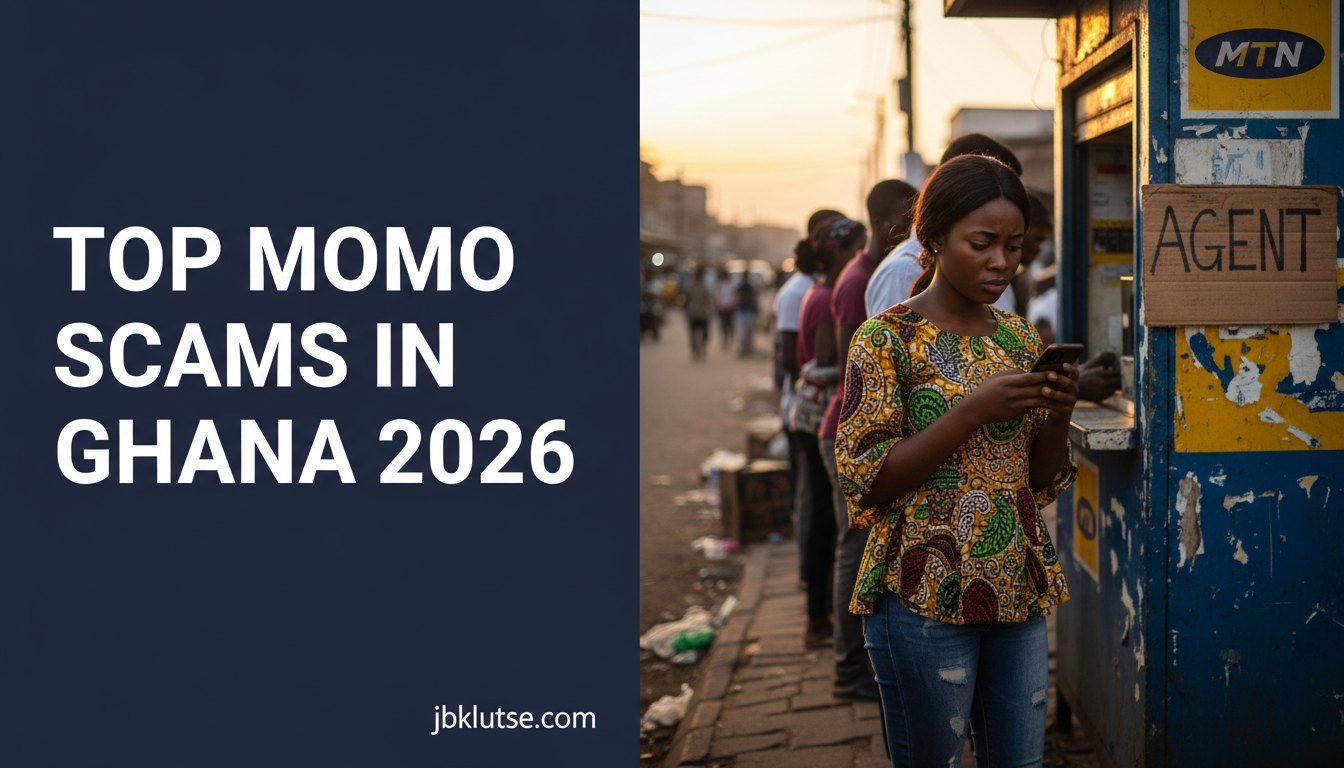
The momo scam types ghana residents face in 2026 range from fake agent booths in Accra markets to sophisticated reversal cons that drain accounts in seconds. Ghanaians lost an estimated GHS 47 million (April 2026) to mobile money fraud in 2025 according to Bank of Ghana incident reports, with MTN, Telecel, and AirtelTigo users all targeted. This guide catalogs the ten most active scam patterns as of April 2026, shows you the red flags scammers rely on, and links you to the exact steps for reporting fraud to the Cyber Security Authority and your telco’s fraud desk.
Table of Contents
- TL;DR
- The Top 10 MoMo Scam Types in Ghana
- 1. Fake MoMo Agent Booths
- 2. Reversal / Wrong Number Scams
- 3. Investment Ponzi Schemes
- 4. Job Offer Fraud
- 5. Romance Scams
- 6. Fake Customer Service Calls
- 7. SIM Swap Fraud
- 8. Fake Promo / Prize Scams
- 9. Money Mule Recruitment
- 10. Fake Loan Apps / USSD Loans
- Ghana-Specific Considerations
- Regulatory Response
- Telco-Specific Protections
- Cash-Out Locations
- Typical Loss Ranges by Scam Type
- FAQs
- Related Reads
- Closing
- Sources
Scammers adapt fast. The “wrong number transfer” trick that was rare in 2023 is now the second-most-reported scam type at MTN Ghana’s call centers. Romance scams have moved from Facebook to WhatsApp and now use voice notes recorded by AI clones. Job offer frauds promise SSNIT contributions and health insurance, then vanish after the “registration fee” MoMo payment clears.
TL;DR
- Fake agent scams account for 28% of reported MoMo fraud in urban Ghana, often via unlicensed kiosks that clone SIM cards or steal PINs
- Reversal scams trick victims into sending money back after a fake “accidental transfer,” costing GHS 200–2,000 (April 2026) per incident
- Investment Ponzis promise 50–100% monthly returns, collapse within 3–6 months, total losses exceed GHS 12 million (April 2026) in 2025
- Job offer cons charge GHS 50–500 (April 2026) “registration fees” for non-existent roles at MTN, AngloGold, Newmont, or government ministries
- Romance fraud moves from dating apps to MoMo requests for medical bills, travel costs, or “business capital,” averaging GHS 1,200 (April 2026) per victim
The Top 10 MoMo Scam Types in Ghana
1. Fake MoMo Agent Booths
Unlicensed kiosks set up near markets, lorry stations, and university campuses. The agent asks you to hand over your phone “to complete the transaction,” then installs malware, clones your SIM, or notes your PIN. Victims realize money is missing hours or days later when the fake booth has vanished.
Reported losses: GHS 150–3,500 (April 2026) per victim. MTN recorded 4,200 cases in Q1 2026 alone.
Red flags:
– No official telco branding or agent ID badge visible
– Agent insists on holding your phone behind a screen
– Booth appears overnight and disappears within days
– Agent offers rates GHS 0.50–1.00 (April 2026) below standard fees
See our full breakdown: Fake MoMo Agent Scams: How to Spot Them
2. Reversal / Wrong Number Scams
You receive a MoMo transfer of GHS 50–500 (April 2026) from an unknown number. Minutes later, a panicked caller or SMS claims they sent money to the wrong number by mistake and begs you to return it. You send it back. Hours later, the original transfer is reversed by the sender (it was never finalized or was sent from a stolen account). You are now out the amount you “returned.”
Reported losses: GHS 200–2,000 (April 2026) per victim, 1,800+ verified cases in Ghana in 2025.
How it works: Scammer initiates a transfer but cancels it before you cash out, or uses a hacked account that the real owner later disputes. Your “return payment” goes to a different number, often registered with a fake ID.
Protection: Never return MoMo transfers to a different number than the sender. Call your telco’s fraud line first. If someone claims a mistake, tell them to request a reversal through official channels.
Read the full mechanics: MoMo Reversal Scams: Beware
3. Investment Ponzi Schemes
WhatsApp groups and Telegram channels promise 30%, 50%, or 100% monthly returns on MoMo deposits. Early investors are paid from new deposits to create social proof. Schemes collapse when new signups slow. Ghana’s Cyber Security Authority shut down 14 investment Ponzis in 2025, but new ones launch weekly.
Notable collapses in 2025:
– Lotto Empire: GHS 8.3 million (April 2026) lost, 6,700 victims
– God’s Time Investment: GHS 2.1 million (April 2026) lost, 2,200 victims
– Bitcoin Mining Ghana: GHS 1.9 million (April 2026) lost, 980 victims
Red flags:
– Guaranteed returns above 10% monthly (no legitimate investment does this)
– Pressure to recruit friends and family for “bonuses”
– No registered office address or SEC Ghana license
– Withdrawal requests delayed or denied after 30–60 days
Deep dive: Investment Scam Patterns in Ghana
4. Job Offer Fraud
Scammers pose as recruiters for MTN, AngloGold Ashanti, Newmont, the Presidency, or international NGOs. You receive a congratulatory SMS or WhatsApp message saying you have been shortlisted. Next step: pay GHS 50–500 (April 2026) for “registration,” “CV processing,” “medical clearance,” or “SSNIT activation.” Payment is via MoMo. The job does not exist.
Target demographics: Recent graduates, national service personnel, unemployed youth in Accra, Kumasi, Takoradi.
Reported losses: GHS 50–500 (April 2026) per victim, estimated 9,000 victims in 2025.
Red flags:
– Unsolicited job offer (you never applied)
– Request for upfront payment before interview
– Grammatical errors in “official” emails
– Recruiter uses a personal Gmail or Yahoo address, not a company domain
– No verifiable HR contact at the named company
Full case studies: Job Offer MoMo Fraud
5. Romance Scams
Scammer builds a relationship on Facebook, Instagram, Snapchat, or dating apps over weeks or months. Once trust is established, urgent requests begin: “My mother is in the hospital, I need GHS 800 (April 2026) for surgery,” “I want to visit you but need GHS 1,500 (April 2026) for the bus ticket,” “My business needs capital, send GHS 2,000 (April 2026) and I will pay you back double.”
Reported losses: GHS 500–10,000 (April 2026) per victim, average GHS 1,200 (April 2026). Women and men both targeted, though tactics differ by gender.
2026 twist: Scammers now use AI voice cloning. They record your voice from a video call, then send voice notes to your contacts claiming you are in trouble and need urgent MoMo transfers.
Red flags:
– Romantic interest escalates unusually fast
– Victim lives abroad or in another region, never meets in person
– Repeated financial emergencies
– Refuses video calls or always has “camera issues”
– Asks you to receive money on their behalf (money mule setup)
More on romance fraud mechanics: Romance Scams via MoMo in Ghana
6. Fake Customer Service Calls
You receive a call from someone claiming to be MTN, Telecel, or AirtelTigo customer care. The caller says there is a “security issue” with your MoMo wallet and asks you to share your PIN, approve a transaction, or dial a USSD code to “verify your account.” The code actually transfers money out or changes your PIN.
Reported losses: GHS 100–5,000 (April 2026) per victim, 3,400 cases in 2025.
How to verify: Hang up. Call your telco’s official customer care number (MTN 100, Telecel 100, AirtelTigo 100). Real customer care will never ask for your PIN or request you approve transactions over the phone.
Similar scam: Fake SMS claiming your wallet is blocked, with a link to a phishing site that harvests your login credentials.
7. SIM Swap Fraud
Scammer obtains your personal details (often from data breaches or fake surveys). They visit a telco office with a fake ID and request a SIM replacement, claiming the original is lost. Once the new SIM activates, your number transfers to their device. They reset your MoMo PIN and drain your wallet.
Reported losses: GHS 500–20,000 (April 2026) per victim. High-profile cases in 2025 included a Kumasi-based businesswoman who lost GHS 18,000 (April 2026) overnight.
Protection:
– Enable SIM change alerts (available on all three telcos as of 2026)
– Use a unique, complex MoMo PIN unrelated to your birthdate or phone number
– Register your SIM with biometric verification at a telco office
– Check your balance daily
See the full prevention checklist in our MoMo Fraud Protection: Consumer Security Guide
8. Fake Promo / Prize Scams
SMS or call notifies you that you have won GHS 5,000 (April 2026), a new phone, or a car in an MTN, Telecel, or Coca-Cola promotion. To claim your prize, you must pay GHS 50–200 (April 2026) in “processing fees” or “taxes” via MoMo. You pay. The prize never arrives.
Reported losses: GHS 50–200 (April 2026) per victim, estimated 12,000 victims in 2025.
Red flags:
– You never entered the promotion
– Sender uses a personal number, not a shortcode
– Grammatical errors or typos in the message
– Upfront payment required to claim a “free” prize
Verification: Call the company’s official line or visit their website. MTN Ghana posts all active promotions at mtnonline.com/promotions. Coca-Cola Ghana uses only shortcode 1355 for legitimate promos.
9. Money Mule Recruitment
You are offered a “job” receiving MoMo transfers into your wallet, keeping 10–20% as commission, and forwarding the rest to another number. The money is stolen or laundered from fraud proceeds. You become an accessory to the crime. Police and Bank of Ghana can freeze your account and prosecute you under Ghana’s Anti-Money Laundering Act (Act 749, amended 2020).
Legal risk: Up to 15 years imprisonment under Act 749 if convicted.
How it starts: Offer comes via WhatsApp, Telegram, or Facebook, often disguised as “remote work,” “financial assistant,” or “payment processing agent.”
Red flags:
– No contract, no registered company
– Pay structure is commission-only on transfer volume
– You are asked to open multiple MoMo wallets or use friends’ numbers
– Sender insists transactions are “confidential”
Protection: Decline. Report the recruiter to the Cyber Security Authority: Filing a Complaint with Cyber Security Authority
10. Fake Loan Apps / USSD Loans
Scammer creates a fake loan app or USSD shortcode promising instant GHS 500–5,000 (April 2026) loans with “no collateral.” You apply by entering your MoMo number, Ghana Card number, and PIN. Your wallet is drained within minutes. The app or shortcode disappears.
Reported losses: GHS 200–3,000 (April 2026) per victim, 2,100 cases in 2025.
Legitimate loan providers in Ghana (as of April 2026):
– MTN Qwikloan (dial *170#)
– Fido (fido.africa)
– Branch (branch.com.gh)
– Gozem Finance (available in-app)
– Izwe Loans (izweloans.com)
Red flags:
– App not listed on Google Play or Apple App Store
– Requests your MoMo PIN (real lenders never ask for this)
– No physical office or customer care line
– Loan terms too good to be true (0% interest, 12-month repayment on GHS 5,000 (April 2026) for first-time borrowers)
Ghana-Specific Considerations
Regulatory Response
The Cyber Security Authority (CSA) launched a MoMo fraud reporting portal in January 2026 at csreport.cybersecurity.gov.gh. Average response time is 48–72 hours for flagged accounts. The portal has processed 8,400 reports as of April 2026, resulting in 340 frozen accounts and 19 arrests.
Bank of Ghana requires telcos to maintain 24/7 fraud desks as of March 2025 (Directive BSD/2025/03). MTN, Telecel, and AirtelTigo now offer in-app fraud reporting buttons and SMS alerts for transactions above GHS 500 (April 2026).
Telco-Specific Protections
| Telco | Fraud Hotline | Daily Transfer Limit (Default) | PIN Reset Requires |
|---|---|---|---|
| MTN | 100 (press 5 for fraud) | GHS 2,000 (April 2026) | Ghana Card + OTP |
| Telecel | 100 (press 4 for fraud) | GHS 1,500 (April 2026) | Ghana Card + OTP |
| AirtelTigo | 100 (say “fraud”) | GHS 1,500 (April 2026) | Ghana Card + secret question |
As of April 2026, all three telcos support transaction velocity limits, blocking accounts that send more than 10 transfers in 5 minutes (a common bot pattern).
Cash-Out Locations
Scammers often cash out stolen funds at remote agents in Kasoa, Madina, Amasaman, Ashaiman, and border towns (Aflao, Elubo, Paga). Bank of Ghana requires agents in these high-risk zones to verify the sender’s identity via biometric scan before cash-out for amounts above GHS 500 (April 2026) (Directive BSD/2024/11).
Typical Loss Ranges by Scam Type
| Scam Type | Typical Loss (GHS, April 2026) | Recovery Rate |
|---|---|---|
| Fake Agent | 150–3,500 | 12% |
| Reversal | 200–2,000 | 8% |
| Investment Ponzi | 500–50,000 | 3% |
| Job Offer | 50–500 | 5% |
| Romance | 500–10,000 | 2% |
| Fake Customer Care | 100–5,000 | 15% |
| SIM Swap | 500–20,000 | 18% |
| Fake Promo | 50–200 | 4% |
| Money Mule | N/A (legal risk) | N/A |
| Fake Loan App | 200–3,000 | 10% |
Recovery rates per Bank of Ghana Q4 2025 fraud report.
FAQs
What is the most common MoMo scam in Ghana right now?
Fake agent scams account for 28% of reported fraud as of April 2026, followed by reversal scams at 19% and investment Ponzis at 14%. Urban areas see more agent fraud, while rural victims report higher rates of fake promo scams.
Can I get my money back after a MoMo scam?
Recovery depends on how fast you report. If you contact your telco’s fraud line within 30 minutes, the account can often be frozen before cash-out. Recovery rate drops to 8% after 24 hours. See step-by-step instructions: Getting Your Money Back After MoMo Fraud
How do I report MoMo fraud to Bank of Ghana?
Use the Cyber Security Authority portal at csreport.cybersecurity.gov.gh or call the CSA hotline at 292 (toll-free from any Ghanaian number). Bank of Ghana fraud reports go through your telco first, then escalate to BoG if the telco does not resolve within 14 days. Full process: How to Report MoMo Fraud to BoG
Are romance scams illegal in Ghana?
Yes. Romance fraud falls under Ghana’s Cybercrime Act 2020 (Act 1038), Section 3 (computer fraud) and Section 5 (identity fraud). Conviction carries up to 5 years imprisonment and fines up to GHS 60,000 (April 2026). Economic and Organised Crime Office (EOCO) handles high-value cases.
What should I do if someone asks me to receive MoMo transfers and forward them?
Decline and report. This is money mule recruitment. You risk prosecution under the Anti-Money Laundering Act (Act 749, amended 2020) and Bank of Ghana can freeze your account permanently. Report the recruiter to the Cyber Security Authority.
Can scammers steal my money if I never share my PIN?
Yes, via SIM swap. If a scammer clones your SIM or convinces a telco agent to issue a replacement SIM, they can reset your PIN using your phone number. Enable SIM change alerts on your account and use biometric SIM registration.
Do fake MoMo agents operate in licensed telco shops?
Rare but possible. In 2025, MTN Ghana revoked licenses for 18 agents caught in collusion with scammers. Always verify the agent’s ID badge matches the shop’s signage. If the agent asks to hold your phone behind a screen, walk out and report to the telco’s fraud line.
What is the difference between a reversal scam and the wrong number scam?
Same scam, two names. The core mechanic is identical: scammer sends you money (or pretends to), claims it was a mistake, and tricks you into sending money back to a different number. The original transfer is then reversed or was never finalized.
Related Reads
- Zoom out: Cybersecurity
- Topic hub: MoMo Fraud Protection: Consumer Security Guide
- Related deep-dives:
- Fake MoMo Agent Scams: How to Spot Them
- You Sent Money to Wrong Number Scam Explained
- Investment Scam Patterns in Ghana
- Romance Scams via MoMo in Ghana
Closing
Scammers in Ghana are organized, fast, and adapt to every new telco security feature within weeks. The scams documented here will mutate, but the psychological tactics stay the same: urgency, authority, fear, greed, and trust exploitation. Your best defense is skepticism, verification, and immediate reporting when something feels wrong. If a deal is too good, a caller too insistent, or a stranger too generous, stop and verify before you send a single pesewa.
Follow our updates on X at @jbklutsemedia.
Sources
- Bank of Ghana Payment Systems Statistics (Q4 2025)
- Cyber Security Authority Fraud Reporting Portal
- MTN Ghana Fraud Prevention Guidelines
- Telecel Ghana MoMo Security Updates
- AirtelTigo Ghana Security Tips
- Economic and Organised Crime Office (EOCO) 2025 Press Releases
- Ghana Cybercrime Act 2020 (Act 1038), Section 3 and Section 5
- Ghana Anti-Money Laundering Act (Act 749, as amended 2020)