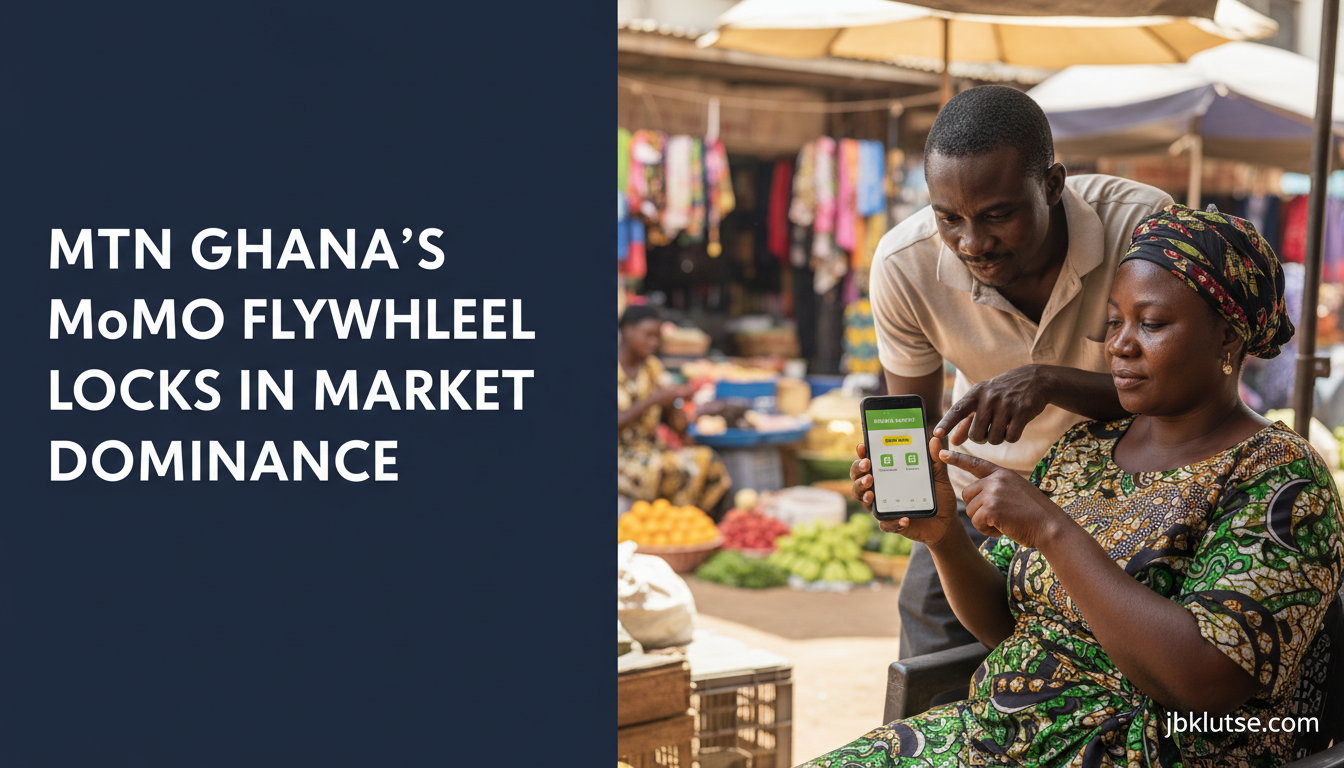
Graphic: JBKlutse
MTN Ghana doesn’t just have the biggest mobile network in Ghana. It has locked in something harder to escape: 19.3 million people who use MTN MoMo, and that number is why rivals Telecel and AT Ghana can’t catch up, no matter how good their signal gets.
The story starts with data. MTN holds 81.29% of Ghana’s mobile data subscriptions as of February 2026, according to the National Communications Authority (NCA). But market share alone doesn’t explain why the gap keeps widening. The real lock-in is financial.
How MoMo Becomes a Trap (For Both Users and the Market)
Here’s the cycle: you buy MTN data bundle with MoMo. You use that data to check your MoMo balance, send money, or pay bills. Next month, you top up again with MoMo. Each transaction cements you deeper into MTN’s ecosystem.
MTN Mobile Money grew 12.3% in active users last year, and revenue from financial services jumped 35.7% in 2025. That’s not because MTN suddenly became better at money transfer—it’s because the more people use MoMo, the more useful it becomes. Your friends are on it. Shops accept it. You can’t easily leave even if you wanted to.
This is called “lock-in,” and it’s why competitors are stuck. Telecel has 14.5% of data subscriptions and AT Ghana has 4.2%. Neither has a mobile money product that comes close to MoMo’s 19.3 million users. Without a financial services layer, switching from MTN to a competitor means giving up access to money transfer, savings, and bill payments—not just a phone network.
The Numbers Show It’s Working
MTN Ghana’s profit after tax jumped 55.9% to GHS 7.8 billion in 2025. The company is now worth roughly 31.6% of Ghana’s entire stock market. Ghana’s telecom industry is expected to grow from USD 1.93 billion in 2025 to USD 2.32 billion by 2031, and MTN is positioned to capture most of that growth because it already holds four-fifths of the market.
What About Regulation?
Here’s the catch: the NCA classified MTN as a “Significant Market Power” back in 2020, which means MTN is supposed to face pricing limits and must share its network with competitors. The goal was to level the playing field.
It hasn’t worked. MTN’s market share has not dropped below 81% in the last three months of data. In fact, the market has moved in the opposite direction.
What This Means for You
If you use MTN MoMo, you’re not just paying for a network—you’re invested in an ecosystem. Switching to Telecel or AT Ghana would mean losing your MoMo account and starting fresh elsewhere, even if their signal or pricing were better. That friction benefits MTN and limits your real choice as a consumer.
For Ghana’s fintech and telecom space, it means innovation will likely happen inside MTN’s walls, not in healthy competition between rivals. The gap between MTN and competitors isn’t closing because network effects—the more people on MoMo, the more valuable it is—are self-reinforcing.
Watch for: Whether the NCA takes new action to break the lock-in, or whether alternatives like bank-backed digital wallets or government-backed payment systems gain traction as workarounds.



Leave a Reply