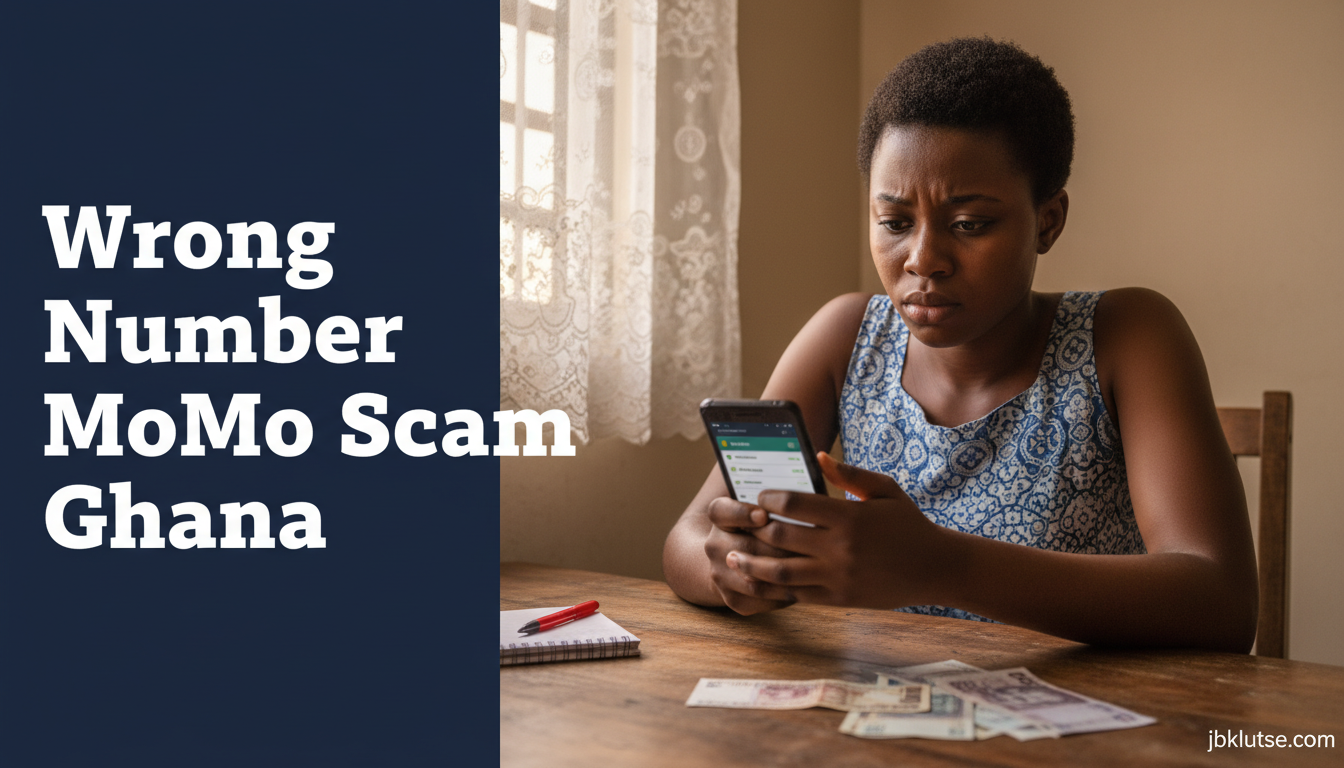
The wrong number momo scam in Ghana starts when someone texts you claiming you sent them mobile money by mistake, then pressures you to send “their money back” to a different number while keeping your original transfer. This classic social engineering attack cost Ghanaians an estimated GHS 2.3 million (April 2026) in 2025 according to Bank of Ghana fraud reports, with MTN and Telecel users hit hardest. This guide breaks down exactly how the scam works, the psychological tactics fraudsters use, the red flags that expose them, and the four steps to protect yourself before you lose a cedi.
Scammers exploit the fact that many Ghanaians send MoMo multiple times daily for everything from susu contributions to market purchases, making a “wrong number” claim seem plausible.
TL;DR
- The scam involves a fraudster claiming YOU sent them money by mistake, then asking you to send money to a “correct” number
- You never actually sent the scammer anything in the first place, it is pure deception
- The goal is to trick you into sending real money while the fraudster keeps any funds if you comply
- Always check your MoMo transaction history before responding to any “wrong number” claim
- MTN, Telecel, and AirtelTigo all offer free transaction reversal for genuine mistakes within 72 hours
- Report suspected scams immediately to your telco and the Cyber Security Authority on 292
How the Wrong Number MoMo Scam Works
The scam follows a predictable four-stage playbook that relies on confusion, urgency, and social pressure.
Stage 1: The false claim
You receive an SMS or WhatsApp message from an unknown number: “Please brother, you sent me GHS 150 by mistake. I need the money urgently, my mother is sick. Send it back to 0244-XXX-XXX.” The message often includes personal details to build credibility, phrases like “God bless you” or “I’m a Christian,” and sometimes a sob story about medical bills, school fees, or a funeral contribution.
The critical detail: you never sent this person anything. The fraudster is fishing, hoping you recently made a MoMo transfer and might confuse their message for a legitimate complaint.
Stage 2: The pressure escalation
If you engage at all, even to ask “which transaction?”, the scammer doubles down. They may send a fake screenshot showing a transfer supposedly from your number, provide a fabricated transaction ID, or threaten to “report you to the police” for theft. The urgency intensifies: “My mother is in the hospital NOW,” “I will come to your house,” “I have your location.”
Some fraudsters work in pairs, with a second number texting you pretending to be a “police officer” or “MTN manager” demanding you resolve the matter immediately.
Stage 3: The misdirection
The scammer never asks you to reverse the original (nonexistent) transaction through official channels. Instead, they insist you send new money to a different number, “my correct number,” “my wife’s number,” or “my MM agent’s number.” This is the trap. The moment you send money to that number, you have made a real, voluntary transfer that cannot be easily reversed.
Stage 4: The vanishing act
After receiving your money, the scammer blocks you. If you realize the con and try to reverse the transfer, you discover the recipient account was registered with a fake ID or quickly cashed out through an agent. The SIM may already be discarded. Your money is gone.
Red Flags That Expose the Scam
You have no matching outgoing transaction
Check your MoMo wallet immediately. Open your MTN MoMo app, Telecel Cash app, or AirtelTigo Money app and review your transaction history for the past 7 days. If there is no outgoing transfer matching the amount and time the scammer claims, you are being scammed. Full stop.
MTN users can dial *170# → My Wallet → My Account → Transaction History. Telecel users dial *110# → My Account → Transaction History. AirtelTigo users dial *110# → My Wallet → Transaction History.
The “send to a different number” instruction
No legitimate person asks you to send money to a different number to “correct” a mistake. Telcos have built-in reversal systems precisely for wrong-number transfers. If someone genuinely received money from you by mistake, they would either send it back to your original number using the “Send Money” function, or guide you to request a reversal through your telco’s customer care (MTN 100, Telecel 200, AirtelTigo 100).
Emotional manipulation and urgency
“My mother is dying,” “I will report you to the police,” “I’m coming to your house with my boys.” Scammers use fear, guilt, and urgency to shut down your logical thinking. A real person in a genuine wrong-transfer situation would be calm, provide verifiable transaction details, and wait for you to check your records.
Fake screenshots and transaction IDs
Screenshots can be doctored in seconds using free apps. Transaction IDs can be invented or copied from unrelated transfers. If someone sends you a screenshot “proving” you sent them money, cross-check it against your actual MoMo statement. Look for mismatched dates, times, or reference numbers. MTN transaction IDs are 10 digits long and start with “MP.” Telecel IDs are 12 characters alphanumeric. AirtelTigo IDs are 14 digits.
The scammer refuses official channels
Suggest calling MTN customer care together on a three-way call, or visiting a MoMo agent in person to verify the transaction. A scammer will refuse, claiming they “don’t have time,” “don’t trust MTN,” or “this is between you and me.” A genuine claimant would welcome third-party verification.
Ghana-Specific Considerations
Telco reversal policies in 2026
All three major telcos in Ghana offer free transaction reversal for wrong-number transfers, but strict time limits apply:
- MTN Ghana: Reversal request must be made within 72 hours of the transaction. Call 100 or visit any MTN service center with your ID. Reversal takes 24-48 hours if the recipient has not withdrawn the funds.
- Telecel Ghana: Reversal window is 48 hours. Call 200 or use the Telecel Cash app’s “Dispute Transaction” feature. Requires transaction ID and recipient number.
- AirtelTigo Ghana: Reversal allowed within 72 hours if funds remain in the recipient wallet. Call 100 or visit an AirtelTigo shop with your national ID or Ghana Card.
After the window closes, reversal requires the recipient’s consent. If they refuse, your only recourse is legal action, which is impractical for small amounts.
Ghana Card and SIM registration impact
Since the 2022 SIM re-registration mandate, every MoMo account is theoretically tied to a Ghana Card or other national ID. This should make scammers easier to trace. However, fraudsters still operate using:
- SIM cards registered with stolen or fake IDs
- Accounts opened by complicit agents who falsify registration data
- Mule accounts belonging to vulnerable people (students, unemployed youth) who “rent” their registered numbers for GHS 20-50 (April 2026)
The National Communications Authority (NCA) deactivated 5.2 million improperly registered SIMs in 2024, but new fraudulent registrations continue.
Reporting channels
If you encounter this scam, report it even if you did not lose money. Each report strengthens the pattern database for law enforcement:
- Cyber Security Authority (CSA): Call 292 (toll-free) or email cybercrime@csa.gov.gh. CSA coordinates with the Ghana Police Service Cybercrime Unit.
- Your telco’s fraud desk: MTN 100, Telecel 200, AirtelTigo 100. Ask specifically for the “fraud and security team.”
- Economic and Organised Crime Office (EOCO): File a report at any regional office if the loss exceeds GHS 500 (April 2026). Bring printed SMS screenshots and MoMo transaction history.
- Bank of Ghana (BoG): For systemic complaints about telco negligence, email headbankinginspection@bog.gov.gh.
Response times vary. CSA typically acknowledges reports within 48 hours. Actual investigation and fund recovery can take 3-6 months, if it happens at all. The priority is prevention.
Why the scam thrives in Ghana
Three factors make this scam particularly effective here:
- High MoMo penetration: 45 million active mobile money accounts in a country of 34 million people (BoG 2025 data). Almost every adult sends MoMo daily, so a “wrong number” claim does not immediately sound absurd.
- Cash-out speed: MoMo can be cashed out at 400,000+ agents nationwide within minutes. Once a scammer receives your transfer, they withdraw it and discard the SIM before you realize the fraud.
- Weak prosecution: Ghana Police Service Cybercrime Unit has 12 officers covering the entire country. Most small-scale MoMo fraud goes uninvestigated unless the loss exceeds GHS 5,000 (April 2026) or involves multiple victims.
How to Protect Yourself: Four Non-Negotiable Steps
Step 1: Never send money based on a text message alone
If someone claims you sent them money by mistake, do not respond immediately. Open your MoMo app or dial your telco’s USSD code and review your transaction history first. If there is no matching outgoing transfer, ignore the message and block the number.
Step 2: Use official reversal channels only
If you genuinely sent money to the wrong number (we all make typos), do NOT send money to a “corrected” number. Instead:
- Call your telco immediately (MTN 100, Telecel 200, AirtelTigo 100)
- Request a transaction reversal using the original transaction ID
- Provide your registered name, phone number, and national ID number
- Wait for the telco to process the reversal (24-72 hours)
The telco will contact the recipient and reverse the funds if they are still in the wallet. If the recipient already cashed out, the telco will note the account for fraud monitoring but cannot force a refund. Your recourse is then a police report.
Step 3: Enable transaction notifications and PIN security
All three telcos send SMS confirmations for every MoMo transaction. Do not ignore these. If you receive a debit confirmation for a transaction you did not authorize, call your telco immediately and request an account freeze while you investigate.
Set a strong 4-digit PIN that is not your birth year, phone number last 4 digits, or 1234. Change it every 90 days. Never share your PIN with anyone, including MoMo agents. See our guide on why you should never share your MoMo PIN for the full breakdown.
Step 4: Verify before you trust
If a “wrong number” claimant sounds convincing, propose meeting at a MoMo agent or MTN service center to verify the transaction together in the presence of a third party. A scammer will refuse. A genuine claimant will agree.
Alternatively, offer to conference-call MTN/Telecel/AirtelTigo customer care right then with the claimant on the line. Let the telco representative confirm whether the transaction exists. Scammers hang up the moment you suggest this.
What to Do If You Already Sent Money
Act within 10 minutes
If you just realized you have been scammed, call your telco fraud line immediately (MTN 0244300000, Telecel fraud hotline 020XXXXXXX, AirtelTigo 0302740000). Request an urgent account freeze on the recipient number. If the scammer has not cashed out yet, the telco can block the withdrawal and reverse the funds.
Speed is critical. Most scammers cash out within 5-15 minutes of receiving a transfer. After that, recovery odds drop to near zero.
File a police report within 24 hours
Visit the nearest police station (or the Ghana Police Service Cybercrime Unit at CID Headquarters in Accra) with:
- Printed screenshots of the scam messages
- Your MoMo transaction history showing the fraudulent transfer
- The scammer’s phone number and any details they provided
- Your national ID or Ghana Card
Ask for a copy of the police report. You will need this document if you later want to pursue the case through EOCO or file a small claims suit.
Report to CSA and your telco
Even if the police do nothing, report the scam to the Cyber Security Authority (292) and your telco’s fraud desk. These reports feed into national fraud statistics and can trigger SIM blacklisting if multiple people report the same number.
Telcos maintain shared fraud databases. A number reported by 5+ customers may be automatically suspended, preventing the scammer from victimizing others.
Do NOT try to “scam back” the scammer
Some victims attempt to reverse-engineer the scam, sending fake “police” messages to the scammer or setting up a counter-trap. This is illegal under Ghana’s Cybersecurity Act (Act 1038). You can be prosecuted for impersonation, extortion, or fraud even if your target is a criminal. Let law enforcement handle it.
How This Scam Differs From Other MoMo Frauds
The wrong number scam is distinct from:
- SIM swap fraud: where scammers port your number to a new SIM and drain your wallet. See SIM swap fraud and MoMo in Ghana for that threat model.
- Fake agent scams: where criminals pose as MoMo agents to steal your PIN at a physical kiosk. Read fake MoMo agent scams for that breakdown.
- Phishing links: where scammers send fake “MoMo upgrade” or “tax refund” links that steal your login credentials. See top MoMo scams in Ghana (2026 edition) for a full taxonomy.
The wrong number scam is pure social engineering. No technical hack, no malware, no SIM swap. Just psychological manipulation and your momentary confusion. That is what makes it so effective and why checking your transaction history before responding is the single best defence.
FAQs
Can I get my money back if I already sent it to a scammer?
Maybe, if you act fast. Call your telco immediately (within 10 minutes) and request a freeze on the recipient account. If the scammer has not cashed out yet, the telco can reverse the transaction. After cash-out, recovery requires police involvement and is unlikely unless the loss exceeds GHS 5,000 (April 2026). The sender bears responsibility for verifying transactions before sending money, so telcos are not legally obligated to refund you.
How do scammers get my phone number?
Your number is probably not specifically targeted. Scammers send mass texts to thousands of random numbers daily, hoping 1-2% will have recently made a MoMo transfer and get confused. They buy bulk SMS credits from telcos (ironically) or use unofficial SMS gateways. Some also scrape numbers from social media, WhatsApp groups, and online marketplaces like Tonaton.
Is MTN MoMo safer than Telecel or AirtelTigo?
No. This scam works identically across all three telcos because it exploits human psychology, not platform vulnerabilities. MTN has the largest user base (19 million active wallets as of March 2026 per BoG), so scammers target MTN users more often simply because that is where the volume is. Telecel and AirtelTigo users face the same risk. Security depends on your behavior, not your telco.
What if the scammer knows my name or other personal details?
Do not panic. Your name may be linked to your phone number in public databases, church directories, alumni lists, or business registries. Scammers can also pull your name from Truecaller or social media. Knowing your name does not mean they hacked your account or have access to your MoMo wallet. It just makes their script sound more convincing. Still check your transaction history before responding.
Can I report the scam anonymously?
Yes. The Cyber Security Authority accepts anonymous reports via their online portal at csa.gov.gh/report. However, if you want follow-up or potential restitution, you will need to provide your contact details and file a formal police report. Anonymous tips help CSA track fraud patterns but do not directly lead to fund recovery for you.
Should I block numbers that send me suspicious “wrong transfer” messages?
Yes, immediately. After you verify your transaction history confirms no matching transfer, block the number on your phone and report it to your telco. This prevents follow-up harassment. Some scammers send 10-20 messages over several days, hoping to wear you down.
What happens if I ignore a genuine wrong-transfer claim?
Legitimate wrong-transfer claims are rare because telcos require you to confirm the recipient number and amount twice before sending. If you genuinely received money by mistake, the ethical response is to inform the sender or let your telco reverse it. However, if someone claims you received their money and you see no incoming transaction in your wallet, it is a scam. Trust your transaction history, not their story.
Are there any legal consequences if I fall for this scam and report it?
No. You are the victim, not the criminal. Filing a police report or CSA complaint will not result in charges against you, even if you sent the money voluntarily. Law enforcement treats this as fraud by deception. Your cooperation helps them build cases against scam networks. Do not let embarrassment prevent you from reporting.
Related Reads
- Zoom out: MoMo & Fintech in Ghana
- Topic hub: MoMo Fraud in Ghana: How to Spot Scams and Protect Yourself
- Related deep-dives:
- How to Reverse a Wrong MoMo Transfer
- Top MoMo Scams in Ghana (2026 Edition)
- What to Do If Your MoMo Account Is Hacked
- How to Secure Your MoMo Account
Closing
The wrong number MoMo scam will keep evolving as long as Ghanaians rely on mobile money for daily transactions. Scammers know we send MoMo in a hurry, at traffic lights, in trotros, while juggling other tasks. They exploit that split-second window when we might doubt ourselves. The defence is simple but requires discipline: check your transaction history before you do anything else. Five seconds of verification can save you GHS 150, GHS 500, or more.
As telcos improve SIM registration enforcement and the Cyber Security Authority expands its fraud monitoring, reporting becomes more effective. Your report today could prevent ten other people from losing money tomorrow. Stay alert, stay skeptical, and never let urgency override verification.
Follow our updates on X at @jbklutsemedia.
Sources
- Bank of Ghana Payment Systems Report (2025): https://www.bog.gov.gh/payment-systems/reports/
- Cyber Security Authority Ghana Fraud Statistics (2025): https://csa.gov.gh/reports/
- MTN Ghana MoMo Customer Care: https://www.mtn.com.gh/personal/support/
- Telecel Ghana MoMo Terms and Conditions: https://www.telecel.com.gh/personal/mobile-money/
- National Communications Authority SIM Registration Report (2024): https://nca.org.gh/sim-registration-2024/
- Ghana Police Service Cybercrime Unit Contact: https://police.gov.gh/cybercrime/