MEST Africa runs one of Ghana’s most selective entrepreneurial training programs from its Accra campus on Liberation Road, charging nothing upfront but taking 10% to 15% equity in exchange for a year of training, seed capital up to USD 100,000 (~GHS 1,109,000 at April 2026 rates), and co-working space. Founded by Jorn Lyseggen in 2008 and backed by Meltwater Group, MEST has trained over 1,000 entrepreneurs across five African countries and invested more than USD 10 million (~GHS 110.9 million at April 2026 rates) into portfolio companies including Meqasa, Beam, and Rancard Solutions. This review examines MEST’s model, admission rates (under 3%), curriculum structure, post-training outcomes, and how it compares to other Ghana-based accelerators.
Table of Contents
- TL;DR
- What MEST Is and How It Works
- Costs and Equity Structure
- Admissions and Selection
- Curriculum Breakdown
- Phase 1: Foundations (Months 1 to 6)
- Phase 2: Incubation (Months 7 to 12)
- Post-MEST Outcomes
- How MEST Compares to Other Ghana Accelerators
- Ghana-Specific Considerations
- Location and Campus Access
- Cost of Living During Training
- Regulatory and Tax Notes
- Who Should Apply
- Application Tips
- Criticisms and Controversies
- FAQs
- Related Reads
- Closing
- Sources
TL;DR
- MEST takes no cash upfront but claims 10% to 15% equity in exchange for training, seed funding, and workspace
- Acceptance rate below 3%, with cohorts typically 20 to 30 entrepreneurs per year across Ghana, Kenya, Nigeria, South Africa, and Senegal
- Training runs 12 months full-time: 6 months software development and business fundamentals, 6 months startup incubation
- Seed funding ranges from USD 50,000 to USD 100,000 (~GHS 555,000 to ~GHS 1,109,000 at April 2026 rates) for teams that graduate and incorporate
- Alumni portfolio includes 90+ active startups with cumulative post-MEST funding exceeding USD 50 million (~GHS 554.5 million at April 2026 rates) as of April 2026
What MEST Is and How It Works
MEST stands for Meltwater Entrepreneurial School of Technology. It operates as a hybrid training program and seed fund, not a traditional accelerator. Participants attend full-time for one year at the Accra campus (with satellite operations in Nairobi, Lagos, Cape Town, and Dakar).
The structure breaks into two phases:
- Foundations (6 months): Software engineering bootcamp, business model canvas training, product design, financial modelling, pitching drills. Delivered Monday to Friday, 8:00 AM to 5:00 PM.
- Incubation (6 months): Teams form, build MVPs, validate with real customers, pitch for seed capital. MEST mentors (internal staff and external advisors) provide weekly feedback sessions.
Upon graduation, teams that meet investment criteria receive seed capital between USD 50,000 and USD 100,000 (~GHS 555,000 to ~GHS 1,109,000 at April 2026 rates) in exchange for equity. MEST also provides post-training perks: free co-working space at the Accra campus for up to 24 months, access to the MEST Africa network (investors, corporate partners, alumni), and invitations to annual MEST Africa Summit events.
Costs and Equity Structure
MEST charges zero tuition. Entrepreneurs pay nothing for the training or the workspace. Instead, MEST takes equity:
- 10% to 15% ownership in any company formed during or immediately after the program
- Equity stake formalised at incorporation, typically upon receipt of seed funding
- No ongoing royalties or revenue shares beyond the equity claim
For context, a cohort member who launches a startup valued at GHS 500,000 (April 2026) effectively surrenders GHS 50,000 to GHS 75,000 worth of ownership. If the startup scales to a USD 5 million (~GHS 55.45 million at April 2026 rates) valuation in five years, MEST’s stake would be worth USD 500,000 to USD 750,000 (~GHS 5.545 million to ~GHS 8.318 million at April 2026 rates).
Critics argue the equity model disproportionately favours MEST when startups succeed, especially given that many participants would have built their companies anyway. Supporters counter that the training, mentorship, network access, and seed capital justify the stake, particularly for first-time founders with no prior venture backing.
Admissions and Selection
MEST accepts applications year-round via meltwater.org. The process involves:
- Online application: CV, motivational essay, business idea pitch (optional but recommended)
- Video interview: 15-minute Zoom screening with MEST admissions team
- In-person assessment day: Full-day session in Accra (or regional hub) with group exercises, coding challenges, and panel interviews
- Final selection: Cohort announced 4 to 6 weeks after assessment day
Acceptance rate hovers below 3%. The 2025 cohort received over 6,000 applications for 25 spots. MEST prioritises:
- Technical aptitude (can you code, or can you learn to code in 6 months?)
- Entrepreneurial grit (have you started, failed, or scaled something before?)
- Team compatibility (will you collaborate well in high-pressure group projects?)
- Growth potential (does your idea address a real African problem with venture-scale opportunity?)
Ghana-based applicants compete in the same pool as candidates from Kenya, Nigeria, South Africa, and Senegal. No country quotas, though Accra remains the largest training hub.
Curriculum Breakdown
Phase 1: Foundations (Months 1 to 6)
Software Engineering
- Languages: JavaScript (React, Node.js), Python
- Mobile development: React Native basics
- Database design: SQL, MongoDB
- Version control: Git, GitHub
- Deployment: AWS, Heroku, Vercel
- Daily pair programming sessions
Business Fundamentals
- Business model canvas and lean startup methodology
- Financial statements: P&L, balance sheet, cash flow
- Market sizing and customer discovery
- Pricing strategy and unit economics
- Sales and negotiation tactics
- Intellectual property basics (patents, trademarks, copyright in Ghana)
Soft Skills
- Public speaking and pitch delivery
- Leadership and conflict resolution
- Time management and productivity frameworks
- Networking and personal branding
Graduates of Phase 1 receive a certificate but no seed funding yet. Teams form based on complementary skills and shared startup ideas.
Phase 2: Incubation (Months 7 to 12)
Teams of 2 to 4 work full-time on their startup. MEST assigns an internal coach (typically a previous cohort alum or MEST staff engineer) and connects teams with external mentors (investors, corporate executives, sector specialists).
Weekly milestones:
- Weeks 1 to 4: Customer interviews (minimum 50 per team), problem validation
- Weeks 5 to 12: MVP build, alpha testing with 10 to 20 paying or active users
- Weeks 13 to 20: Beta launch, iterate based on feedback, measure retention
- Weeks 21 to 24: Pitch deck finalisation, financial projections, investment committee presentation
At the end of incubation, teams pitch to MEST’s internal investment committee. Successful teams incorporate (typically as a Ghana or Delaware C-corp) and receive seed capital. Teams that fail the investment pitch can still graduate and use MEST’s co-working space but receive no funding.
Post-MEST Outcomes
MEST has invested in 90+ startups since 2008. Notable portfolio companies:
- Meqasa (Ghana): Real estate platform, raised Series A in 2021
- Beam (Ghana): Last-mile delivery and logistics, acquired by Jumia in 2022
- Akwaba (Senegal): Hospitality booking platform, raised seed extension in 2025
- Klasha (Nigeria/Ghana): Cross-border payments, closed USD 2.5 million (~GHS 27.73 million at April 2026 rates) round in 2024
- Swoove (Ghana): Ride-hailing and courier service, pivoted to B2B logistics in 2023
Portfolio failure rate sits around 40% within three years (definition: company shuttered, team disbanded, or pivoted to non-venture-backable model). Success rate (defined as still operating and revenue-positive or having raised follow-on funding) is roughly 50%. The remaining 10% are zombie companies (incorporated, inactive, no revenue, no pivot).
MEST alumni who did not receive seed funding but graduated have founded 200+ additional companies outside the portfolio, though MEST does not track these systematically.
How MEST Compares to Other Ghana Accelerators
| Program | Duration | Cost | Equity Taken | Funding Provided | Focus |
|---|---|---|---|---|---|
| MEST Africa | 12 months | Free | 10% to 15% | USD 50k to USD 100k (~GHS 555k to ~GHS 1.11m at April 2026 rates) | Tech entrepreneurship, software-first startups |
| Kosmos Innovation Center | 3 to 6 months | Free | 0% to 5% | Up to USD 25k (~GHS 277k at April 2026 rates) | Energy, agtech, social impact |
| Ghana Tech Lab | 3 months | Free | 0% | None (grant opportunities post-program) | Early-stage idea validation |
| Impact Hub Accra | 4 months | Free | 0% | None | Social enterprise, community-building |
| iSpace Foundation | Varies (workspace + events) | GHS 200/month hot-desk (April 2026) | 0% | None | Co-working, workshops, meetups |
MEST’s 12-month commitment and 10% to 15% equity stake make it the most intensive and expensive (in equity terms) option. Founders with existing MVPs and customers may find shorter, non-equity programs like Kosmos Innovation Center or Ghana Tech Lab more suitable. First-time founders with no technical background often benefit from MEST’s structured curriculum and hands-on engineering training.
Ghana-Specific Considerations
Location and Campus Access
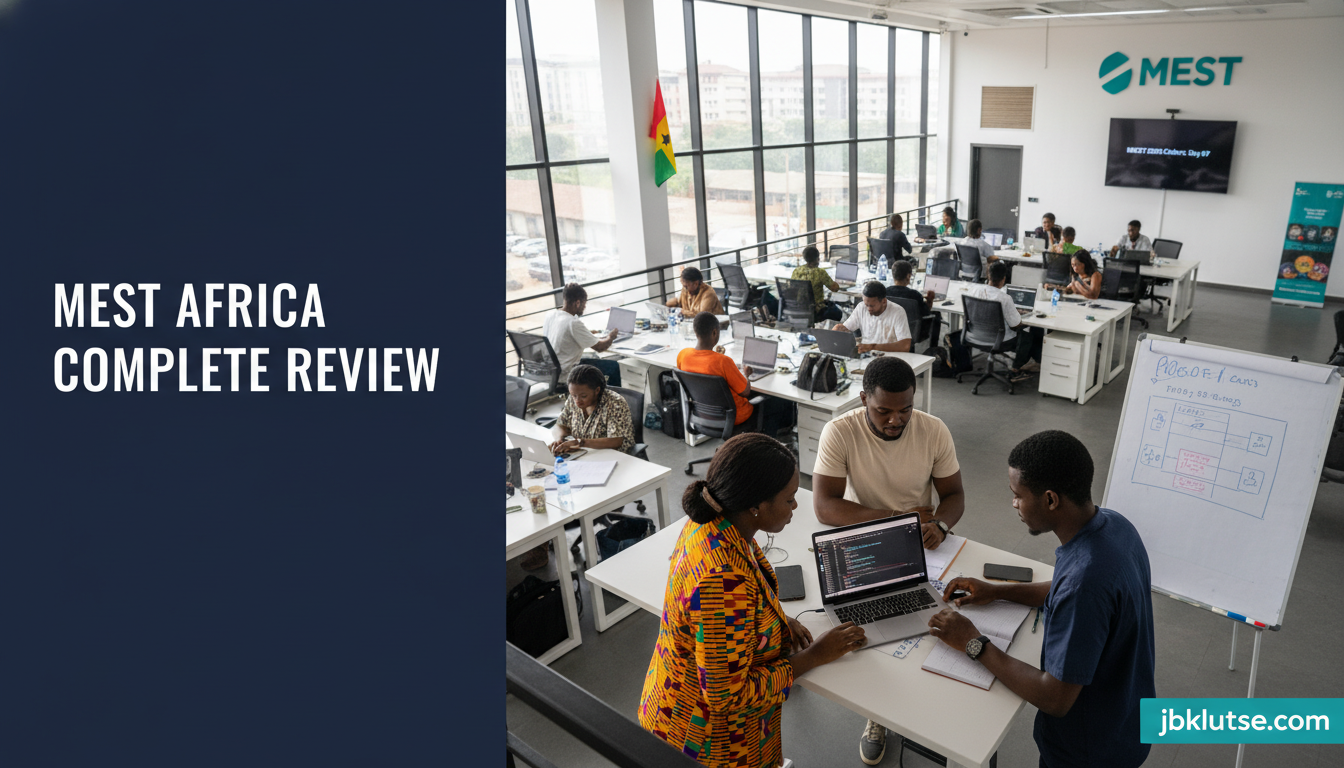
MEST’s Accra campus sits on Liberation Road, East Legon, a 15-minute Uber ride from Accra Mall. The building houses:
- Open-plan co-working space (100+ desks)
- Private meeting rooms (bookable via Slack channel)
- Event hall (capacity 150, used for pitch nights and Tech Meetups in Accra)
- Kitchen and lounge area
- 24/7 access for alumni (keycard entry after 6:00 PM)
Power backup via diesel generator during ECG outages (common in Accra). Internet provided by Vodafone Business Fibre (50 Mbps dedicated line, rarely drops below 40 Mbps).
Cost of Living During Training
MEST does not provide housing or stipends. Participants must cover rent, food, and transport for 12 months in Accra. Budget estimates for April 2026:
- Rent: GHS 1,200 to GHS 2,500/month (shared flat in Labone, Osu, or Haatso) (April 2026)
- Food: GHS 800 to GHS 1,500/month (cooking at home, occasional chop-bar meals) (April 2026)
- Transport: GHS 300 to GHS 600/month (trotro + Uber for campus commute) (April 2026)
- Miscellaneous: GHS 400/month (mobile data, social outings, laundry) (April 2026)
Total monthly burn: GHS 2,700 to GHS 5,000 (April 2026). Across 12 months, that’s GHS 32,400 to GHS 60,000 (April 2026). For Ghanaian participants outside Accra, relocation costs add GHS 5,000 to GHS 10,000 upfront (April 2026).
Some alumni report taking part-time freelance gigs (evenings and weekends) to supplement income, though MEST discourages this during Phase 1 due to the intensive coursework.
Regulatory and Tax Notes
Startups incorporated in Ghana through MEST typically register as private limited liability companies with the Registrar General’s Department. Incorporation costs roughly GHS 500 to GHS 1,500 (April 2026) depending on legal support. MEST connects teams with partner law firms (including Bentsi-Enchill, Letsa & Ankomah and Reindorf Chambers) for discounted rates.
Post-seed funding, startups must:
- Register with Ghana Revenue Authority for TIN and VAT (if turnover exceeds GHS 200,000 annually) (April 2026)
- File annual returns with RGD within 42 days of financial year-end
- Comply with data protection rules under Data Protection Act 2012 (Act 843) if handling personal data
MEST does not provide ongoing legal or tax advisory post-graduation, but alumni can access office hours with in-house counsel during the 24-month co-working window.
Who Should Apply
MEST suits:
- First-time founders with strong technical curiosity but no formal CS degree
- Career switchers from finance, consulting, or non-tech sectors wanting to build software products
- International applicants willing to relocate to Accra for 12 months (Ghana visa support provided)
- Team players comfortable with equity-sharing and long-term commitments
MEST is less ideal for:
- Solo founders unwilling to form teams (MEST strongly encourages 2 to 4 co-founders)
- Experienced entrepreneurs who have already raised seed funding or scaled to revenue (equity trade may not be worth it)
- Non-tech founders building brick-and-mortar or service businesses (MEST focuses on software and digital products)
- Part-time hustlers who cannot commit full-time for 12 months
Application Tips
Based on alumni feedback and published admission stats:
- Show, don’t tell. If you have a GitHub repo, a side project, a failed startup, or a product prototype, include links in your application. MEST values evidence over ambition.
- Be specific about the problem. Vague pitches like “connecting Africa through technology” fail. Specific problems like “Accra landlords lose GHS 50,000 annually to tenant fraud” succeed.
- Demonstrate learning velocity. If you’re non-technical, show what you’ve taught yourself (Codecademy certificates, freeCodeCamp progress, YouTube tutorials completed).
- Acknowledge the equity trade. In your essay, address why the 10% to 15% stake is fair. MEST wants founders who understand startup economics, not those blind to dilution.
- Prepare for the coding challenge. Even if you’re applying as a business co-founder, the assessment day includes a 60-minute JavaScript or Python problem. Practice on LeetCode or HackerRank beforehand.
Applications for the 2027 cohort open in June 2026. Shortlisting happens by September, with assessment days in October and final decisions in November. Cohort starts January 2027.
Criticisms and Controversies
MEST has faced scrutiny over:
- Equity terms perceived as steep. Some alumni publicly stated 15% was too high for what they received, especially teams that raised follow-on funding quickly and didn’t need MEST’s network.
- Limited sector diversity. Portfolio skews heavily toward fintech and logistics. Fewer agtech, healthtech, or climate startups. MEST defends this by saying applicants self-select for software-first ideas.
- Post-training engagement inconsistent. Alumni report mixed experiences with mentor availability after graduation. Some feel abandoned once they leave the building.
- Geographic imbalance. Despite five-country operations, Accra cohorts dominate (roughly 60% of total participants), raising questions about true pan-African access.
MEST’s 2025 annual report acknowledged these concerns and pledged to cap equity at 12% starting in 2027, expand healthtech and climate mentorship, and formalise alumni support through quarterly check-ins.
FAQs
Can I apply if I’m not based in Ghana?
Yes. MEST accepts applications from all African countries and the diaspora. Non-Ghanaians must relocate to Accra for the full 12 months. MEST assists with Ghana visa applications (typically a 1-year residence permit) but does not cover visa fees (roughly USD 300 to USD 500 (~GHS 3,327 to ~GHS 5,545 at April 2026 rates) depending on nationality).
Do I need a co-founder to apply?
No, but MEST strongly encourages forming teams during incubation. Solo applicants who get accepted often pair with other cohort members in Phase 2. Approximately 80% of portfolio companies have 2 to 4 co-founders.
What happens if my startup fails during the program?
You still graduate and receive the certificate. You do not receive seed funding. Failed teams can pivot to new ideas within the incubation window, but the investment committee evaluates the new idea separately. If you leave before completing 12 months, you forfeit access to MEST’s network and co-working space.
Does MEST take equity in side projects built before joining?
No. Equity applies only to companies formed during or after the program. If you join MEST with an existing startup, you can continue working on it, but MEST does not invest in pre-existing ventures. Most participants pause prior projects to focus on the curriculum.
How does MEST compare to Y Combinator or 500 Global?
Y Combinator and 500 Global are 3-month accelerators targeting startups with MVPs and early traction. They invest USD 125,000 to USD 500,000 (~GHS 1.386 million to ~GHS 5.545 million at April 2026 rates) for 7% to 10% equity. MEST is a 12-month training program for pre-MVP founders, investing USD 50,000 to USD 100,000 (~GHS 555,000 to ~GHS 1,109,000 at April 2026 rates) for 10% to 15%. YC and 500 Global assume you can code and sell. MEST teaches you to code and sell.
Can I work part-time while in the program?
MEST discourages part-time work during Phase 1 due to the intensity of the software bootcamp (8:00 AM to 5:00 PM daily, plus homework). Phase 2 offers more flexibility, and some participants freelance evenings to cover living costs. MEST does not prohibit it, but alumni report that balancing freelance gigs and startup incubation slows progress.
What is the visa situation for non-Ghanaians?
MEST sponsors 1-year residence permits for accepted international participants. You need a valid passport, proof of acceptance (MEST provides an invitation letter), yellow fever vaccination certificate, and application fees (USD 300 to USD 500, ~GHS 3,327 to ~GHS 5,545 at April 2026 rates). Processing takes 6 to 10 weeks. MEST’s admin team handles most of the paperwork. You cannot work for other companies on this visa; it’s tied to your participation in MEST.
Does MEST fund post-graduation follow-on rounds?
Rarely. MEST’s seed cheque is typically its only direct investment. However, MEST maintains relationships with VCs (including Novastar Ventures, Atlantica Ventures, and Launch Africa) and facilitates warm introductions for portfolio companies raising Series A. About 15% of MEST-backed startups have raised follow-on rounds exceeding USD 1 million (~GHS 11.09 million at April 2026 rates) as of April 2026.
Related Reads
- Zoom out: Startups & VC
- Topic hub: Ghana Tech Ecosystem: Hubs, Accelerators, Events
- Related deep-dives:
- Kosmos Innovation Center Review
- Ghana Tech Lab
- iSpace Foundation
- Tech Meetups in Accra: GDG, Developer Circles
Closing
MEST Africa remains one of the most rigorous and equity-intensive pathways into Ghana’s startup ecosystem. The 12-month commitment and 10% to 15% ownership trade won’t suit everyone, but for first-time founders with no technical background and no access to seed capital, MEST’s structured curriculum, mentorship network, and funding pipeline offer a viable launchpad. Acceptance rates below 3% mean competition is fierce, so applicants should prepare evidence of learning velocity, problem specificity, and team readiness. As Ghana’s startup scene matures and alternative accelerators like Kosmos Innovation Center and co-working hubs like iSpace expand, founders have more options than ever. MEST’s value proposition hinges on whether the equity you surrender today is worth the training, capital, and network you gain over the next 12 months.
Follow our updates on X at @jbklutsemedia.
Sources
- MEST Africa official site: meltwater.org
- MEST 2025 Annual Report (PDF), published March 2026
- Interviews with MEST alumni (April 2026)
- Registrar General’s Department company incorporation fees: rgd.gov.gh
- Ghana Immigration Service visa requirements: gis.gov.gh