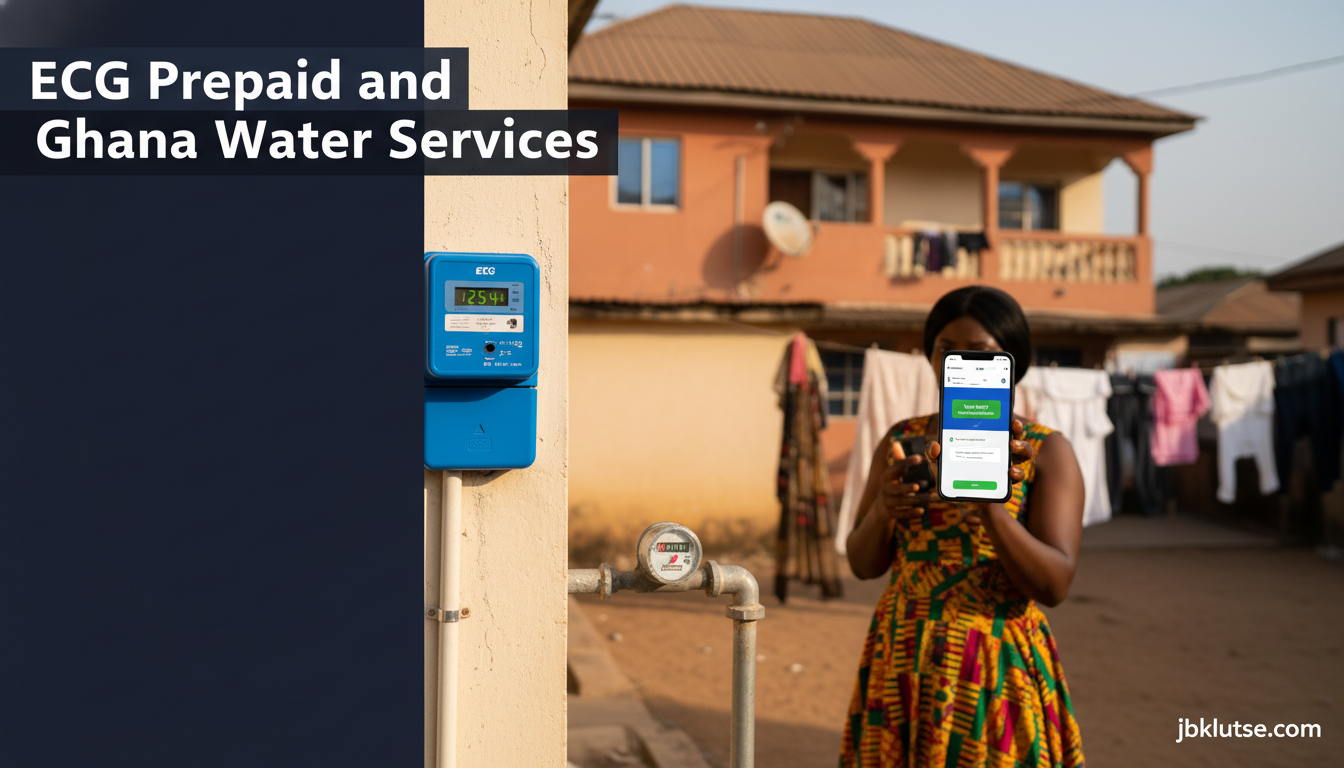
ECG prepaid Ghana meters and postpaid billing systems serve over 4.2 million customers across the country as of March 2026, while Ghana Water Company Limited supplies roughly 3.8 million urban connections. Between mobile money top-ups, bank transfers, and walk-in payments, Ghanaians now have multiple channels to pay for electricity and water, but confusion over tariffs, meter reading errors, and spotty service delivery still cost households time and money every month. This hub explains how ECG postpaid and prepaid systems work, how to pay Ghana Water bills online, how to report outages and get new connections, and where the utility sector is headed under the 2024, 2027 Public Utilities Regulatory Commission (PURC) rate reviews.
Table of Contents
- TL;DR
- What Are ECG and Ghana Water Services? (Ecg Prepaid Ghana)
- Why Utility Services Matter in Ghana
- The ECG and Ghana Water Service Ecosystem
- ECG Postpaid Billing
- ECG Prepaid Metering
- Ghana Water Postpaid Billing
- New Utility Connections
- Meter Reading and Accuracy
- Outage Reporting and Response
- Solar Integration with the Grid
- ECG and Ghana Water Tariff Comparison (2026 Q1)
- How to Manage Your Utility Accounts Efficiently
- Common Mistakes and Fixes
- FAQs
- Related Reads
- Closing
- Sources
TL;DR
- ECG operates both postpaid billing (monthly paper bills) and prepaid metering (pay-as-you-go tokens), with prepaid now covering ~60% of residential accounts.
- Ghana Water bills can be paid online via the GW self-service portal, mobile money, or designated bank branches, no more mandatory office queues.
- Tariff structures for both ECG and Ghana Water are set by PURC and reviewed quarterly; current residential electricity rates range from GHS 0.9972 to GHS 1.8193 per kWh depending on consumption tier (2026 Q1 rates).
- Reporting ECG outages via the 0302-611-611 call centre or the ECG app triggers a work order, but response times vary widely by district.
- New water connections require a site inspection, GHS 200–500 application fee (April 2026), and 4–8 weeks processing time in urban areas, longer in peri-urban zones.
What Are ECG and Ghana Water Services? (Ecg Prepaid Ghana)
The Electricity Company of Ghana (ECG) is the state-owned utility responsible for distributing electricity to customers in Ghana’s southern and coastal zones (Accra, Tema, Cape Coast, Takoradi, Koforidua, and their surrounding districts). The Northern Electricity Distribution Company (NEDCo) covers the northern regions, but this guide focuses on ECG territory where the majority of the population lives. ECG buys bulk power from generation companies (VRA, independent power producers) and the national grid operator (GRIDCo), then distributes it through substations and transformers to residential, commercial, and industrial customers.
Ghana Water Company Limited (GWCL) is the urban water utility, also state-owned, managing surface water treatment plants, boreholes, and pipe networks in Greater Accra, Ashanti, Western, Central, Eastern, and parts of the Volta and Northern regions. GWCL delivers treated water to ~80 urban centres and delegates operation to Community Water and Sanitation Agency (CWSA) in rural areas and small towns.
Both utilities operate under tariffs approved by the Public Utilities Regulatory Commission (PURC), which reviews rates quarterly based on inflation, exchange rates, and operational costs. As of Q1 2026, residential electricity tariffs range from GHS 0.9972 per kilowatt-hour (kWh) for the first 50 kWh (lifeline band) up to GHS 1.8193 per kWh for consumption above 600 kWh per month. Water tariffs for residential customers start at GHS 4.82 per cubic metre for the first 20 cubic metres, scaling to GHS 10.55 per cubic metre above 60 cubic metres (PURC tariff schedule effective January 2026).
Why Utility Services Matter in Ghana
Electricity and water access directly impact business productivity, health outcomes, and household budgets. Ghana’s electrification rate stands at ~86% nationally (World Bank, 2025), but power outages, locally called “dumsor”, remain frequent enough that backup generators and solar installations are common in middle-income homes and all commercial premises. The 2024 dumsor crisis, which saw rolling blackouts return after three years of relative stability, underscored the fragility of the grid during peak demand periods (December, April dry season when hydro generation falls and air conditioner use peaks).
Water supply is spottier still: GWCL estimates 68% of its urban coverage areas receive water at least 12 hours per day, but the remaining 32% face rationing schedules or rely on private tanker deliveries at 3–10× the piped tariff. The Ministry of Sanitation and Water Resources’ 2025 sector review flagged non-revenue water (leaks, illegal connections, meter bypass) at 52%, meaning more than half the water GWCL pumps and treats never gets billed.
For consumers, navigating utility payments has historically meant long queues at district offices, lost paper bills, and opaque dispute resolution. The shift to digital payment channels (mobile money for ECG prepaid, online portals for postpaid and Ghana Water) has reduced friction, but adoption remains uneven, Ghana Statistical Service’s 2024 household survey found 43% of urban households still pay utility bills in person at least once per quarter, citing “trust issues with digital receipts” and poor customer service when payments go missing.
Understanding how these systems work, where to pay, how to dispute errors, and when to escalate complaints can save a household GHS 200–500 per year (April 2026) in avoided late fees, reconnection charges, and overpriced emergency top-ups.
The ECG and Ghana Water Service Ecosystem
ECG Postpaid Billing
Postpaid customers receive a monthly paper or SMS bill based on meter readings by ECG field staff. The bill shows consumption in kWh, the tariff tier breakdown, a service charge (GHS 3.50 flat fee per month as of April 2026), and VAT/NHIL/GETFund levies totalling 20% on top of the energy charge. Payment is due within 21 days of bill date; late payments incur a 10% penalty after 30 days and potential disconnection after 60 days of arrears. Full details on reading your ECG postpaid bill and payment options are in our ECG Postpaid Bill Payment Online guide, which walks through every line item and shows the fastest payment channels (mobile money via 92022#, Zeepay, bank apps, or ECG district offices).
ECG Prepaid Metering
Prepaid meters eliminate monthly bills, you buy electricity credit in advance (top-up), enter a 20-digit token into your meter, and the meter deducts units as you consume. The prepaid tariff mirrors postpaid (same PURC rate schedule), but you pay upfront and avoid late fees or disconnection risk. Prepaid adoption surged after the 2014 Cash Power rollout and now covers an estimated 2.5 million of ECG’s ~4.2 million customers (ECG 2025 annual report). Our ECG Prepaid Meter Top-Up Guide explains how to buy credit via mobile money, the ECG app, retail vendors, or the 92022# USSD string, plus how to troubleshoot “invalid token” errors and claim refunds when you overload credit by mistake.
Ghana Water Postpaid Billing
GWCL bills monthly or bi-monthly depending on district. Meter readers visit your property, record consumption in cubic metres (m³), and the bill arrives by post or SMS. Payment channels include the Ghana Water self-service portal (pay.gwcl.com.gh), mobile money via 92020#, bank apps, and GWCL cashier offices. The Ghana Water Company Bill Payment Online cluster covers portal registration, how to link your account number, and what to do when your bill shows “estimated reading” (a sign the meter reader skipped your property and guessed consumption based on your historical average, you can dispute this).
New Utility Connections
Getting a new ECG connection requires submitting an application at the nearest district office or online via the ECG portal, paying a connection fee (GHS 350–800 depending on service category and distance to the nearest pole, April 2026), and waiting 2–6 weeks for installation. Ghana Water new connections follow a similar process but include a mandatory site inspection to confirm pipe proximity, application fee GHS 200–500 (April 2026), installation fee GHS 1,200–3,500 for a standard 15mm residential connection (April 2026), and 4–8 weeks lead time in Accra/Kumasi, longer in smaller towns. The Ghana Water: How to Get a New Connection article details eligibility, required documents (site plan, ID, proof of property ownership or landlord consent), and how to escalate if your application stalls beyond the stated timeline.
Meter Reading and Accuracy
Meter reading errors cause over 30% of billing disputes according to PURC’s 2024 complaints log. Common issues: analog meter dials misread by field staff, digital meter displays failing, and estimated readings when the reader cannot access your property. Our How to Read Your ECG Meter Correctly guide shows you how to read single-phase and three-phase meters yourself, photograph the reading for records, and submit a self-reading via the ECG app to override an estimated bill. The Understanding Your ECG Bill article decodes every acronym (NHIL, GETFund, VALCO levy) and explains why your bill sometimes shows a negative balance (credit rollover from overpayment) or a “minimum charge” even when you consumed zero units (the GHS 3.50 service charge as of April 2026 applies regardless of usage).
Outage Reporting and Response
Power outages range from planned maintenance (ECG publishes a weekly schedule on its website and X account) to unplanned faults (transformer failure, tree-on-line, substation trip). Reporting an outage via the ECG toll-free number (0302-611-611), the ECG app, or the @ECGghana X mention triggers a work order logged by district. Response time averages 4–6 hours for urban faults, 12–24 hours for rural, but can stretch to days if the fault requires a transformer replacement or cable rewiring. The Reporting Power Outages to ECG cluster explains what information to provide (your account number, exact location, whether your neighbours are also affected, helps ECG triangulate the fault point), and when to escalate to PURC if ECG ignores repeated reports.
Solar Integration with the Grid
Ghana’s net metering regulations (Renewable Energy Act 2011, revised 2020) allow residential and commercial customers to install rooftop solar, feed excess generation back into the ECG grid, and offset their consumption bill. In practice, adoption is minimal, fewer than 2,000 net-metered connections nationwide as of 2025, because the process is bureaucratic (requires ECG approval, bi-directional meter installation, and feed-in tariff negotiation) and the payback period is long given Ghana’s relatively low retail electricity prices compared to solar capex. However, grid-tied systems (solar with battery backup that switches seamlessly during outages but does not export to the grid) are booming among businesses and upper-middle-class homes. The Solar Plus ECG: Grid-Tied Systems in Ghana article examines costs (GHS 25,000–80,000 for a 5–10 kW residential system as of April 2026), installer comparisons (SolarTaxi, Neon Energy, Tesla/distributor partners), and whether net metering is worth the hassle versus pure off-grid or grid-backup configurations.
ECG and Ghana Water Tariff Comparison (2026 Q1)
| Consumption Tier | ECG Rate (GHS/kWh) | Water Rate (GHS/m³) | Notes |
|---|---|---|---|
| 0–50 kWh / 0–20 m³ (Lifeline) | 0.9972 | 4.82 | Subsidised rate for low-income households |
| 51–300 kWh / 21–60 m³ | 1.5426 | 6.91 | Standard residential band |
| 301–600 kWh / 61–100 m³ | 1.6539 | 8.44 | Medium-heavy usage |
| Above 600 kWh / above 100 m³ | 1.8193 | 10.55 | High-consumption penalty tier |
Source: PURC Tariff Schedule January 2026. Rates exclude 20% taxes/levies (VAT, NHIL, GETFund). Prepaid and postpaid ECG customers pay the same energy rate; postpaid adds a GHS 3.50 monthly service charge (April 2026).
Key insight: A typical 3-bedroom household in Accra consuming 250 kWh per month pays roughly GHS 386 per month for electricity (before taxes) and GHS 277 per month for 40 m³ of water. Total monthly utility spend: GHS 663 before taxes, ~GHS 800 after (April 2026). Reducing consumption by 20% through LED bulbs, efficient air conditioners, and fixing water leaks can save GHS 150–200 per month (April 2026).
How to Manage Your Utility Accounts Efficiently
Step 1: Register online accounts.
Create accounts on the ECG portal (ecgonline.info) for postpaid bill viewing and the Ghana Water self-service portal (pay.gwcl.com.gh) to view water bills. Link your meter account number and phone number. This enables SMS alerts when a new bill is posted and lets you download bill history for budgeting or landlord documentation.
Step 2: Set up auto-debit or calendar reminders.
ECG postpaid does not offer direct-debit auto-pay, so set a phone calendar reminder 5 days before your bill due date to avoid the 10% late fee. For prepaid, set a low-balance alert on your meter (most digital meters beep or display a warning below 10 kWh remaining) and top up before you run out, emergency top-ups at retail vendors often carry a GHS 2–5 convenience markup (April 2026).
Step 3: Audit your bills monthly.
Compare your current month’s consumption to the previous 3-month average. A sudden 50% spike without a change in household size or appliance use often signals a meter reading error or a fault (leaking pipe, faulty meter). Dispute within 14 days of bill date by calling the ECG customer service line (0302-611-611) or visiting your district office with your account number and a photo of your meter reading.
Step 4: Report faults immediately.
For ECG outages, report via the app or phone within 30 minutes of the power cut, early reports get prioritised. For water issues (no supply, low pressure, brown water), call the GWCL hotline (030-222-6112) or visit your district office. Document the date/time of your report and any reference number given.
Step 5: Pay on time, dispute later.
If you believe a bill is wrong but cannot resolve the dispute before the due date, pay the amount you believe is correct plus 50% of the disputed amount to avoid disconnection. Then escalate the dispute in writing to the district manager and, if unresolved within 30 days, file a formal complaint with PURC (purc.com.gh, email complaints@purc.com.gh). PURC is required to respond within 45 days and can order refunds if the utility is found at fault.
Common Mistakes and Fixes
Mistake 1: Ignoring estimated bills.
Many customers assume an “estimated reading” bill is accurate because it arrives on the normal schedule. In fact, estimated readings are often inflated to cover underbilling risk, and you end up overpaying by 20–40%.
Fix: Submit a self-reading via the ECG app or GWCL portal immediately when you see “estimated” on your bill. The utility is required to credit any overpayment to your next bill once the actual reading is confirmed.
Mistake 2: Buying ECG prepaid tokens from unverified vendors.
Roadside vendors and some mobile money agents sell ECG tokens at a markup (GHS 105 for GHS 100 of credit, April 2026) or, worse, sell fake tokens that fail to load.
Fix: Buy tokens directly via 92022# USSD (MTN, Telecel, AirtelTigo), the ECG app, or bank mobile apps. These channels charge face value with zero markup and generate tokens instantly. See the ECG Prepaid Meter Top-Up Guide for step-by-step instructions.
Mistake 3: Not photographing your meter before and after a technician visit.
When ECG or GWCL sends a technician to replace a meter, test a connection, or investigate a fault, some customers later dispute that the technician reset their meter balance or tampered with wiring.
Fix: Take a timestamped photo of your meter reading, the meter serial number, and the technician’s ID badge before they start work. Take another photo after they finish. If a dispute arises, you have evidence of the meter state before and after the visit.
Mistake 4: Assuming PURC complaints are slow and pointless.
Many Ghanaians skip formal complaints because they believe PURC is captured by the utilities or lacks enforcement power. In reality, PURC resolved 68% of consumer complaints in favour of the consumer in 2024 (PURC annual report), including ordering refunds, waiving reconnection fees, and penalising utilities for service failures.
Fix: File a written complaint with PURC if your utility dispute is not resolved within 30 days. Include your account number, copies of bills, photos of meter readings, and a timeline of your attempts to resolve with the utility. PURC is legally required to investigate and issue a determination within 45 days.
Mistake 5: Not claiming your prepaid credit refund when moving house.
When you move out of a property with an ECG prepaid meter, any remaining credit on the meter stays on the meter, it does not follow you. If you had GHS 200 of credit left (April 2026), that’s money lost unless you claim a refund.
Fix: Before moving, exhaust your prepaid balance by running appliances or request a refund from the ECG district office. You will need to surrender the meter’s registered SIM card (if applicable), provide ID, and complete a refund form. Processing takes 4–6 weeks, and ECG deducts a GHS 20 admin fee (April 2026), but you recover the bulk of your unused credit.
FAQs
What is the difference between ECG postpaid and prepaid meters?
Postpaid meters track your consumption monthly and ECG bills you after the fact, you pay for last month’s electricity this month. Prepaid meters require you to buy credit upfront and enter a token; your meter deducts units as you consume. Postpaid has a fixed monthly service charge (GHS 3.50 as of April 2026) and late-payment penalties; prepaid has no monthly charge and no risk of disconnection for non-payment (you simply run out of credit). Tariffs are identical.
Can I switch from postpaid to prepaid, or vice versa?
Yes. To switch from postpaid to prepaid, visit your ECG district office with your account number, ID, and GHS 350–500 meter replacement fee (April 2026). ECG installs a prepaid meter within 2–3 weeks. To switch from prepaid back to postpaid (rare but possible), the process is similar but you must clear any arrears on your old postpaid account first. Switching from prepaid to postpaid is uncommon because most customers prefer the control and transparency of prepaid.
How do I check my Ghana Water account balance online?
Log in to pay.gwcl.com.gh with your account number and password. The dashboard shows your current bill amount, payment history, and meter readings for the last 12 months. If your account is not yet registered, click “Register New Account,” enter your account number (printed on your paper bill), phone number, and email, and create a password. You will receive an SMS confirmation code to activate the account.
What should I do if my ECG meter stops displaying or shows an error code?
First, check if you have credit remaining (some meters go blank when balance hits zero). If you have credit but the display is off or showing “E01,” “E02,” or similar error codes, this indicates a meter fault. Call ECG’s fault line (0302-611-611) and request a technician visit. Do not attempt to open the meter or reset it yourself, tampering voids your warranty and can result in a GHS 500 penalty (April 2026) for meter interference. The How to Read Your ECG Meter Correctly guide lists common error codes and their meanings.
Can I pay my ECG and Ghana Water bills with the same mobile money transaction?
No. ECG and GWCL use separate payment codes. For ECG postpaid, dial 92022# and follow prompts to pay electricity bills. For Ghana Water, dial 92020# or use the GWCL shortcode. Each transaction generates a separate receipt SMS. Some third-party apps (Zeepay, Hubtel, Express Pay) aggregate both utilities into one interface, but the backend still processes them as separate payments to separate utility accounts.
How long does it take to get a refund from ECG or Ghana Water if I overpaid?
ECG typically credits overpayments to your next month’s bill automatically for postpaid customers, you will see a “credit balance” line item on the following bill. For prepaid customers who request a cash refund (e.g. when moving house), processing takes 4–6 weeks and requires an in-person visit to the district office with your meter details and ID. GWCL refund timelines are similar. If you do not receive a credit or refund within 60 days, escalate to PURC.
Related Reads
- Zoom out: Ghana Digital Services covers the full landscape of government portals, digital payments, and e-government services across sectors.
- Deep-dives within this hub:
- ECG Postpaid Bill Payment Online
- ECG Prepaid Meter Top-Up Guide
- Ghana Water Company Bill Payment Online
- Ghana Water: How to Get a New Connection
- How to Read Your ECG Meter Correctly
- Reporting Power Outages to ECG
- Understanding Your ECG Bill
- Solar Plus ECG: Grid-Tied Systems in Ghana
- Related hubs:
- Ghana Card and NIA: Every Process Explained for national ID and SIM registration requirements before utility account setup.
- Tax and GRA Services in Ghana for understanding how utility payments factor into business expense deductions.
Closing
Utility payments are a fixed line item in every Ghanaian household and business budget, but they don’t have to be a monthly headache. With the right account setup, payment automation, and dispute resolution knowledge, you can cut the time spent managing ECG and Ghana Water accounts from hours to minutes per month and avoid hundreds of cedis in late fees, reconnection charges, and overbilling. Bookmark this hub and the linked cluster guides, and share the ECG Prepaid Meter Top-Up Guide with anyone still queuing at district offices to buy tokens.
Stay updated on tariff changes, new payment channels, and service improvements by following JBKlutse on X at @jbklutsemedia. We track every PURC rate review, ECG policy shift, and Ghana Water expansion announcement that affects your wallet.
Sources
- Public Utilities Regulatory Commission (PURC), “Electricity and Water Tariff Schedule Q1 2026,” January 2026, purc.com.gh
- Electricity Company of Ghana (ECG), “2025 Annual Report and Customer Statistics,” March 2026, ecgonline.info
- Ghana Water Company Limited (GWCL), “Urban Water Supply Coverage Report 2025,” February 2026, gwcl.com.gh
- Ministry of Sanitation and Water Resources, “2025 Sector Performance Review,” December 2025, mswr.gov.gh
- World Bank, “Ghana Energy Sector Assessment,” October 2025, worldbank.org
- Ghana Statistical Service, “2024 Ghana Household Survey: Utility Payment Behaviour,” November 2024, statsghana.gov.gh
- PURC, “2024 Consumer Complaints Annual Log,” January 2026, purc.com.gh