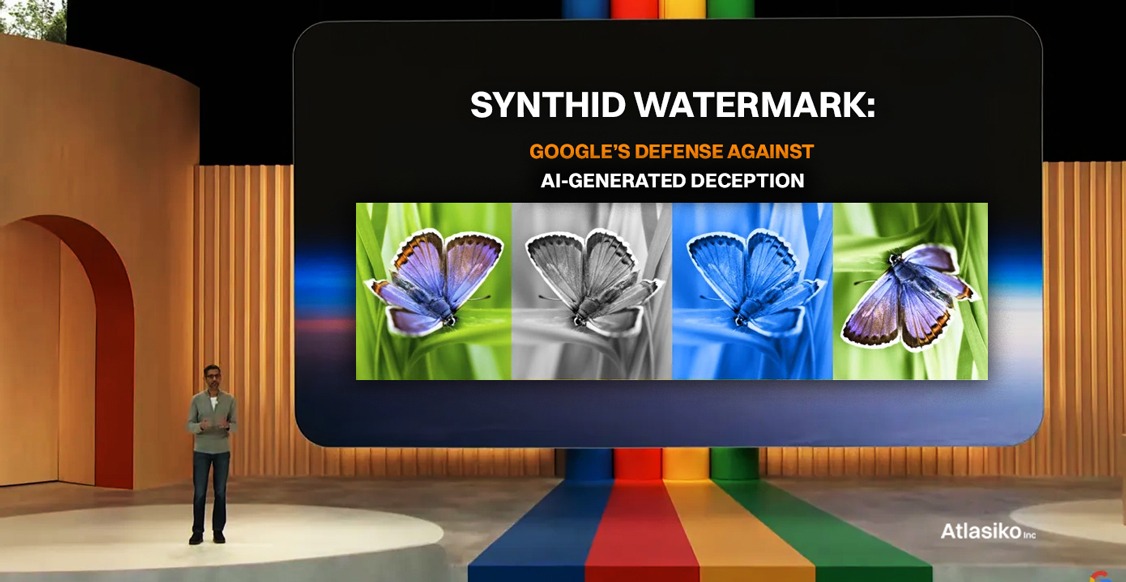
Artificial intelligence is getting so good at creating fake images that telling real from fake is now harder than ever. Google DeepMind has built a tool called SynthID to solve this problem, and it works in a way most people won’t notice but computers will easily spot.
Here’s what you need to know about how it works and what it means for you as someone navigating the web in Ghana.
What exactly is SynthID?
SynthID is an invisible digital watermark that Google embeds directly into AI-generated images at the moment they’re created. Unlike visible watermarks you might see stamped on a photo, this one is hidden inside the pixel data itself, so the image looks exactly the same to your eye.
Think of it like marking your Ghana Card with a hidden security feature that only special equipment can verify. The watermark encodes information that proves “this image came from a Google AI tool.”
Google launched SynthID in August 2023, starting with select users of Imagen (Google’s image-generation model). By May 2025, the watermark had been applied to over 10 billion pieces of content across images, videos, audio, and text.
How does it actually work?
For images, SynthID uses two separate systems working together.
First, a watermarking model takes the freshly generated image and makes extremely tiny adjustments to individual pixels. These changes are so small your eyes will never catch them, but they embed a specific pattern into the image. It’s like adjusting the brightness of one pixel by 1%, repeated thousands of times in a precise way.
Second, a detection model scans an image and looks for this hidden pattern. Upload an image to Google’s SynthID Detector tool (now available to the public), and it tells you whether it carries the watermark and was likely generated by a Google AI tool.
The watermark is also tough to accidentally destroy. Google tested it against common things that happen to images: JPEG compression (when you screenshot and re-upload), resizing, brightness changes, and light cropping. The watermark survives all of these, so you can’t accidentally erase it through normal use.
What about text, video, and audio?
Watermarking text works differently because text has no pixels to tweak. Instead, when an AI language model like Gemini generates text, SynthID subtly shifts which words and phrases it picks from the available options, creating a detectable pattern that readers won’t notice.
Google open-sourced this text watermarking system, allowing other companies to use it in their own AI.
Industry adoption beyond Google
While other companies have started to adopt SynthID watermarks, the technology is gradually expanding beyond Google’s own products. The open-sourcing of the text watermarking system suggests Google is positioning SynthID as a potential industry standard, though widespread implementation across AI platforms remains an ongoing process.
What SynthID cannot do
SynthID only detects images that were watermarked at creation. If an AI tool doesn’t use SynthID, the Detector won’t find a watermark, and you won’t know if it’s real or fake.
The watermark also isn’t bulletproof. If someone deliberately tries to remove it using aggressive filters or image-editing techniques, they have a reasonable chance of succeeding. Google itself acknowledges this openly.
SynthID is not a replacement for human judgment or other verification methods. Think of it as one helpful layer, not the whole solution.
Why this matters for Ghana
Deepfakes and AI-generated scam images are already circulating in West Africa. Fake celebrity endorsement images, forged banking screenshots, and manipulated news photos can spread quickly on WhatsApp and Facebook, causing real harm.
A widespread watermarking standard could make it easier for ordinary Ghanaians to verify whether an image they’re about to share or trust actually came from a real camera or an AI. Over time, if every major AI tool embeds SynthID or similar watermarks, spotting AI-generated fakes becomes much simpler.
What you should do
When you see an image on social media or in a message that seems suspicious, you can now upload it to Google’s SynthID Detector to check if it carries a watermark. If it does and the tool says it’s from a Google model, you know for certain it’s AI-generated.
If the detector finds no watermark, it doesn’t mean the image is real—it could be a real photo, an older AI image, or an image from a non-Google AI tool.
Stay skeptical, verify important claims with trusted sources, and remember: watermarks are just one tool in spotting misinformation.



Leave a Reply