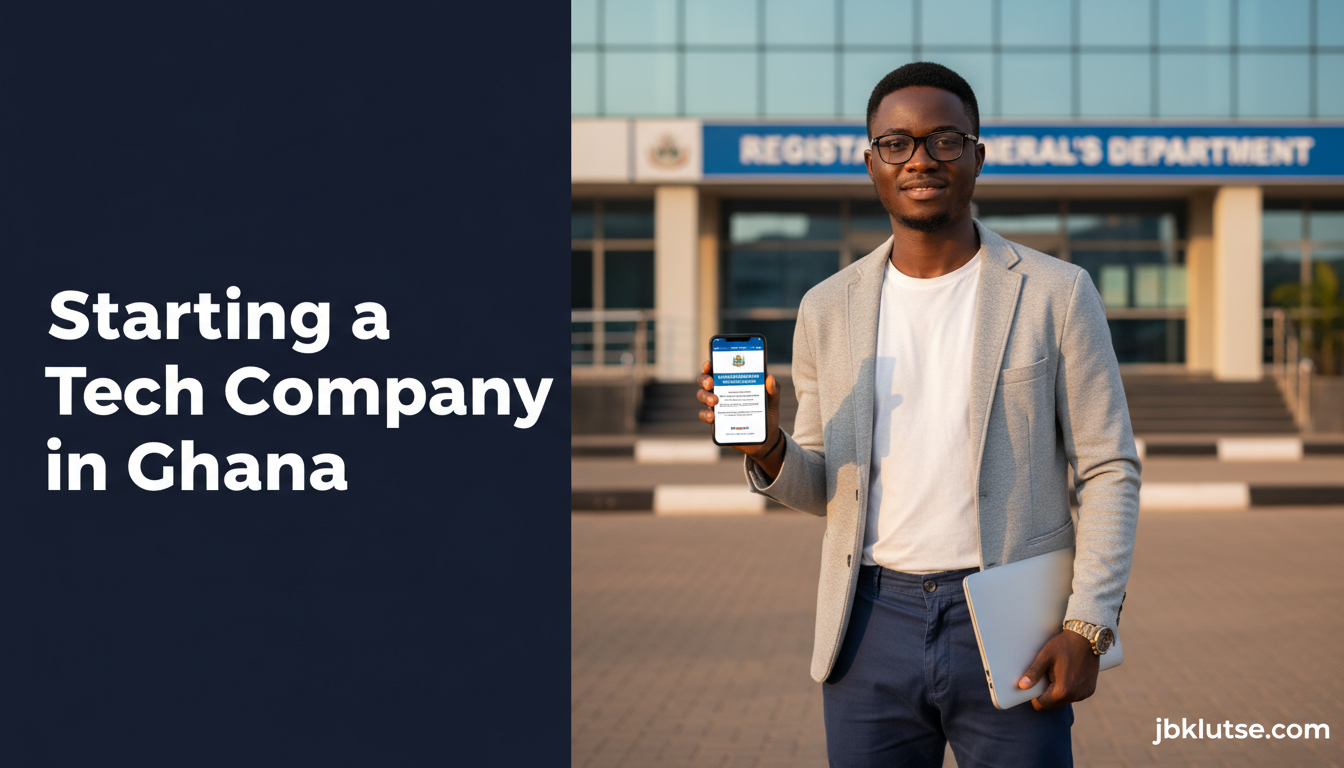
When you start tech company Ghana, you face three decisions in the first 30 days: where to register your entity (Ghana vs offshore), which business structure gives you flexibility for VC funding later, and how to set up banking that supports mobile money collections and USD invoicing. This guide walks through every operational step from name reservation at the Registrar General’s Department to shipping your first MVP, with costs in cedis, timelines, legal traps to avoid, and founder stories showing what actually works in Accra, Kumasi, and Takoradi as of April 2026.
Table of Contents
- TL;DR
- What Is the Ghana Startup Registration Process?
- Why Registration Structure Matters in Ghana
- The Startup Launch System: Five Phases
- Phase 1: Idea Validation and Co-Founder Alignment (Week 0–4)
- Phase 2: Legal Registration (Week 5–8)
- Phase 3: Infrastructure Setup (Week 9–10)
- Phase 4: Team Assembly (Week 11–16)
- Phase 5: Product Launch (Week 17–26)
- Comparison: Ghana vs Delaware for Tech Founders
- How to Choose Your Business Structure in Ghana
- Common Mistakes and Fixes
- Mistake 1: No Shareholder Agreement
- Mistake 2: Wrong Entity for Fundraising
- Mistake 3: No Vesting Schedule
- Mistake 4: Mixing Personal and Business Finances
- Mistake 5: Ignoring GRA Deadlines
- FAQs
- Related Reads
- Closing
- Sources
TL;DR
- Register locally via RGD as Private Limited Company by Shares if staying Ghana-focused, Delaware C-Corp via Stripe Atlas if raising US VC
- Budget GHS 1,200–2,500 for Ghana registration (including lawyer, tax clearance, name search) (April 2026), USD 500–1,000 (~GHS 5,545–11,090 at April 2026 rates) for Delaware via Atlas
- Open Stanbic or Zenith for cedi ops, Chipper or Flutterwave for USD collections
- Avoid the 5 common legal mistakes: no shareholder agreement, no vesting schedule, wrong entity structure for fundraising, mixing personal and company accounts, ignoring GRA deadlines
- Ship an MVP in 60–90 days using no-code tools or one contract engineer before burning cash on a full team
What Is the Ghana Startup Registration Process?
When founders talk about “starting a tech company in Ghana,” they mean registering a legal entity with the Registrar General’s Department that can own assets, sign contracts, employ staff, open bank accounts, and receive investment. The default structure for tech startups is a Private Limited Company by Shares (Ltd.), which gives you limited liability, separates personal finances from business finances, and allows you to issue shares to co-founders and investors.
As of April 2026, there are 47,000+ registered companies in Ghana per RGD filings, with 12% classified as “information and communication” sector (includes software, fintech, media). Only 200–300 of those receive any venture funding annually, mostly concentrated in Accra, according to AVCA data. The rest are bootstrapped or dead.
Why Registration Structure Matters in Ghana
Your entity choice determines whether you can legally raise venture capital, qualify for accelerator programs like MEST or Meltwater, hire remote talent, and invoice international clients. Get it wrong and you face expensive restructuring later, or you lose deals because your cap table is a mess.
Two structural paths dominate for Ghanaian tech founders:
1. Ghana Private Limited Company for local-market SaaS, fintech, e-commerce, and services targeting West Africa
2. Delaware C-Corp (with Ghana subsidiary if needed) for founders targeting US/global VCs or building pan-African platforms from day one
The split between these two paths happened around 2018–2020 when Stripe Atlas made Delaware incorporation cheap and fast, and Y Combinator started funding more African teams who needed US entities for investment docs. Before that, everyone incorporated in Ghana first, then flipped to Delaware when fundraising, which burned GHS 15,000–40,000 in legal fees per founder.
Recent regulatory clarity from the Bank of Ghana (BoG) and Ghana Revenue Authority (GRA) has made hybrid structures (Delaware parent, Ghana subsidiary) easier. You can now repatriate dividends and management fees without customs hassles if your paperwork is clean. See our full breakdown of Ghana vs Delaware structures.
The Startup Launch System: Five Phases
Launching a tech company in Ghana breaks into five sequential phases. Skip one and you create technical debt or legal risk.
Phase 1: Idea Validation and Co-Founder Alignment (Week 0–4)
Before filing paperwork, align with co-founders on:
– Equity split (use our cap table template)
– Vesting schedule (standard is 4-year vest, 1-year cliff)
– Role definitions (who is CEO, who is CTO, who handles ops)
– Incorporation location (Ghana vs Delaware)
Document this in a Founder Agreement. Don’t wait for a lawyer. Use a template from Y Combinator or MEST, sign it, and refine it with counsel later. Many Ghanaian founding teams blow up in Year 2 because they never wrote down who owns what.
Phase 2: Legal Registration (Week 5–8)
Register your startup with the Registrar General’s Department if going the Ghana route. The process takes 7–14 business days if you use a lawyer, 4–6 weeks if you do it yourself via the RGD portal.
Steps for Ghana registration:
1. Name search (GHS 100, 48 hours, rgd.gov.gh)
2. Reserve name (GHS 50, valid 30 days)
3. File incorporation forms (Statement and Particulars of Directors, form RGD 1A, Constitution/Articles)
4. Pay incorporation fee (GHS 300 base + GHS 2 per GHS 1,000 stated capital, capped at GHS 10,000)
5. Get Tax Identification Number (TIN) from GRA (free, same day if RGD submits electronically)
6. Register with Social Security and National Insurance Trust (SSNIT) for payroll (GHS 200)
7. Open business bank account (see banking guide)
All-in cost: GHS 1,200–2,500 including lawyer fees (April 2026). Timeline: 10–21 days.
Delaware via Stripe Atlas: USD 500 (~GHS 5,545 at April 2026 rates) incorporation + registered agent (USD 300/year, ~GHS 3,327 at April 2026 rates), EIN from IRS (free, 2 weeks), done remotely. No physical presence required. Mercury or Brex for banking. Timeline: 7–10 days.
Phase 3: Infrastructure Setup (Week 9–10)
Banking: Open a cedi account at Stanbic, Zenith, or Fidelity. Budget 3–5 business days for account approval. Bring incorporation cert, TIN letter, directors’ IDs, business plan (1-page summary is fine). See which banks support startups best.
Domain and brand: Register your .com and .com.gh via Namecheap or Crazy Domains Ghana. Cost: USD 12/year (~GHS 133 at April 2026 rates) for .com, GHS 150/year for .com.gh. Don’t skip trademark search at the Ghana Trademarks Office if your name is distinctive.
Financial tools: QuickBooks Online (USD 120/month, ~GHS 1,331 at April 2026 rates) or Wave (free) for accounting. Pesewa for invoicing mobile money customers. Flutterwave or Paystack for card payments.
Legal docs: Shareholder Agreement, Employee IP Assignment templates, NDA for contractors. Use YC’s SAFE templates adapted for Ghana law, or hire a Ghanaian tech lawyer (GHS 3,000–8,000 for a full startup pack, April 2026). Avoid copy-pasting US templates that reference Delaware law.
Phase 4: Team Assembly (Week 11–16)
Hire your first engineer as a contractor, not full-time employee, until you have 6 months runway. Use Upwork, JBKlutse Jobs, or MEST alumni network. Budget GHS 3,000–8,000/month for mid-level full-stack engineer in Accra (April 2026).
Equity for early hires: 0.5%–2% with 4-year vest is standard for the first 3 non-founder engineers. Use option pool (10%–15% of cap table reserved for future hires). Document via Employee Stock Option Plan.
Common hiring mistake: Bringing on 5 people before product-market fit. Stay lean. The MVP shipping timeline assumes 1 founder who codes + 1 contract designer.
Phase 5: Product Launch (Week 17–26)
Ship your MVP in 60–90 days using no-code (Bubble, Webflow, Flutterwave for payments) or low-code (React + Supabase + Vercel). Don’t build native apps first. Mobile web is fine for 80% of Ghanaian users.
Launch checklist:
– Landing page with waitlist (Carrd or Webflow, GHS 0–200)
– Payment integration (Paystack or Flutterwave, 2.5% transaction fee)
– Customer support (WhatsApp Business or Zendesk, free tier)
– Analytics (Google Analytics 4 + Hotjar for session recordings)
– Legal pages (Privacy Policy, Terms of Service, Refund Policy)
Go live with 10 design partners, not 1,000 strangers. Get feedback. Iterate weekly.
Comparison: Ghana vs Delaware for Tech Founders
| Factor | Ghana Private Ltd | Delaware C-Corp |
|---|---|---|
| Setup cost | GHS 1,200–2,500 (lawyer + govt fees, April 2026) | USD 500–1,000 (~GHS 5,545–11,090 at April 2026 rates) (Stripe Atlas or Firstbase) |
| Timeline | 10–21 days | 7–10 days |
| VC compatibility | Works for African VCs, harder for US VCs (need flip or dual structure) | Standard for US/global VCs, uses SAFE or priced equity rounds |
| Banking ease | Easy locally (Stanbic, Zenith), hard for USD collections | Easy USD (Mercury, Brex), hard for cedi ops unless you add Ghana subsidiary |
| Tax rate | 25% corporate income tax, 5% withholding on dividends to non-residents | 21% US federal + state (if you have US ops), no tax if no US nexus |
| Regulatory burden | GRA monthly/quarterly filings, BoG forex reporting if USD revenues exceed USD 10k/month (~GHS 110,900 at April 2026 rates) | Annual Delaware franchise tax (USD 450, ~GHS 4,991 at April 2026 rates), IRS 1120 filing, state taxes if applicable |
| Exit liquidity | Ghana Stock Exchange or private sale, limited M&A market | NASDAQ/NYSE path exists, easier M&A by US acquirers |
| Best for | B2C/B2B targeting Ghana, West Africa, staying bootstrapped or taking African VC | Pan-African SaaS, fintech infrastructure, aiming for US VC or global acquisition |
Data: JBKlutse research + founder interviews, April 2026. Corporate tax rates per GRA and IRS publications.
Full decision tree in Ghana LLC vs Delaware C-Corp comparison.
How to Choose Your Business Structure in Ghana
Ghana offers 5 entity types. Tech startups use 2 of them 95% of the time:
Private Limited Company by Shares (Ltd.) — default for startups, limited liability, can issue shares, requires 1+ shareholders, 1+ directors (can be same person), minimum stated capital GHS 1 (no minimum paid-in requirement). This is what Flutterwave Ghana, mPharma, and Zeepay used at launch.
Public Limited Company (PLC) — used if you plan to list on Ghana Stock Exchange within 5 years. Requires 2+ shareholders, 2+ directors, GHS 50,000 minimum stated capital (GHS 12,500 paid-in at incorporation). Overkill for 99% of founders.
Sole Proprietorship — easy to register (GHS 100, 24 hours), but zero liability protection. Your personal assets are at risk if the business gets sued. Do not use for tech.
Partnership — liability shared among partners, messy for equity and exit. Avoid.
Branch of Foreign Company — if your Delaware C-Corp wants a Ghana presence, register as a branch. Costs GHS 2,000+ and requires annual compliance filings. Only makes sense once you have revenue and local staff.
Most Ghanaian founders incorporate as Private Limited by Shares on Day 1. Read the full choosing a business structure guide for edge cases.
Common Mistakes and Fixes
Mistake 1: No Shareholder Agreement
Fix: Draft a shareholder agreement before filing incorporation papers. It covers equity splits, vesting, decision-making (who has veto rights), dispute resolution, drag-along and tag-along rights if you sell later. Use our equity split template as a starting point. A lawyer charges GHS 2,000–5,000 for a custom shareholder agreement (April 2026). Do it now, not after your first fight.
Mistake 2: Wrong Entity for Fundraising
Fix: If you want US VC money, incorporate in Delaware, not Ghana. US funds won’t invest in a Ghana Ltd. directly because their LPs don’t understand Ghana law, exit mechanics are unclear, and tax treaties are messy. You can have a Ghana subsidiary later. If raising from African VCs (EchoVC, Lateral Capital, Launch Africa), Ghana Ltd. is fine. See funding guide for investor preferences.
Mistake 3: No Vesting Schedule
Fix: All founder shares and employee options vest over 4 years with a 1-year cliff. This means if a co-founder quits in Month 6, they forfeit their equity. If they stay 12 months, they get 25%, then monthly vesting for the next 36 months. Document this in your Articles of Association or an Option Plan. Without vesting, a co-founder who leaves in Year 1 still owns 40% of your company and can block future fundraising.
Mistake 4: Mixing Personal and Business Finances
Fix: Open a business bank account within 10 days of incorporation. Pay yourself a salary (even GHS 500/month) from Day 1 so GRA sees payroll activity. Never use your personal MoMo wallet for business transactions. Investors will audit your financials during due diligence. If your books show “withdrew GHS 20,000 for personal use” every month, you lose the deal. See banking for startups.
Mistake 5: Ignoring GRA Deadlines
Fix: File your corporate tax return by April 30 every year (for calendar-year filers). File VAT returns monthly if registered (threshold is GHS 200,000 annual revenue, April 2026). Miss a deadline, pay 20% penalty + interest. GRA started enforcing penalties in 2023 after digitizing their systems. Hire a part-time accountant (GHS 1,500–3,000/month, April 2026) or use an accounting firm (GHS 5,000–10,000/month, April 2026). Don’t DIY your taxes if you have investors.
Full list of legal mistakes to avoid with case studies.
FAQs
How much does it cost to start tech company Ghana in 2026?
GHS 1,200–2,500 for Ghana Private Limited registration (includes lawyer, RGD fees, TIN, SSNIT, April 2026), plus GHS 3,000–8,000 for legal docs (shareholder agreement, contracts, April 2026), plus GHS 5,000–15,000 for MVP development (designer + engineer for 2 months, April 2026). All-in first 90 days: GHS 10,000–30,000 (April 2026). For Delaware C-Corp, add USD 500 (~GHS 5,545 at April 2026 rates) incorporation, USD 300/year (~GHS 3,327 at April 2026 rates) registered agent, USD 0–2,000 (~GHS 0–22,180 at April 2026 rates) for US legal templates.
Can I start a tech company in Ghana without a co-founder?
Yes. Ghana law allows single-shareholder, single-director Private Limited Companies. You can incorporate alone, issue 100% of shares to yourself, and add co-founders later by issuing new shares. The challenge is operational, not legal. Solo founders raise 50% less capital than teams per TechCrunch data, and VCs prefer 2–3 co-founders with complementary skills (tech + business + product).
Do I need a lawyer to register a startup in Ghana?
No, but it saves time. You can file directly via rgd.gov.gh for GHS 450–600 total (no lawyer fees, April 2026). The RGD portal walks you through forms RGD 1, 1A, 3, and 13. Budget 4–6 weeks if you do it yourself, vs 10–14 days with a lawyer. A lawyer also drafts your shareholder agreement and Articles of Association, which you’ll need before taking investment. Lawyer cost: GHS 1,500–3,000 for basic incorporation, GHS 5,000–8,000 for full startup pack (shareholder agreement, option plan, contractor agreements, April 2026).
What is the minimum capital to start a company in Ghana?
GHS 1 stated capital for Private Limited Company, no minimum paid-in. “Stated capital” is the nominal value of your shares. If you issue 10,000 shares at GHS 0.01 each, stated capital is GHS 100. You don’t need to deposit this anywhere. It’s a legal fiction. For Public Limited Companies, minimum is GHS 50,000 stated, GHS 12,500 paid-in at incorporation.
Can foreigners start a tech company in Ghana?
Yes. Ghana allows 100% foreign ownership in most sectors (exceptions: small-scale mining, taxi services, some retail). A foreigner can be the sole shareholder and director of a Ghana Private Limited Company. You need a Ghana Investment Promotion Centre (GIPC) permit if your business capital is under USD 500,000 (~GHS 5,545,000 at April 2026 rates) and you’re employing Ghanaians. GIPC registration costs USD 1,000 (~GHS 11,090 at April 2026 rates) and takes 3–4 weeks. Startups often skip GIPC at launch and apply when raising institutional funding. Immigration rules require a work permit (Business Operating Permit, USD 2,000/year, ~GHS 22,180 at April 2026 rates) if the foreigner lives in Ghana.
Should I register a trademark for my startup name?
Yes, if your brand is consumer-facing (B2C SaaS, fintech app, e-commerce). Trademark search and filing via Ghana Trademarks Office costs GHS 300–500 (April 2026), takes 12–18 months for approval. Do the search before filing your company name with RGD so you don’t pick a name someone else trademarked. See domain and brand guide.
Related Reads
Zoom out:
Startups & VC: The Complete Guide for Ghana and West Africa — the Super Pillar covering funding, ecosystem, founder profiles, and company-building in Ghana.
Deep-dives within this hub:
– How to Register a Tech Startup in Ghana — step-by-step RGD filing walkthrough
– Choosing a Business Structure in Ghana — Private Ltd vs PLC vs Sole Proprietorship vs Branch
– Ghanaian LLC vs Delaware C-Corp: Which for Founders? — the incorporation location decision tree
– Banking for Ghanaian Startups — which banks support tech, USD accounts, MoMo integration
– Equity and Cap Tables for Ghana Founders — equity splits, vesting, dilution math
– Ghanaian Startup Legal Mistakes to Avoid — 12 common pitfalls with fixes
– Hiring Your First Engineer in Ghana — sourcing, salaries, contracts, equity
– Registering a Domain and Brand for a Ghanaian Startup — .com vs .com.gh, trademark search
– Shipping MVPs from Ghana — no-code and low-code paths, timeline, tools
Related hubs:
– Startup Funding and Investors in Ghana — who invests, how to raise, term sheet breakdowns
– Ghana Tech Ecosystem: Hubs, Accelerators, Events — where to find co-founders, mentors, office space
Closing
Starting a tech company in Ghana is cheaper and faster in 2026 than it was in 2016, when founders spent GHS 30,000+ on incorporation and legal fees, waited 8 weeks for RGD approval, and struggled to find engineers or investors who understood software. Today, you can register a Private Limited Company for GHS 1,200–2,500 in 10 days, hire a mid-level engineer for GHS 5,000/month via MEST alumni or Upwork, and raise a USD 50k–150k (~GHS 554,500–1,663,500 at April 2026 rates) pre-seed round from EchoVC, Launch Africa, or angel syndicates in Accra without needing a US entity.
The operational mistakes that kill Ghanaian startups in Year 1 are avoidable: no shareholder agreement, wrong incorporation structure for your fundraising strategy, mixing personal and business money, and burning runway on a 5-person team before product-market fit. Follow the 5-phase launch system in this guide, link up with the Ghana tech ecosystem hubs, and ship an MVP in 90 days.
Follow our startup coverage on X at @jbklutsemedia for new founder profiles, funding announcements, and ecosystem updates every week.
Sources
- Registrar General’s Department Ghana, incorporation fees schedule, rgd.gov.gh, accessed April 2026
- Ghana Revenue Authority corporate tax guidelines, gra.gov.gh, April 2026
- African Private Equity and Venture Capital Association 2025 data report, avca-africa.org
- Y Combinator SAFE templates and founder resources, ycombinator.com/documents
- Stripe Atlas incorporation guide, stripe.com/atlas
- Ghana Investment Promotion Centre foreign investment rules, gipcghana.com, April 2026
- Founder interviews: 12 Ghanaian tech founders (Accra, Kumasi, Takoradi) January–March 2026, JBKlutse research