Getting a roadworthy certificate ghana drivers need before renewing their vehicle insurance or registration means visiting one of the DVLA-approved inspection centres across Accra, Kumasi, Takoradi, and other regions, paying GHS 100 to GHS 150 (April 2026) depending on vehicle type, and passing a mechanical safety check. This guide breaks down the full renewal process as of April 2026, lists every required document, explains the 12-month validity window, and flags the GHS 500 (April 2026) penalty for driving without one.
Table of Contents
- TL;DR
- What Is a Roadworthy Certificate?
- Where to Get Your Roadworthy Certificate Renewed
- Roadworthy Certificate Fees 2026
- Documents Required for Roadworthy Renewal
- The Inspection Process
- Common Reasons Vehicles Fail Inspection
- Validity Period and Renewal Timeline
- Penalties for Driving Without a Roadworthy Certificate
- Ghana-Specific Considerations
- Roadworthy and Insurance Renewal Sequence
- Regional Pricing Variations
- Digital Roadworthy Certificates
- Older Vehicles and Emissions Standards
- FAQs
- Related Reads
- Closing
- Sources
Every private vehicle, commercial vehicle, and motorcycle in Ghana must carry a valid roadworthy certificate. The certificate proves your car, bus, or bike meets minimum safety standards for brakes, lights, tyres, steering, and emissions. Without it, you cannot renew your insurance, you cannot renew your registration at DVLA, and the Motor Traffic and Transport Department (MTTD) can impound your vehicle.
TL;DR
- Roadworthy certificate costs GHS 100 to GHS 150 (April 2026) at DVLA-approved centres
- Valid for 12 months from issue date
- Required documents: vehicle registration card, previous roadworthy (if renewing), driver’s license
- Inspection covers brakes, lights, tyres, steering, emissions, body condition
- Driving without a valid certificate attracts a GHS 500 (April 2026) fine and possible vehicle impoundment
- Over 200 DVLA-approved centres operate across Ghana as of 2026
What Is a Roadworthy Certificate?
A roadworthy certificate is an official document issued by a DVLA-licensed vehicle inspection centre confirming your vehicle meets Ghana’s Road Traffic Regulations safety standards. The certificate lists your vehicle registration number, chassis number, make and model, inspection date, and expiry date.
The National Road Safety Authority (NRSA) and DVLA jointly regulate the roadworthy inspection regime. Centres must employ certified mechanics and use calibrated testing equipment for brake efficiency, headlight alignment, and emissions output.
Where to Get Your Roadworthy Certificate Renewed
DVLA licenses over 200 vehicle inspection centres across all 16 regions. Major centres include:
Greater Accra:
– DVLA Head Office Inspection Centre, Accra (Cantonments)
– STC Workshop, Achimota
– Mechanical Lloyd, Spintex Road
– Auto Service Ghana, Tema Community 4
Ashanti Region:
– DVLA Kumasi Inspection Centre, Adum
– KNUST Motors, Ayeduase
– ADB Motors, Asokwa
Western Region:
– DVLA Takoradi Inspection Centre, Market Circle
– Coastline Motors, Sekondi
Northern Region:
– DVLA Tamale Inspection Centre, Central Market Area
A full list of licensed centres appears on the DVLA website at dvla.gov.gh, updated quarterly. Unlicensed roadside mechanics cannot issue valid certificates. DVLA publishes a monthly blacklist of fake centres. Check your chosen centre’s license number against the official registry before paying.
Roadworthy Certificate Fees 2026
| Vehicle Type | Fee (GHS, April 2026) |
|---|---|
| Private cars (saloon, estate, SUV) | 100 |
| Motorcycles (all engine sizes) | 80 |
| Pick-ups and light commercial | 120 |
| Buses and heavy trucks | 150 |
| Articulated trucks and trailers | 200 |
Fees are set by DVLA and uniform across licensed centres. Centres charging above these rates should be reported to DVLA’s enforcement unit via SMS to 0302-666-160 or email to complaints@dvla.gov.gh.
The inspection itself takes 20 to 45 minutes. Centres that fail your vehicle must provide a written defect report at no extra charge. You pay again when you return after repairs.
Documents Required for Roadworthy Renewal
Bring the following to the inspection centre:
- Vehicle registration card (log book) , original, not photocopy
- Previous roadworthy certificate , if your vehicle has been inspected before
- Driver’s license or national ID , to verify you are the registered owner or authorised agent
- Insurance certificate , some centres ask for proof of current insurance, though legally it is not required until after you pass inspection
If you are not the registered owner, bring a signed letter of authorisation from the owner plus a copy of their ID. Company vehicles need a company letter on letterhead.
The Inspection Process
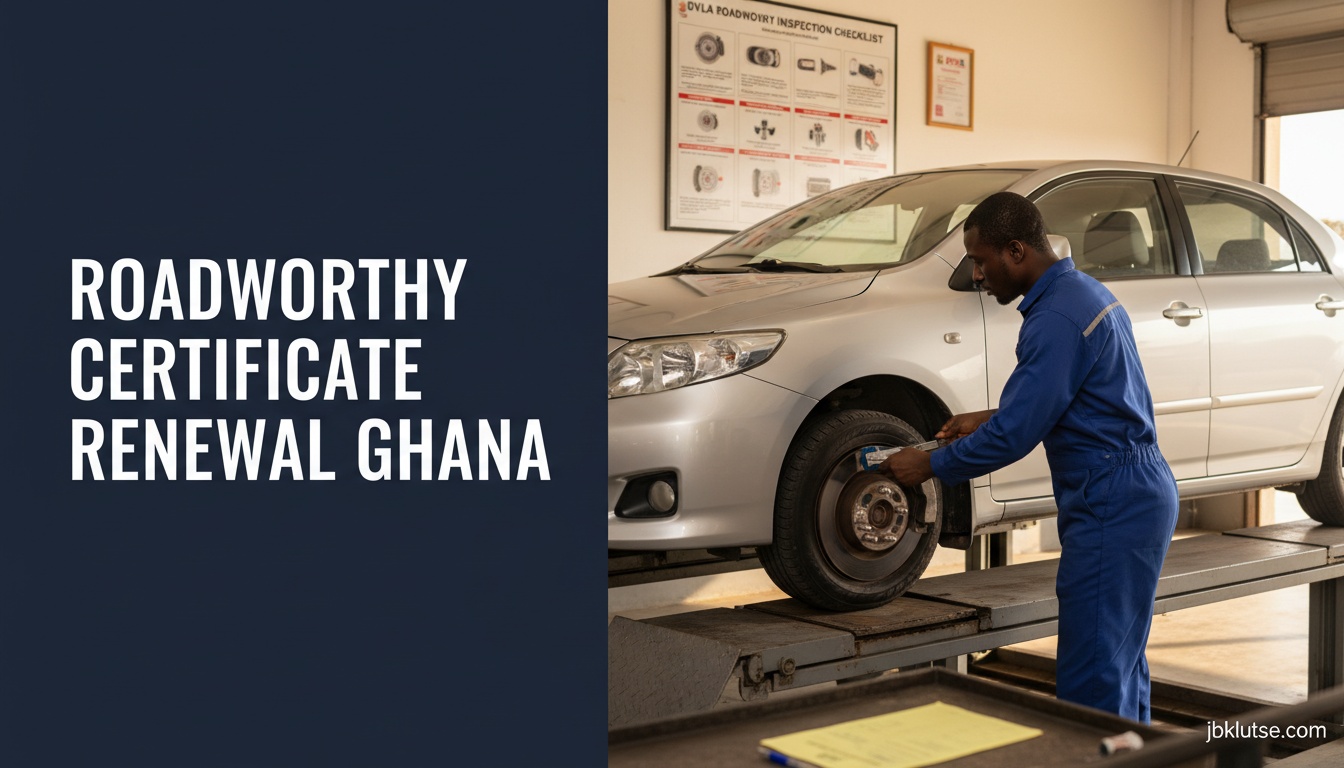
Inspection centres check 12 core components:
- Brakes , front and rear pad thickness, brake fluid level, parking brake hold
- Tyres , tread depth minimum 1.6mm, no cuts or bulges, correct pressure
- Lights , headlights, tail lights, indicators, brake lights, number plate light all functional
- Steering , no excessive play, tie-rod ends secure
- Suspension , shock absorbers not leaking, springs intact
- Windscreen , no cracks in driver’s line of sight, wipers working
- Horn , audible from 50 metres
- Seatbelts , all belts present and locking properly
- Mirrors , side mirrors and rear-view mirror fitted and uncracked
- Exhaust system , no loud leaks, emissions within legal limits
- Body and chassis , no severe rust, doors close securely
- Fire extinguisher , commercial vehicles must carry one, private cars recommended
Emissions testing uses a gas analyser for petrol engines (carbon monoxide and hydrocarbon limits) and a smoke opacity meter for diesel engines. Vehicles older than 15 years often fail emissions. Fitting a catalytic converter or DPF cleaning can help.
Common Reasons Vehicles Fail Inspection
Data from DVLA’s 2025 annual report shows 34% of vehicles failed their first inspection attempt. Top failure reasons:
- Worn brake pads or discs (41% of failures)
- Bald tyres (28%)
- Non-functioning lights (19%)
- Excessive emissions (9%)
- Cracked windscreens (3%)
Before visiting the centre, check your brake pedal feels firm, your tyres show visible tread, all lights work, and your exhaust does not smoke heavily on start-up. Fixing these issues at a local garage before inspection saves you the GHS 100 (April 2026) re-inspection fee.
Validity Period and Renewal Timeline
Roadworthy certificates are valid for 12 months from the date of issue. The expiry date is printed on the certificate. DVLA and MTTD enforce this strictly. Expired certificates carry the same penalty as having no certificate at all.
You can renew up to 30 days before expiry without losing any validity period. For example, if your certificate expires on 15 May 2026 and you renew on 20 April 2026, your new certificate runs from 15 May 2026 to 14 May 2027.
Letting your certificate lapse means you cannot legally drive the vehicle on any public road until you renew. Some insurance companies also refuse to pay claims if your roadworthy certificate was expired at the time of an accident, even if the accident was not your fault.
Penalties for Driving Without a Roadworthy Certificate
Regulation 18 of the Road Traffic Regulations 2012 (L.I. 2180) makes it an offence to drive a vehicle without a valid roadworthy certificate. Penalties as of 2026:
- First offence: GHS 500 (April 2026) fine
- Second offence within 12 months: GHS 1,000 (April 2026) fine plus possible vehicle impoundment for 7 days
- Third offence: GHS 2,000 (April 2026) fine, vehicle impounded until owner renews certificate and pays storage fees
MTTD checkpoints at Kasoa Tollbooth, Suhum barrier, and Takoradi roundabouts routinely inspect roadworthy certificates. Drivers caught without one must pay the fine on the spot or have their vehicle towed to the nearest police station yard. Storage fees at police yards run GHS 50 per day (April 2026).
Ghana-Specific Considerations
Roadworthy and Insurance Renewal Sequence
Ghana’s insurance law requires a valid roadworthy certificate before any insurer will issue or renew a comprehensive or third-party motor policy. The sequence is:
- Get roadworthy certificate renewed
- Take certificate to your insurance broker or use the NIC online portal
- Pay insurance premium
- Receive insurance certificate
- Use both certificates to renew vehicle registration at DVLA if due
Trying to renew insurance with an expired roadworthy certificate will trigger an automatic rejection in the National Insurance Commission (NIC) database. See our guide to DVLA vehicle registration for the full renewal workflow.
Regional Pricing Variations
While DVLA sets national fees, some rural centres add a GHS 10 to GHS 20 (April 2026) “service charge” for remote locations. This is technically against DVLA policy but common in Upper East, Upper West, and parts of Northern Region where centres are sparse. If a centre charges above the table in section 3, ask for a receipt and lodge a complaint. DVLA’s enforcement directorate investigates within 14 days.
Digital Roadworthy Certificates
DVLA announced in February 2026 it is piloting a digital roadworthy certificate system at 15 centres in Accra and Kumasi. Drivers receive a QR code via SMS after passing inspection. MTTD officers scan the code to verify validity. The physical certificate remains mandatory until the national rollout completes in 2027. Track progress at the DVLA online services hub.
Older Vehicles and Emissions Standards
Vehicles manufactured before 2005 face stricter emissions testing under NRSA’s 2024 clean air directive. If your car is 15 years or older and fails emissions, you have three options:
- Install an aftermarket catalytic converter (GHS 800 to GHS 1,500 at Auto Service Ghana or ADB Motors, April 2026)
- Perform a full engine tune-up including spark plug and air filter replacement (GHS 300 to GHS 600, April 2026)
- Apply for a conditional roadworthy valid for 6 months while you source parts (requires written justification submitted to DVLA head office)
Option 3 is rare and requires proof you have ordered the necessary parts from abroad.
FAQs
Can I renew my roadworthy certificate at any licensed centre or must I return to the same centre?
You can use any DVLA-licensed centre. Your previous certificate and vehicle registration number are sufficient. Centres do not share inspection histories, so each renewal is a fresh inspection.
What happens if my vehicle fails inspection?
The centre issues a defect report listing every failed component. You have 30 days to repair the defects and return for re-inspection at the same centre. Some centres waive the re-inspection fee if you return within 7 days. Confirm this policy before leaving.
Do I need a roadworthy certificate for a brand-new vehicle?
Yes. Even vehicles driven off the showroom floor need a roadworthy certificate before DVLA will issue registration plates. Dealerships usually arrange the first inspection as part of the sale package.
Can I drive my vehicle to the inspection centre if my roadworthy has expired?
Technically no. The law requires a valid certificate to drive on public roads. In practice, MTTD officers allow a 7-day grace period if you carry proof of a booked inspection appointment. Print the appointment SMS or email and keep it in the vehicle.
Is roadworthy inspection the same as vehicle registration renewal?
No. Roadworthy inspection checks mechanical safety. Vehicle registration renewal updates your ownership record at DVLA and issues new number plates if needed. Both processes require each other. See our vehicle registration guide for the registration workflow.
How do I verify a centre is DVLA-licensed?
Check the centre’s license certificate displayed at the entrance. It should show the DVLA logo, the centre’s license number (format: RC/2026/XXX), and an expiry date. Call DVLA on 0302-666-160 with the license number to confirm it is active. Fake centres proliferate in peri-urban areas.
Can motorcycles use the same centres as cars?
Most centres inspect both. Some small centres only handle motorcycles and tricycles. Confirm by phone before visiting. Motorcycle inspection costs GHS 80 (April 2026) and covers brakes, lights, horn, chain tension, and exhaust noise level.
What is the penalty for using a fake roadworthy certificate?
Producing a fake certificate to MTTD or an insurance company is a criminal offence under the Road Traffic Act. Penalties include a GHS 5,000 (April 2026) fine, 6 months imprisonment, or both. DVLA prosecutes 20 to 30 cases annually.
Related Reads
- Zoom out: Ghana Digital Services , the full ecosystem of online and offline government services
- Topic hub: DVLA and Driver’s License Services in Ghana , licensing, registration, and enforcement
- DVLA fees across all services: DVLA Fees 2026
- Vehicle registration workflow: DVLA Vehicle Registration Process
- Find your nearest DVLA office: DVLA Offices Across Ghana
- Renew your driver’s license: DVLA License Renewal Process
Closing
Roadworthy certificate renewal is straightforward when you prepare the required documents and fix obvious defects before inspection. The GHS 100 (April 2026) fee and 12-month validity make it Ghana’s most accessible vehicle compliance requirement. As DVLA rolls out digital certificates and tightens emissions standards, staying ahead of expiry dates and maintaining your vehicle year-round becomes more important. Bookmark this guide and check back quarterly for fee updates and new centre listings.
Follow our updates on X at @jbklutsemedia.
Sources
- Driver and Vehicle Licensing Authority (DVLA) Ghana, Official Website, dvla.gov.gh, accessed April 2026
- Road Traffic Regulations 2012 (L.I. 2180), Ghana Legal Information Institute
- National Road Safety Authority (NRSA), Vehicle Inspection Standards 2024
- DVLA Annual Report 2025, Vehicle Inspection Statistics
- National Insurance Commission (NIC) Ghana, Motor Insurance Requirements, nicgh.org