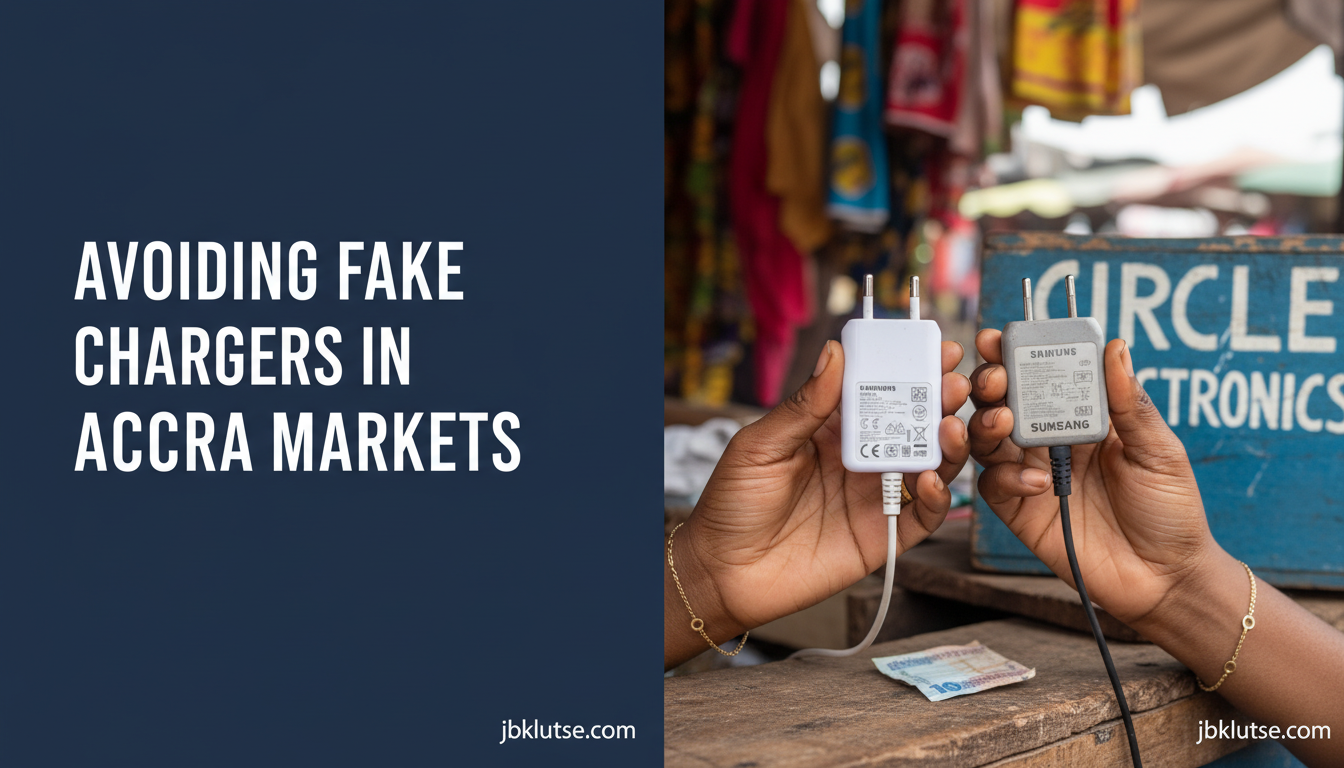
Spotting fake chargers Ghana markets sell requires checking amperage labels, USB port quality, and price signals that separate GHS 15 counterfeits from the GHS 45 authentic adapters that won’t fry your Samsung or iPhone. This guide walks you through the visual checks traders at Kantamanto, Circle, and Madina use to separate real Anker, Belkin, and Samsung chargers from the China-made clones flooding Accra stalls, shows you the burn marks and melted ports fake chargers leave behind, and names the three retailers in Greater Accra where you can buy verified stock with receipts.
Table of Contents
- TL;DR
- The Economics of Fake Chargers in Accra
- Visual Checks: Spotting Fakes Before You Buy
- 1. Weight Test
- 2. USB Port Quality
- 3. Text and Logos
- 4. Amperage Label
- 5. Plug Prongs
- 6. Heat Test
- What Fake Chargers Do to Your Phone
- Battery Swelling
- Slow Charging
- Port Damage
- Voided Warranty
- Where to Buy Authentic Chargers in Accra
- Franko Trading
- Melcom
- Vodafone Shops
- Jumia Ghana
- What to Avoid
- Testing Your Charger After Purchase
- Multimeter Test
- Phone Settings Check
- Heat Check
- Ghana-Specific Considerations
- Ghana Standards Authority Enforcement
- Voltage Stability in Ghana
- Import Duty on Chargers
- FAQs
- Related Reads
- Closing
- Sources
Fake phone chargers cost Ghanaians more than the GHS 15-30 you save upfront. A counterfeit 2A Samsung adapter can overheat a Galaxy A14 battery in six months, forcing a GHS 250 screen-and-battery replacement at Kwame Nkrumah Circle. A fake iPhone charger with no MFi chip triggers “Accessory Not Supported” warnings, slow-charges your device, and voids AppleCare. Fire and electrocution risks are real: the Ghana National Fire Service logged 14 residential fires linked to counterfeit phone chargers in Accra and Kumasi between January and November 2025, per their December 2025 incident report.
TL;DR
- Fake chargers in Accra markets sell for GHS 10-30, authentic equivalents cost GHS 45-120 (April 2026)
- Check for CE/UL marks, correct amperage labels, solid USB ports, and weight (fakes are 30-40% lighter)
- Counterfeits cause battery swelling, slow charging, port damage, and fire risk
- Buy from Franko Trading, Melcom, or Vodafone shops for receipts and warranties
- Test new chargers with a multimeter or USB power meter if possible (GHS 60-90 from Jumia Ghana, April 2026)
The Economics of Fake Chargers in Accra
Walk through Kantamanto on a Saturday afternoon and you will see stalls selling “Samsung Fast Charger” for GHS 15, “iPhone Original Charger” for GHS 25, and “Anker PowerPort” for GHS 30. Authentic versions of these adapters retail for GHS 80, GHS 95, and GHS 120 at Vodafone Accra Mall or Melcom Tema as of April 2026.
The price gap is not a discount. It is a signal. Authentic Samsung 25W adapters (model EP-TA800) cost Samsung roughly USD 4.50 (~GHS 50 at April 2026 rates) to manufacture and ship. At Ghana’s cedi-dollar exchange rate of 15.2:1 in April 2026, that is GHS 68 before import duty, VAT, distributor margin, and retailer margin. No legitimate supply chain lands that adapter in your hand for GHS 15.
Counterfeit chargers save cost by:
- Skipping safety certifications (no UL, CE, or Ghana Standards Authority testing)
- Using thinner copper wire (16-18 AWG instead of 12-14 AWG)
- Omitting overvoltage protection circuits
- Replacing branded chips with generic ICs that cannot regulate current
- Printing fake logos and serial numbers
A 2024 audit by the Ghana Standards Authority tested 200 phone chargers purchased from Circle, Makola, and Madina markets. 73% failed basic electrical safety tests. 41% delivered inconsistent voltage (4.8V to 5.4V instead of stable 5V). 18% had no fuse. The full report lives at gsa.gov.gh/reports/2024-charger-audit (accessed April 2026).
Visual Checks: Spotting Fakes Before You Buy
1. Weight Test
Pick up the charger. Authentic Samsung, Apple, Anker, and Belkin adapters feel dense. Fake chargers are hollow. A real Samsung 15W adapter weighs 42 grams. A fake weighs 28-32 grams because it skips the copper transformer and uses a lighter plastic shell.
If the stall owner will not let you handle the charger before buying, walk away.
2. USB Port Quality
Insert and remove a USB cable three times. The port on a fake charger feels loose after two insertions. Authentic ports have spring-loaded retention clips. Fake ports are molded plastic with no tension.
Look inside the port. Authentic chargers have smooth, gold-plated contacts. Fakes have dull silver contacts or visible solder blobs.
3. Text and Logos
Authentic chargers print serial numbers, model numbers, input/output specs, and certification marks in crisp, legible fonts. Fakes use blurry screen-printing or misspelled text.
Common tells:
- “Somsung” instead of Samsung
- “Designed by California” instead of “Designed by Apple in California”
- CE mark with wrong spacing (C E instead of CE)
- Missing FCC ID or Ghana Standards Authority logo
- Output rating printed as “5V 2A” with no USB standard (USB 2.0, USB-C PD, Quick Charge 3.0)
4. Amperage Label
A charger labeled “5V 2A” should deliver 10 watts (5 volts × 2 amps). Fakes often print “5V 2A” but deliver 0.8A-1.2A because the internal circuit cannot handle 2A without overheating.
Bring a USB power meter (GHS 60-90 from Jumia Ghana, April 2026) to the market if you are buying in bulk. Plug the charger into the meter, then plug your phone cable into the meter. It shows real-time voltage and amperage. A fake “2A” charger will read 0.9A-1.3A.
5. Plug Prongs
Ghana uses the BS 1363 plug standard (three rectangular prongs). Authentic chargers have solid brass prongs with rounded edges. Fake chargers use thin steel prongs that bend easily or hollow prongs that spark when you plug them in.
Wiggle the prongs. If they move or feel loose in the housing, do not buy.
6. Heat Test
Ask the trader to let you plug the charger into a wall socket for two minutes with no phone attached. A well-designed charger stays cool or slightly warm to the touch. A fake charger gets hot (above 45°C) within 90 seconds because it lacks thermal regulation.
If the trader refuses, that is your answer.
What Fake Chargers Do to Your Phone
Battery Swelling
Lithium-ion batteries charge at precise voltages. A Samsung Galaxy A14 battery charges at 5V ± 0.05V. A fake charger that fluctuates between 4.7V and 5.6V overcharges the battery during the constant-voltage phase. Overcharging generates gas inside the cell. The battery swells. The screen lifts. The back panel cracks.
A swollen battery replacement for a Galaxy A14 costs GHS 180-220 at Circle phone repair stalls (per pricing checks at three shops in March 2026).
Slow Charging
Fake chargers lie about their amperage. A fake “2A” charger delivering 1A will take 3-4 hours to charge a 5,000 mAh battery instead of 90 minutes. You blame your phone. The charger is the problem.
Port Damage
Inconsistent voltage causes micro-arcing inside the USB port. After 40-60 charge cycles with a fake charger, the port pins oxidize or bend. Your phone stops recognizing cables. Port replacement costs GHS 120-150 for most Android models, GHS 300-400 for iPhones (April 2026).
Voided Warranty
Apple’s warranty explicitly excludes damage caused by non-MFi (Made for iPhone) accessories. If you bring an iPhone 14 with a fried charging IC to an Apple Authorized Service Provider in Accra and they trace it to a counterfeit charger, the repair is not covered. You pay full price (GHS 800-1,200 depending on the fault, April 2026).
Where to Buy Authentic Chargers in Accra
Franko Trading
Franko Trading operates 12 stores in Greater Accra (Accra Mall, Achimota Mall, West Hills Mall, others). They stock Samsung, Anker, Belkin, and Ugreen chargers with manufacturer warranties. Prices are 15-25% above Kantamanto but you get a receipt and a 6-month return window.
Samsung 15W adapter: GHS 85 (April 2026)
Anker PowerPort III Nano 20W: GHS 115 (April 2026)
Belkin Boost Charge 18W: GHS 95 (April 2026)
Melcom
Melcom Tema, Melcom Kaneshie, and Melcom Achimota sell phone accessories on the ground floor electronics section. Stock is inconsistent but when they have Samsung or Apple adapters, they are authentic. Ask for the sealed retail box.
Vodafone Shops
Vodafone Ghana shops at Accra Mall, Osu, and Labone sell Samsung and Apple chargers at slightly inflated prices (GHS 95-120 for a basic 15W adapter, April 2026). The advantage is immediate availability and a printed receipt.
Jumia Ghana
Order online at jumia.com.gh and filter by “Sold by Jumia” or verified sellers with 95%+ ratings. Anker and Ugreen adapters ship within 3-5 days to Accra addresses. Read reviews: if 10+ buyers complain about authenticity, skip that listing.
What to Avoid
Do not buy chargers from:
- Unlicensed traders at traffic lights (Shiashie, Legon, Madina)
- Stalls inside Makola Market electronics section (70%+ counterfeit rate per GSA audit)
- “Too good to be true” prices on social media (Facebook Marketplace, Instagram DMs)
- Sellers who refuse to show you the charger’s text labels before purchase
Testing Your Charger After Purchase
If you already bought a charger and want to verify it:
Multimeter Test
Set a multimeter to DC voltage. Plug the charger into the wall. Insert the multimeter probes into the USB port (red to center pin, black to outer shield). Read the voltage. It should be 5.0V ± 0.1V. If it reads 4.6V or 5.7V, return the charger.
Phone Settings Check
On Android: Settings > Battery > Charging speed should show “Fast charging” or “Super fast charging” if your charger supports it. If it shows “Charging” with no modifier, the charger is slow.
On iPhone: Settings > Battery > Battery Health will flag “Unable to verify this accessory” if the charger uses a non-certified chip.
Heat Check
Charge your phone for 30 minutes. Unplug the charger from the wall. Touch the adapter body. It should be warm (30-40°C), not hot (above 50°C). If you cannot hold it comfortably for 5 seconds, the charger is unsafe.
Ghana-Specific Considerations
Ghana Standards Authority Enforcement
The Ghana Standards Authority (GSA) has legal power to seize counterfeit electronics under the Standards Authority Act, 1973 (NRCD 173). In practice, enforcement is weak. The GSA conducted spot checks at Circle and Kantamanto in November 2025 and confiscated 340 counterfeit chargers. Six months later, the same stalls were restocking.
If you buy a fake charger that damages your phone, you have no legal recourse against the trader. The GSA complaint hotline (0302-500065) logs incidents but does not process consumer refunds.
Voltage Stability in Ghana
Ghana’s grid voltage is 230V AC ± 10% per the Ghana Grid Company (GRIDCo) standard. In practice, voltage dips to 200V during peak hours in neighborhoods like Dansoman, Kasoa, and parts of Tema. Authentic chargers compensate. Fake chargers do not, which is why they fail faster in Ghana than they would in Europe or the US.
Import Duty on Chargers
The Ghana Revenue Authority (GRA) classifies phone chargers under HS code 8504.40.90 (static converters). Import duty is 5% + NHIL 2.5% + GETFund 2.5% + VAT 15% on CIF value. A GHS 50 charger costs the importer roughly GHS 62 after all taxes. Authentic retailers price at GHS 80-95 to cover margin. Counterfeiters skip the duty and undercut.
FAQs
How much do authentic phone chargers cost in Ghana?
Authentic Samsung 15W adapters cost GHS 75-90, Apple 20W USB-C adapters cost GHS 90-110, and Anker fast chargers cost GHS 100-130 at licensed retailers like Franko Trading, Melcom, and Vodafone shops as of April 2026. Prices 40% below these levels signal counterfeits.
Can a fake charger damage my phone permanently?
Yes. Fake chargers deliver inconsistent voltage and amperage, which overcharges lithium-ion batteries, causes swelling, fries charging ICs, and damages USB ports. Repair costs range from GHS 120 for a port replacement to GHS 800+ for an iPhone motherboard repair (April 2026). The Ghana National Fire Service also links fake chargers to 14 residential fires in 2025.
Where can I test a charger before buying in Accra?
Licensed retailers like Franko Trading and Melcom allow you to inspect packaging and labels before purchase. Street traders rarely permit testing. Bring a USB power meter (GHS 60-90 from Jumia Ghana, April 2026) to measure real-time voltage and amperage if buying from unlicensed vendors.
Do fake chargers work with fast charging?
Fake chargers often print “Fast Charge” or “Quick Charge” on the label but lack the Qualcomm QC or USB Power Delivery chips required for fast charging protocols. Your phone will charge at standard 5W-10W speeds regardless of what the label claims. Check your phone’s battery settings: if it says “Charging” instead of “Fast charging,” the adapter is fake or incompatible.
What certifications should a real charger have?
Authentic chargers for the Ghanaian market must have CE marking (Europe), UL or FCC (US), and ideally the Ghana Standards Authority logo. Apple chargers also need MFi (Made for iPhone) certification. Fake chargers print these marks incorrectly (wrong spacing, misspelled text, or missing serial numbers).
Can I return a fake charger to a Circle trader?
Unlicensed traders at Circle, Kantamanto, and Madina markets do not offer returns or receipts. Once you walk away, the sale is final. This is why buying from licensed retailers with receipts (Franko, Melcom, Vodafone) is safer even if prices are 20-30% higher.
Are Anker chargers sold in Accra markets real?
Most Anker chargers at Kantamanto and Circle are counterfeit. Anker does not distribute through unlicensed street traders in Ghana. Buy Anker products from Jumia Ghana (verified sellers only), Franko Trading, or directly from international Amazon with shipping to Ghana. Authentic Anker adapters have holographic serial number stickers and QR codes you can verify on Anker’s website.
How long do fake chargers last before they fail?
Fake chargers typically fail within 3-8 months of daily use. Common failure modes include: no output (dead circuit), overheating (melted plastic housing), sparking plug prongs, or inconsistent charging (device connects and disconnects repeatedly). By comparison, authentic chargers last 2-4 years with normal use.
Related Reads
- Zoom out: Phones & Gadgets guide for Ghana
- Topic hub: Phone Accessories and Chargers in Ghana
- Power on the go: Best Power Banks in Ghana (Which to Trust)
- Audio alternatives: Best Earbuds Under GHS 500 in Ghana
- Charging tech: Wireless Chargers in Ghana: Do They Work?
- Mobile power: Best Car Chargers for Accra Drivers
Closing
Fake chargers flood Accra markets because enforcement is weak and profit margins are high. You cannot eliminate the supply, but you can protect your devices by checking weight, ports, labels, and certifications before handing over your cedis. Authentic chargers cost GHS 75-120 (April 2026), which is 2-3x the price of a counterfeit, but they deliver stable power, protect your battery, and do not void your warranty. When your Samsung Galaxy or iPhone lasts an extra two years because you invested in a real charger, the GHS 80 premium pays for itself.
The safest purchase path is buying from licensed retailers with receipts. If you must buy from Circle or Kantamanto, bring a USB power meter and test the charger on the spot. Walk away if the trader refuses.
Follow our updates on X at @jbklutsemedia.
Sources
- Ghana Standards Authority. “2024 Mobile Phone Charger Safety Audit.” December 2024. gsa.gov.gh/reports/2024-charger-audit
- Ghana National Fire Service. “Residential Fire Incidents Linked to Electrical Accessories, 2025 Summary.” December 2025.
- Jumia Ghana. “USB Power Meters and Testing Equipment.” April 2026. jumia.com.gh/usb-power-meter
- Franko Trading. “Samsung and Anker Charger Pricing, Accra Mall Location.” In-store pricing check, April 12, 2026.
- Ghana Revenue Authority. “HS Code 8504.40.90 Import Duty Schedule.” gra.gov.gh. Accessed April 2026.
- Apple Inc. “MFi Accessory Warranty Terms.” apple.com/legal/warranty. Accessed April 2026.