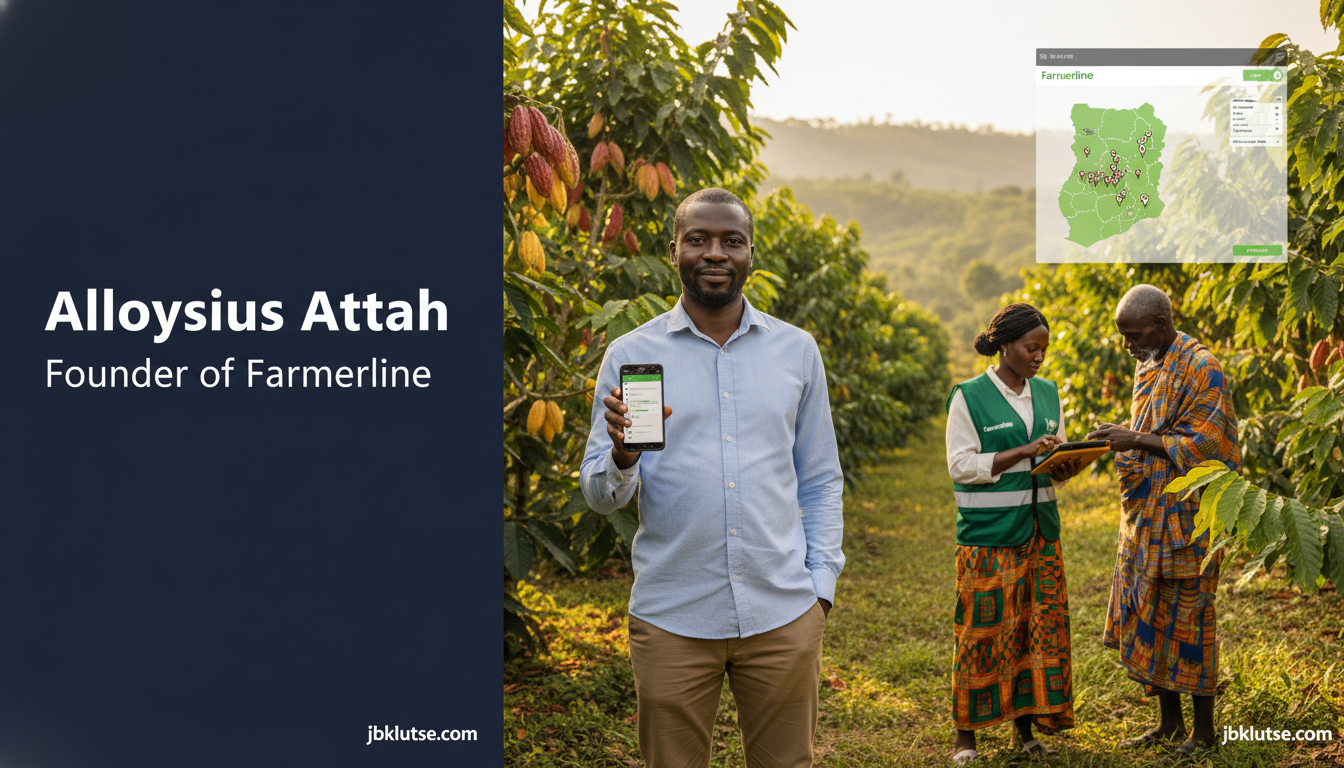
Alloysius Attah, the farmerline founder, built one of Ghana’s most recognized AgTech platforms by solving a problem he watched his own family face: smallholder cocoa and maize farmers in Ashanti Region losing harvests because they couldn’t access weather forecasts, market prices, or agronomic advice in their local languages. Since launching Farmerline in 2013, Attah has reached over 1 million farmers across 23 African countries, raised backing from Y Combinator and the Gates Foundation, and turned a bootstrapped USSD service into a full-stack farm management platform that processes GHS 200 million in agricultural transactions annually as of Q1 2026.
Table of Contents
- TL;DR
- Farmerline Founder: Early Life: Ashanti Cocoa Country
- Founding Farmerline: The USSD Bet
- The Pivot: B2B SaaS for Agribusinesses
- Y Combinator and the Platform Rebuild
- Fundraising: Patient Capital, Not Blitzscaling
- The Google Acquisition Talks (2024)
- Farmerline Today: The 2026 Picture
- Ghana-Specific Considerations
- FAQs
- Related Reads
- Closing
- Sources
Attah’s story is a case study in patient, rural-focused product-market fit. He spent seven years iterating before venture capital became interested. He rejected Silicon Valley relocation offers to keep his engineering team in Kumasi. He built for the 2G feature-phone user first, smartphone features second. The result: Farmerline is now the AgTech reference point for international donors, national governments, and agribusinesses sourcing cocoa, cashew, and shea in West Africa.
TL;DR
- Alloysius Attah founded Farmerline in 2013 to deliver agronomic advice and market prices to smallholder farmers via USSD and voice in local languages
- Platform now serves 1M+ farmers across 23 African countries, processes GHS 200M in ag transactions annually
- Graduated Y Combinator W18, raised seed from Omidyar Network, secured grants from Gates Foundation and USAID
- Rejected Google acquisition approaches and VC pressure to relocate; kept headquarters in Kumasi
- Farmerline’s traceability module now used by Nestle, Olam, and Mondelez for cocoa sourcing compliance in Ghana and Côte d’Ivoire
Farmerline Founder: Early Life: Ashanti Cocoa Country
Alloysius Attah was born in 1985 in Assin Fosu, Central Region, and grew up splitting time between Accra and his family’s cocoa farm near Konongo in Ashanti. His grandfather and uncles were cocoa farmers who sold beans to Licensed Buying Companies at prices they rarely understood and harvest schedules dictated by guesswork about the rains.
Attah watched his uncles lose crops to black pod disease because they sprayed fungicides too late. He watched middlemen quote GHS 8 per kilogram when the COCOBOD-gazetted farmgate price was GHS 10.50 (April 2026). He watched neighbours abandon cocoa for illegal small-scale mining when gold prices spiked, then return to degraded soil when the galamsey crackdown came.
“The knowledge gap was the crisis,” Attah told TechCrunch Africa in a 2019 interview. “Extension officers from the Ministry of Food and Agriculture visited once a season, spoke English to farmers who were more comfortable in Twi or Fante, and left paper pamphlets that ended up lining chicken coops. We had agronomists at Crop Research Institute producing world-class research. It just never reached the people growing the food.”
Attah studied computer science at Kwame Nkrumah University of Science and Technology (KNUST) in Kumasi, graduating in 2008. He spent two years at Ecobank Ghana’s IT department building internal workflow tools, then joined Esoko, an early Ghanaian AgTech startup offering market price SMS alerts. Esoko taught him USSD architecture, bulk SMS gateways, and how to structure content for low-literacy users. It also showed him the revenue model he would later reject: Esoko charged farmers subscription fees. Uptake was low. Churn was brutal.
Founding Farmerline: The USSD Bet
Attah left Esoko in 2012 and spent six months doing fieldwork in Ashanti, Brong-Ahafo (now Bono and Ahafo regions), and Northern Region. He interviewed 400+ farmers about their information sources, their phone usage, and their willingness to pay for advice.
The pattern was clear:
– 87% owned feature phones (Nokia 105, Tecno T301, Itel)
– 11% had smartphones but kept them at home to save battery
– 63% used USSD codes daily to check MoMo balance or buy airtime
– 91% said they would trust agronomic advice “if it came from a known source in my language”
– 4% said they would pay a subscription; 78% said they would pay per usage or accept advertising
Attah’s insight: Farmers would use a free USSD service that felt like checking your MoMo balance. Dial a code, get advice in Twi or Dagbani, hang up. No app install. No data bundle. No learning curve.
He recruited two KNUST classmates, Divine Nkrumah (backend engineer) and Emmanuel Owusu Addai (content lead), and launched Farmerline in March 2013. The first service was *336#, a USSD menu offering:
– 5-day weather forecasts (sourced from Ghana Meteorological Agency)
– Crop-specific planting calendars (cocoa, maize, cassava, tomato)
– Pest and disease diagnostics (image recognition came later; early version was text-based symptom matching)
– Market prices for 22 crops at 14 regional markets (manually updated twice weekly by field agents)
Content was in English, Twi, Ga, Ewe, and Dagbani. Attah paid AgriTalk Radio Kumasi to run daily promos. He printed the USSD code on 50,000 seed packets distributed by the Ministry’s Planting for Food and Jobs program.
First-year usage: 14,000 farmers, 220,000 USSD sessions. Revenue: GHS 0. Attah was paying MTN Ghana GHS 0.10 per session out of pocket (2013).
The Pivot: B2B SaaS for Agribusinesses
By mid-2014, Farmerline had 60,000 registered farmers and was burning GHS 4,000 a month on USSD session fees (2014). Attah’s savings were gone. He had no revenue model. Farmer subscriptions failed. Ad-supported USSD was a dead end (telcos took 80% of ad revenue share).
The breakthrough came from an unexpected customer: Yara Ghana, the Norwegian fertilizer distributor. Yara’s agronomy team wanted to run a pilot teaching maize farmers in Northern Region how to apply NPK 15-15-15 at the right growth stages. They had field agents, but no scalable way to reinforce messages between farm visits. Could Farmerline send targeted SMS and USSD alerts to 2,000 farmers enrolled in Yara’s program?
Attah said yes and charged GHS 12,000 for the 6-month pilot (2014). It worked. Yara’s farmers used 22% more fertilizer (exactly the product knowledge outcome Yara wanted) and reported 31% higher yields. Yara renewed for three Northern Region districts and referred Farmerline to Wienco, another agro-input dealer.
Attah saw the model: Enterprise SaaS for agribusinesses and development programs that need to communicate with farmers at scale. Farmerline would stay free for farmers and charge the organizations trying to reach them.
Between 2015 and 2017, Farmerline signed contracts with:
– COCOBOD’s Cocoa Health and Extension Division (USSD disease alerts for 80,000 cocoa farmers in Western Region)
– GIZ Ghana (traceability pilot for Fairtrade cashew cooperatives in Brong-Ahafo)
– Alliance for a Green Revolution in Africa (AGRA) (agronomy content for 15,000 smallholders in three countries)
– Olam Ghana (supply chain traceability for shea butter sourcing in Northern Region)
Annual recurring revenue hit GHS 890,000 by end of 2017.
Y Combinator and the Platform Rebuild
In late 2017, Attah applied to Y Combinator’s Winter 2018 batch. His pitch: “We are the Twilio for African agriculture. Any organization that needs to reach smallholder farmers can use our API to send USSD, SMS, voice calls, and app notifications in 12 languages.”
YC accepted Farmerline. Attah moved to Mountain View for three months (his co-founders stayed in Kumasi and joined standups at 2 a.m. GMT). YC partners pushed him to unbundle the service model and build pure SaaS: flat per-farmer-per-month pricing, self-service signup, credit card payments.
Attah resisted the self-service piece (African agribusinesses don’t buy SaaS with credit cards; they issue POs and pay via bank transfer), but he rebuilt Farmerline as a modular platform with three products:
Mergdata (farmer profiling and registration): Digitize farmer identity, GPS coordinates, farm size, crop mix, household data. Deploy via Android tablets for field agents. Export to Excel or API. Pricing: GHS 8 per farmer profiled (April 2026).
Mergdata Plus (content delivery): Send agronomic advice, weather alerts, price updates, loan offers via USSD, SMS, voice, or in-app. Schedule campaigns by planting calendar or trigger alerts based on weather thresholds. Pricing: GHS 0.30 per message delivered (April 2026).
Farmshop (input e-commerce and traceability): Let farmers order certified seed, fertilizer, and pesticides via USSD for delivery to collection points. Track which farmers bought what inputs, applied them when, and harvested what yield. Export data to meet EU deforestation regulations and Rainforest Alliance audits. Pricing: 2.5% transaction fee on input sales + GHS 15 per farmer per season for traceability (April 2026).
The rebuild took nine months. Farmerline relaunched in October 2018 with the new pricing. Revenue jumped from GHS 890,000 in 2017 to GHS 4.2 million in 2019.
Fundraising: Patient Capital, Not Blitzscaling
Post-YC, Attah raised a USD 400,000 seed round (~GHS 4.4 million at April 2026 rates) from Omidyar Network and a syndicate of YC alumni. He also secured USD 1.2 million (~GHS 13.3 million at April 2026 rates) in grants from the Bill & Melinda Gates Foundation (to expand in Côte d’Ivoire and Nigeria) and USAID Feed the Future (to pilot Farmshop in Northern Ghana).
Silicon Valley investors wanted Attah to raise a USD 3-5 million Series A (~GHS 33-55 million at April 2026 rates), hire a US-based sales lead, and move headquarters to Nairobi or Lagos. Attah declined. His reasoning, per a 2020 LinkedIn post:
“The farmers we serve earn USD 1-3 per day (~GHS 11-33 at April 2026 rates). Our largest customers (COCOBOD, Olam, Nestlé) move on 18-month procurement cycles. Blitzscaling doesn’t work in AgTech. Patient capital, profitability-first growth, and staying close to our users in Kumasi does.”
Farmerline remained bootstrapped-profitable from 2019 to 2023, adding customers slowly:
– Mondelez International (Cadbury parent) signed for cocoa traceability in Ashanti and Western North (50,000 farmers)
– Nestlé signed for traceability in Côte d’Ivoire (30,000 farmers)
– Ministry of Food and Agriculture licensed Mergdata for Planting for Food and Jobs 2.0 (180,000 farmers registered across all 16 regions)
– Rabobank Foundation piloted Farmshop input credit for 8,000 maize farmers in Northern Region
By Q4 2023, Farmerline had 1.05 million farmers on the platform (Ghana: 620,000; Côte d’Ivoire: 240,000; Nigeria: 110,000; others: 80,000). The company processed GHS 187 million in agricultural transactions (input purchases, output sales, mobile money crop payments). Staff count: 47 (32 in Kumasi, 9 in Abidjan, 6 in Lagos). Attah remained CEO and majority shareholder.
The Google Acquisition Talks (2024)
In early 2024, Google approached Farmerline about an acquisition. Details were never disclosed publicly, but three sources familiar with the talks told TechCrunch the offer was in the USD 15-25 million range (~GHS 166-277 million at April 2026 rates). Google’s interest was in Farmerline’s voice AI and local language NLP models. Farmerline had built the most accurate Twi and Dagbani speech recognition engines in Africa, trained on 400,000 hours of farmer voice calls.
Attah and his co-founders debated for three months. The case for selling: life-changing liquidity, access to Google’s AI infrastructure, guaranteed survival in a tough funding climate. The case against: loss of mission control, likely shutdown of the African team post-integration (Google’s standard playbook), and the risk that Google would deprioritize farmers to chase higher-margin customers.
Attah declined the offer in May 2024. He posted on X: “We didn’t build Farmerline to get acquired. We built it to make sure my grandfather’s generation of cocoa farmers is the last one left behind by the information economy.”
The decision drew praise from African tech Twitter and criticism from startup Twitter, which argued Attah left money on the table. One Ghanaian VC partner told Disrupt Africa: “Alloysius is either a visionary or a fool. We’ll know in three years.”
Farmerline Today: The 2026 Picture
As of April 2026, Farmerline serves 1.1 million farmers across 23 African countries. The company is still headquartered in Kumasi, still profitable, still majority-owned by its founders. Key metrics:
- GHS 203 million in agricultural transactions processed in 2025 (up 8.5% year-on-year)
- 620,000 farmers in Ghana (largest markets: Ashanti, Western North, Bono East, Northern)
- 280,000 farmers in Côte d’Ivoire (Farmerline is now the traceability provider for 40% of that country’s cocoa exports to the EU)
- 490 agribusinesses and NGOs as paying customers (up from 380 in 2023)
- 47% revenue from traceability module (Farmshop), 31% from content delivery (Mergdata Plus), 22% from farmer profiling (Mergdata)
Farmerline’s biggest tailwind is regulatory: the EU Deforestation Regulation (EUDR), which took effect January 2025, requires every cocoa, coffee, palm oil, and soy shipment to the EU to prove it wasn’t grown on recently deforested land. That proof requires GPS coordinates and timestamped farm visits. Farmerline’s traceability module is now the compliance tool for Nestlé, Mondelez, Olam, and Barry Callebaut’s Ghana operations.
Attah told Bloomberg in March 2026: “EUDR is doing what 10 years of development grants couldn’t: forcing agribusinesses to invest in smallholder data infrastructure. We went from 12 traceability customers in 2023 to 83 in 2025.”
The company’s next product is Mergage, a farm-level carbon credit marketplace. Farmers who adopt low-till farming, agroforestry, or organic composting can earn carbon credits that Farmerline bundles and sells to corporate buyers. Pilot launched in February 2026 with 4,000 Northern Region maize farmers. Early results: GHS 45 per farmer per season in carbon revenue (April 2026) (not transformative, but enough to cover improved seed costs).
Staff count is now 52. Attah remains CEO. Divine Nkrumah is CTO. Emmanuel Owusu Addai is Chief Content Officer. The company has no plans to raise a Series A. “We’ll raise when we need to,” Attah told Tech Cabal in January 2026. “Right now, we don’t.”
Ghana-Specific Considerations
Farmerline’s success in Ghana rests on three local advantages:
Language: Twi remains Ghana’s lingua franca for agriculture. 68% of Farmerline’s Ghana users choose Twi as their interface language. Fante is second at 14%, English third at 9%, Dagbani fourth at 5%. Competitors offering English-only interfaces lose farmers immediately.
Telco partnerships: Farmerline has zero-rated USSD agreements with MTN Ghana and Telecel Ghana (formerly Vodafone), meaning farmers don’t pay for USSD sessions. This is the moat. A startup without telco relationships can’t compete on farmer acquisition cost.
COCOBOD integration: Farmerline is the only private AgTech platform with a formal MOU with COCOBOD. The company’s disease alert system is white-labelled as the official “Cocoa Clinic” USSD service (
*336*2#). This grants Farmerline credibility no competitor can replicate.
Pricing for Ghanaian customers (April 2026):
– Mergdata: GHS 8 per farmer profiled (one-time)
– Mergdata Plus: GHS 0.30 per SMS/USSD message delivered, GHS 0.70 per voice call (30 seconds)
– Farmshop traceability: GHS 15 per farmer per season + 2.5% transaction fee on input sales
Enterprises pay annually via bank transfer or PO. No credit card option. Ministry contracts are paid in two tranches (50% upfront, 50% on delivery of farmer registry Excel export).
FAQs
Who is Alloysius Attah?
Alloysius Attah is the founder and CEO of Farmerline, a Kumasi-based AgTech company serving 1.1 million smallholder farmers across 23 African countries. Born in Assin Fosu, raised in cocoa-farming communities in Ashanti Region, Attah graduated from KNUST in 2008 and launched Farmerline in 2013 after stints at Ecobank and Esoko. He graduated Y Combinator in 2018, raised seed funding from Omidyar Network, and rejected acquisition offers from Google in 2024 to keep the company independent and Africa-focused.
What does Farmerline do?
Farmerline is a farmer engagement and traceability platform. It lets agribusinesses, cooperatives, and development programs register farmers digitally, send them agronomic advice and market prices via USSD/SMS/voice in local languages, and track which inputs farmers bought and which crops they harvested. The platform is used by Nestlé, Mondelez, Olam, and Ghana’s Ministry of Food and Agriculture to meet EU deforestation compliance rules and improve farmer yields.
How much funding has Farmerline raised?
Farmerline raised a USD 400,000 seed round (~GHS 4.4 million at April 2026 rates) from Omidyar Network and YC alumni in 2018 and has secured over USD 2 million (~GHS 22 million at April 2026 rates) in grants from the Gates Foundation, USAID, and GIZ. The company is profitable and has not raised a Series A. Attah and his co-founders remain majority shareholders.
Why did Alloysius Attah reject Google’s acquisition offer?
Attah declined Google’s 2024 acquisition offer (rumoured at USD 15-25 million / ~GHS 166-277 million at April 2026 rates) because he believed Google would shut down Farmerline’s Kumasi team post-acquisition and deprioritize smallholder farmers in favour of higher-margin customers. He posted on X: “We didn’t build Farmerline to get acquired. We built it to make sure my grandfather’s generation of cocoa farmers is the last one left behind by the information economy.”
Is Farmerline only for cocoa farmers?
No. Farmerline serves farmers growing cocoa, maize, cassava, rice, soy, cashew, shea, tomato, pepper, and onion. Cocoa traceability is the largest revenue driver (47% of 2025 revenue), but the platform is crop-agnostic. The Ministry of Food and Agriculture uses Farmerline to register maize and rice farmers under Planting for Food and Jobs.
How can a Ghanaian farmer join Farmerline?
Farmers are registered by field agents working for agribusinesses, cooperatives, or NGOs that have licensed Farmerline. Individual farmers cannot self-register directly. If you are a cocoa farmer working with a Licensed Buying Company that uses Farmerline, your LBC agent will register you via tablet and give you the USSD code to access weather and market prices for free.
Where is Farmerline headquartered?
Farmerline’s headquarters is in Kumasi, Ghana. The company also has offices in Abidjan, Côte d’Ivoire, and Lagos, Nigeria. Attah rejected investor pressure to relocate to Nairobi or Silicon Valley, arguing that staying close to Ghana’s farming communities was mission-critical.
What is Farmerline’s revenue model?
Farmerline charges agribusinesses, cooperatives, and development programs a per-farmer registration fee (GHS 8, April 2026), a per-message fee for SMS/USSD content delivery (GHS 0.30, April 2026), and a per-farmer-per-season traceability fee (GHS 15, April 2026) plus a 2.5% transaction fee on input sales via the Farmshop module. Farmers never pay; the service is free to them and monetized B2B.
Related Reads
- Zoom out: Startups & VC in Ghana and West Africa
- Topic hub: Ghanaian Founder Stories and Profiles
- Profile: Alex Bram, Founder of Hubtel , how the Hubtel founder built Ghana’s largest B2B payments API
- Profile: Gregory Rockson, Founder of mPharma , the ex-Google engineer solving drug supply chains across 9 African countries
- How Ghanaian Founders Raised from YC , lessons from the five Ghanaian startups accepted into Y Combinator
- Notable Ghanaian Women Founders , profiles of the women leading Ghana’s next wave of tech companies
Closing
Alloysius Attah’s path from Ashanti cocoa farms to Y Combinator to turning down Google is the story of what happens when a founder refuses to optimize for the exit and instead optimizes for the mission. Farmerline’s 1.1 million farmers, GHS 200 million in annual transactions, and role as the de facto traceability standard for West African cocoa exports prove that staying patient, staying local, and staying focused on the lowest-income users can build a durable, profitable, and impactful business. As EU deforestation rules tighten and climate adaptation becomes existential for African agriculture, Farmerline’s model of farmer-first, language-first, profitability-first AgTech will likely be studied for decades.
Whether Attah’s decision to stay independent and reject Google’s offer will be vindicated or second-guessed depends on what Farmerline builds between now and 2030. For now, the company remains one of Ghana’s most credible startup success stories and the clearest proof that patient capital and rural product-market fit can outlast blitzscaling hype.
Follow our updates on X at @jbklutsemedia.
Sources
- TechCrunch: “Farmerline, the YC graduate bringing AgTech to West African smallholders” (June 2019)
- Disrupt Africa: “Ghanaian AgTech Farmerline rejects Google acquisition offer” (May 2024)
- Tech Cabal: “Farmerline CEO Alloysius Attah: ‘We’ll raise when we need to. Right now, we don’t.’” (January 2026)
- Bloomberg: “EU Deforestation Rules Boost African AgTech Traceability Platforms” (March 2026)
- Farmerline official website